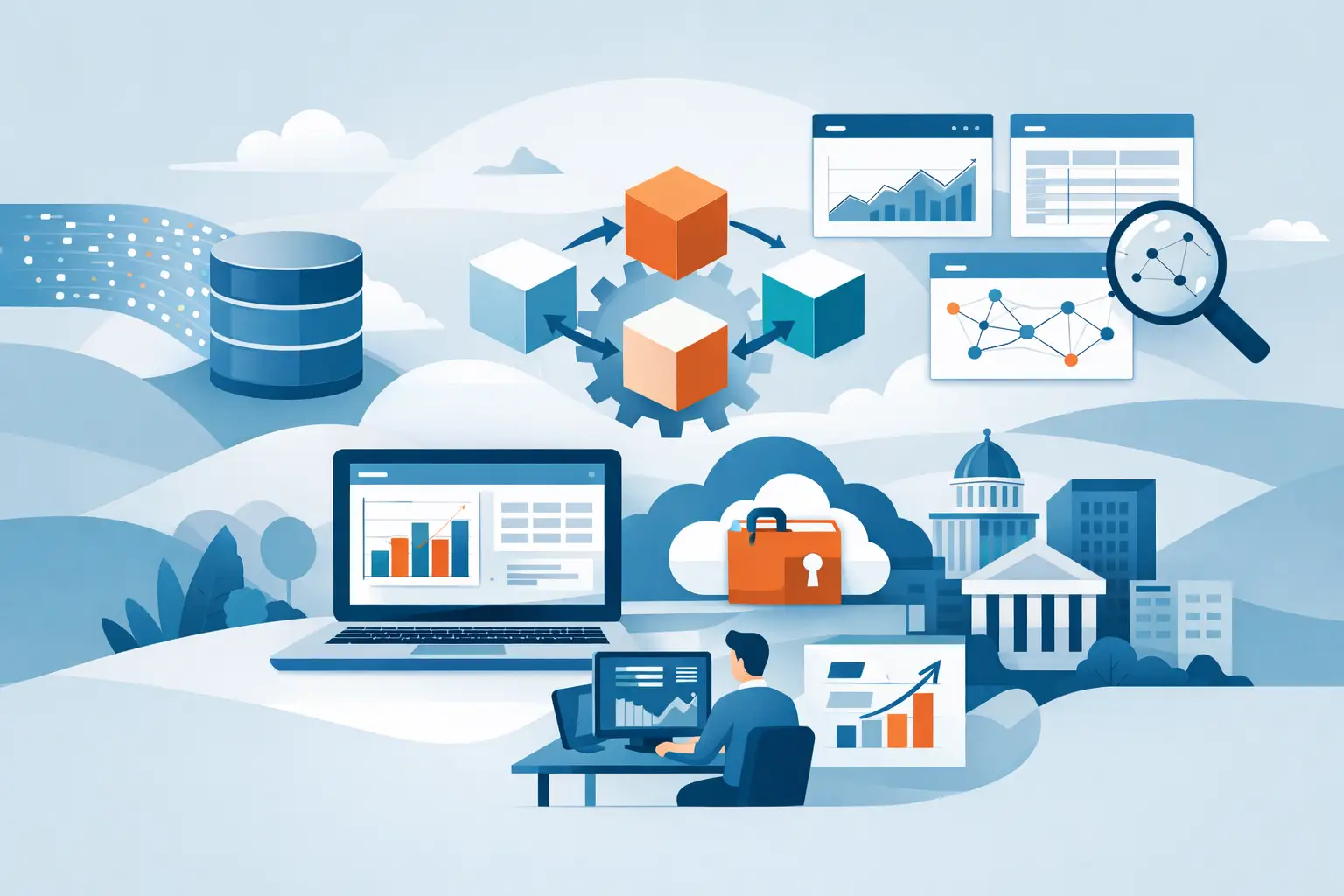
A budget review is due on Friday, the policy team wants faster reporting, and audit is asking how a number in the dashboard was produced. That is usually when the need for a government analytics transformation framework becomes clear. In many agencies, analytics is still constrained by fragmented systems, spreadsheet workarounds, unclear ownership, and governance models that were built for reporting, not enterprise decision-making.
For public sector leaders, the issue is rarely whether data matters. It is whether the organization can trust its data, move it responsibly, and use it fast enough to improve service delivery, risk oversight, planning, and operational performance. A credible framework gives agencies a way to modernize without losing control.
What a government analytics transformation framework is meant to solve
A government analytics transformation framework is not a technology stack diagram. It is an operating model for how data becomes usable intelligence across policy, operations, finance, compliance, and citizen services. The framework should connect strategy, governance, architecture, delivery, and workforce capability.
That distinction matters because many transformation programs stall after early platform investments. A new data lake, a cloud migration, or a dashboard initiative can improve isolated use cases, but it does not automatically create institutional analytics maturity. Agencies often end up with more tools than outcomes.
The stronger approach starts with three realities. Government data is distributed. Accountability is high. Change must be sustainable beyond a single project cycle. A framework that ignores any of those conditions will struggle in production.
The five layers of a government analytics transformation framework
The most effective framework is usually layered. Each layer supports the next, and weakness in one layer tends to create friction everywhere else.
1. Strategic alignment
Analytics programs fail when they are treated as technical modernization efforts with vague business sponsorship. In government, the starting point should be mission outcomes. That may include reducing claims leakage, improving tax compliance, shortening permit processing time, strengthening fraud monitoring, or improving budget planning.
The framework should define which decisions need better data, which operating processes need more visibility, and which outcomes matter at the executive level. This creates a funding and prioritization model that is easier to defend. It also reduces the common problem of analytics teams delivering outputs that are interesting but not operationally used.
2. Data governance and control
Public sector analytics cannot scale on informal data sharing. Agencies need clear rules for data ownership, stewardship, access, quality, retention, and lineage. Governance is often misunderstood as a control gate that slows delivery. In practice, poor governance is what slows delivery because every new request becomes a negotiation.
A workable model defines decision rights early. Who owns the definition of a citizen record, a case file, a financial event, or a service transaction? Who approves access? Who validates quality? Which data can move across agencies, and under what conditions? Those questions are operational, not theoretical.
For regulated and sovereign environments, the framework should also address hosting constraints, auditability, and policy enforcement across cloud, on-premises, or hybrid architectures. The right answer depends on the agency mandate and risk profile. Not every workload belongs in the same environment.
3. Modern data architecture
Legacy government environments typically contain reporting databases, line-of-business systems, document stores, and manual extracts that were never designed to work as a coherent analytics foundation. A transformation framework should define how those assets are integrated into a governed data platform.
In most cases, that means moving toward a modern lakehouse or equivalent architecture that supports batch and near-real-time ingestion, standardized transformation, metadata management, and scalable consumption. But architecture choices should follow use cases and control requirements. A highly centralized model can improve standardization, while a domain-oriented model can improve agility. Many agencies need a balanced design that combines shared platform services with domain accountability.
The goal is not architectural fashion. It is creating reliable pipelines, reusable data products, and traceable metrics that can support both enterprise reporting and advanced analytics.
4. Delivery and analytics engineering
This is where many programs either accelerate or lose momentum. Agencies often invest heavily in platforms but underinvest in the engineering discipline required to make data usable. Raw ingestion is not transformation.
Analytics engineering provides the layer between source systems and trusted consumption. It standardizes business logic, testing, documentation, lineage, and deployment practices so that dashboards, scorecards, and analytical models rely on consistent definitions. Without that layer, one department’s performance metric becomes another department’s exception report.
A mature framework should establish repeatable delivery patterns. Intake processes, data modeling standards, release controls, testing protocols, and service-level expectations all matter. The objective is to reduce one-off development and increase reusable, governed delivery.
5. Adoption, capability, and operating model
Analytics transformation is not complete when the platform goes live. It is complete when agency teams can use, govern, and extend it with confidence. That requires more than training sessions. It requires role clarity, embedded ownership, and practical capability transfer.
Some agencies need a centralized center of excellence to establish standards and accelerate early adoption. Others benefit from federated delivery once the foundation is stable. The right model depends on organizational maturity, budget structure, and the complexity of cross-agency coordination. What matters is that the model supports continuity, not dependency.
Why frameworks fail in real government programs
The most common failure is treating analytics transformation as a reporting upgrade. Reporting matters, but executive dashboards alone do not fix fragmented data pipelines, low data quality, or weak governance. They can actually conceal those issues for a while.
Another failure point is trying to solve everything in a single phase. Government agencies often carry decades of system debt, overlapping mandates, and uneven data literacy. A framework should be ambitious, but the delivery plan should be staged. Early wins build trust. Overreach creates resistance.
There is also a recurring governance mistake. Some programs centralize all decisions in the name of control, which slows every use case. Others decentralize too early, which leads to duplicate logic, inconsistent metrics, and uncontrolled data movement. The better model usually combines enterprise guardrails with delegated execution.
How to apply the framework in practice
A practical rollout starts with an enterprise diagnostic. That means identifying high-value decisions, critical data domains, current-state architecture, governance gaps, and delivery bottlenecks. The outcome should not be a large theoretical blueprint. It should be a transformation roadmap tied to business cases and implementation sequencing.
The next step is establishing the foundation. This includes target architecture, governance structure, core data models, integration patterns, and a prioritized backlog of use cases. At this stage, agencies should also define nonfunctional requirements such as auditability, resilience, observability, security, and sovereign control where relevant.
Then comes execution through use-case-led delivery. This is where many leaders get the sequencing wrong. It is tempting to wait until the entire platform is complete before releasing anything. A better path is to deliver a small number of priority use cases on the target foundation while refining standards in parallel. That creates immediate value and tests whether the operating model actually works.
For example, an agency might begin with financial performance visibility, service operations monitoring, or compliance and risk analytics. These use cases usually expose the real quality, access, and lineage issues quickly. Solving them creates assets that can be reused for later domains.
This is also where an engineering-led partner can make a difference. ORTECH’s approach, for example, is built around combining strategic planning with implementation discipline so agencies do not end up with a roadmap that cannot be operationalized.
What leaders should measure
If success is measured only by platform deployment, the framework is incomplete. Public sector leaders should track whether trusted data is reaching decision-makers faster, whether manual reconciliation is falling, whether compliance and audit effort is improving, and whether teams are reusing governed assets rather than rebuilding logic repeatedly.
Program metrics should include adoption and operating efficiency, not just technical completion. Time to onboard a new data source, percentage of certified data products, defect rates in reporting, and time required to answer audit queries are often better indicators of maturity than the number of dashboards produced.
It is also worth measuring organizational resilience. Can the agency absorb policy changes, reporting changes, or new analytical demands without starting from scratch each time? That is one of the clearest signs that transformation is real.
The framework should fit the institution, not the other way around
There is no universal template for government analytics modernization. A tax authority, a healthcare regulator, and a state-owned enterprise may all need better data foundations, but their control environments, operating models, and priorities differ. The framework should provide structure without forcing artificial uniformity.
That is why mature transformation programs balance standardization with flexibility. Shared definitions, governance controls, and platform services create consistency. Domain ownership, phased delivery, and use-case prioritization create momentum. Both are necessary.
The real test of a government analytics transformation framework is not whether it looks complete on paper. It is whether it helps leaders make better decisions with greater confidence, under real institutional constraints, and whether the capability remains inside the organization after the program ends. That is the point where analytics stops being a project and starts becoming infrastructure for public sector performance.