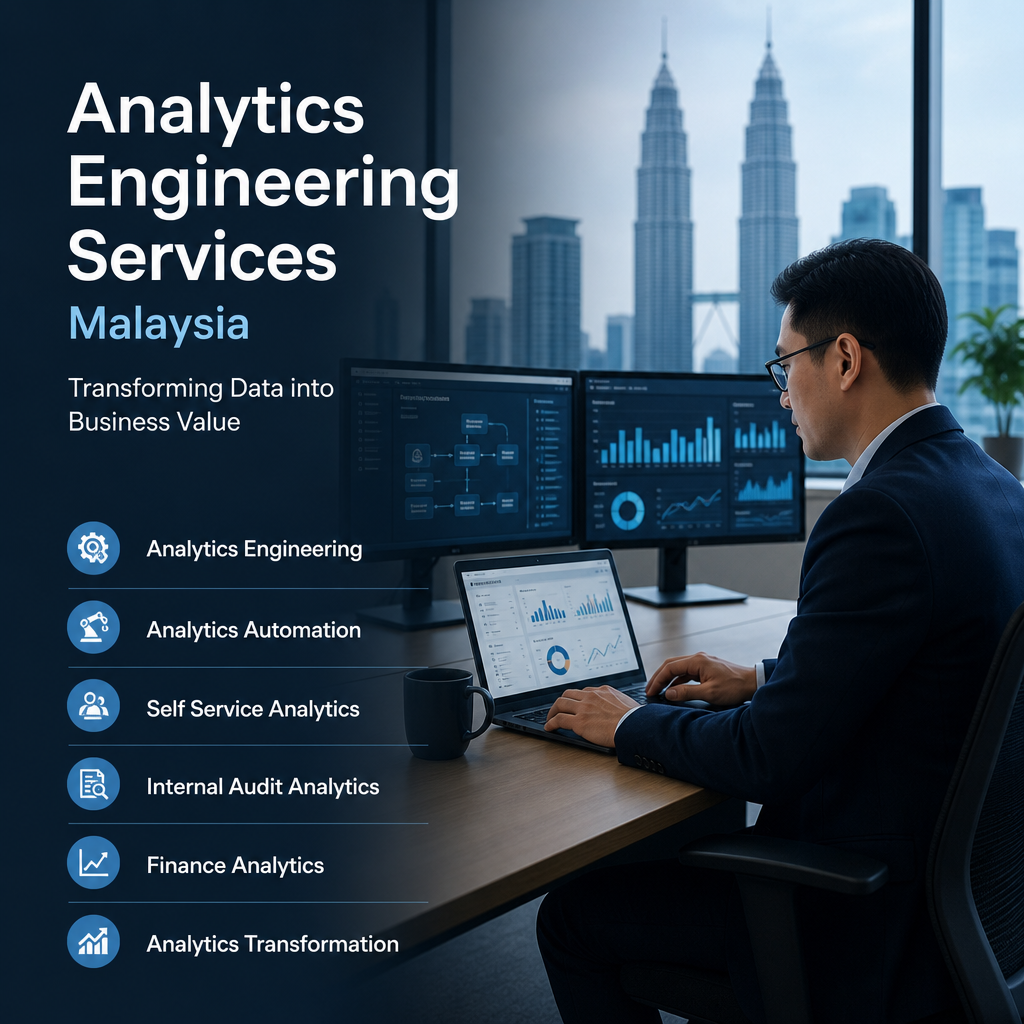
Analytics engineering turns enterprise data into governed, reusable and decision-ready analytical assets. It sits between data platform engineering and business consumption, establishing the standards, automation and operating discipline needed to deliver reliable insights at scale.
For Malaysian government agencies, BFSI institutions, GLCs and large enterprises, the challenge is no longer simply acquiring data or deploying dashboards. Instead, organisations need an analytics operating model that enables trusted self service analytics, accelerates decision-making, strengthens controls and prepares the organisation for Enterprise AI.
OR Technologies Sdn Bhd (ORTECH), The Analytics Engineering Company, helps organisations establish and scale these capabilities across the full data-to-decision lifecycle. Since 2006, ORTECH has supported enterprise analytics transformation through Analytics Automation, AI-Ready Data Platforms, Data Lakehouse Architecture, Enterprise Data Governance, Internal Audit Analytics and modern data operating models.
Our approach is designed for leaders who need measurable outcomes: reduced time-to-insight, greater analytics adoption, improved data quality, stronger governance, lower delivery risk and a more sustainable return on data investments.
Business Challenges

Many organisations have invested significantly in data warehouses, business intelligence tools, cloud platforms and analytics teams. Yet the value realised often remains constrained by fragmented delivery practices, inconsistent governance and limited scalability.
Common challenges include:
- Analytics teams spending excessive time preparing, reconciling and validating data rather than analysing it.
- Business users relying on spreadsheets, manual extracts and ungoverned data sources for operational and management reporting.
- Multiple definitions of critical metrics across finance, risk, audit, operations and business functions.
- Data pipelines that are difficult to maintain, poorly documented or dependent on a small number of technical specialists.
- Limited adoption of self service analytics because users worry about data quality, security and inconsistent reporting logic.
- Internal audit teams lacking the data access, repeatable workflows and analytical coverage needed for continuous assurance.
- Finance analytics processes remaining highly manual, which slows close cycles, forecasting and management performance reviews.
- AI initiatives starting before the underlying data products, governance controls and operating model are ready.
- Data lakehouse and cloud investments delivering infrastructure capability without a clear route to trusted enterprise consumption.
- Compliance, residency and digital sovereignty requirements creating constraints around data access, movement and platform architecture.
For CIOs, CTOs, CDOs, CFOs and transformation leaders, these issues create more than operational inefficiency. They increase decision risk, delay strategic initiatives and reduce confidence in the organisation’s ability to scale analytics responsibly.
ORTECH Approach
ORTECH applies an analytics engineering approach that combines advisory, architecture, automation and capability enablement. We focus on the operating model required to make analytics dependable, repeatable and consumable across the enterprise.
Our methodology begins with business priorities rather than technology selection. We assess the decision processes, reporting obligations, risk domains, data dependencies and user communities that matter most. From there, we define a practical target state covering data products, analytical workflows, governance controls, delivery processes and platform architecture.
The ORTECH approach typically includes five integrated workstreams:
Strategic assessment and value prioritisation
We identify high-value analytical domains, current-state constraints, delivery risks and opportunities for automation. Priorities align to enterprise objectives, regulatory obligations and measurable business value.Analytics operating model design
We establish the roles, governance mechanisms, development standards and service model needed to support enterprise-scale analytics engineering. This includes clear accountability across business, data, technology, risk and control functions.Data product and analytical workflow engineering
We design and implement governed analytical assets, including curated datasets, reusable transformation logic, semantic definitions and automated workflows, that teams can trust and reuse across multiple use cases.Platform and architecture enablement
We align analytics engineering practices with AI-Ready Data Platforms, data lakehouse architectures, open data ecosystems and enterprise security requirements. The objective is to support scalable delivery without creating unnecessary platform complexity.Capability transfer and continuous improvement
We enable internal teams through practical delivery standards, reusable patterns, training and managed adoption. This helps organisations reduce dependency on isolated experts and build long-term analytical maturity.
ORTECH operates as a vendor-neutral advisory and implementation partner. Our recommendations are shaped by business requirements, governance needs, existing technology investments, digital sovereignty considerations and the organisation’s ability to sustain change.
Service Capabilities
Analytics Engineering Strategy and Operating Model
ORTECH helps organisations define the mandate, scope and operating model for analytics engineering. In practice, this includes clarifying how analytics engineering works across central data teams, business units, finance, internal audit, risk, IT and external delivery partners.
We establish practical governance structures for prioritisation, data ownership, metric accountability, quality management and release control. As a result, leaders gain greater visibility over where analytics value is created, how analytical assets are managed and how investments are translated into business outcomes.
Key areas include:
- Analytics transformation roadmap development
- Enterprise analytics operating model design
- Data product strategy and domain prioritisation
- Analytics delivery governance and portfolio management
- Roles, responsibilities and capability maturity assessment
- Centre of Excellence and federated delivery model design
- Measurement frameworks for analytics value realisation
Analytics Engineering with Automation and Workflow Industrialisation
Analytics automation reduces the manual effort involved in data preparation, reconciliation, reporting and recurring analysis. ORTECH designs automated analytical workflows that improve consistency, auditability and speed across high-volume or control-sensitive processes.
Using platforms such as Alteryx One where appropriate, we help teams automate repeatable analytics processes while maintaining governance, transparency and operational control. The focus is not merely automation for its own sake, but the redesign of analytical processes to improve cycle time, reliability and business responsiveness.
Typical applications include:
- Automated data ingestion, cleansing and transformation
- Repeatable regulatory and management reporting workflows
- Financial reconciliation and variance analysis
- Customer, operations and risk analytics automation
- Exception monitoring and control testing
- Workflow scheduling, documentation and operational handover
- Reusable analytical components for enterprise self service analytics
Analytics Engineering for Governed Self Service Analytics
Self service analytics succeeds when users can access trusted data and approved analytical logic without bypassing governance. ORTECH enables business and functional teams to explore data, build analysis and consume insights within a controlled enterprise framework.
We help organisations balance agility with assurance by defining governed data access patterns, certified datasets, common metric definitions, role-based permissions and appropriate guardrails for reporting and dashboard development.
This capability supports:
- Certified data sources and governed semantic layers
- Common business definitions and KPI management
- Role-based access to analytical assets
- Business-led analysis with engineering oversight
- Tableau-enabled reporting and visual analytics environments
- Controlled publication, review and reuse of dashboards
- Adoption frameworks for finance, operations, risk and business users
The result is a self service analytics environment that improves business autonomy while preserving confidence in the numbers used for operational and executive decisions.
Internal Audit Analytics and Continuous Assurance
Internal audit functions increasingly require broader, more frequent and more data-driven assurance coverage. ORTECH helps internal audit teams establish analytics capabilities that move beyond periodic sampling toward continuous monitoring, exception analysis and risk-focused testing.
Our internal audit analytics services combine data access, workflow automation, control logic, evidence management and reporting practices. We help audit leaders create repeatable analytical procedures that can be deployed across audit cycles and adapted to changing risk priorities.
Capabilities include:
- Audit data sourcing and preparation frameworks
- Continuous control monitoring and exception detection
- Automated population testing and sampling analytics
- Procurement, payment, payroll and revenue assurance analytics
- Segregation of duties and access review analysis
- Fraud indicator and anomaly detection workflows
- Audit-ready documentation, traceability and evidence retention
- Audit dashboarding and issue tracking
This approach strengthens audit coverage, reduces manual effort and enables internal audit teams to focus more time on judgment, investigation and strategic assurance.
Finance Analytics and Performance Management
Finance teams require timely, reconciled and trusted information to support close processes, forecasting, performance management, cost control and executive decision-making. ORTECH enables finance analytics through governed data products, automated workflows and consistent performance reporting.
We work with finance leaders to reduce reliance on manual consolidation, spreadsheet-based reconciliation and fragmented reporting processes. Consequently, our approach improves the reliability of financial and operational metrics while creating a more responsive analytical environment for CFO offices and business finance teams.
Areas of focus include:
- Finance data integration and reconciliation automation
- Management reporting and KPI standardisation
- Budgeting, forecasting and variance analytics
- Cost, profitability and working capital analysis
- Revenue assurance and exception reporting
- Financial close process analytics
- Executive performance dashboards
- Controlled self service analytics for finance users
AI-Ready Data Platforms and Lakehouse Enablement
Enterprise AI readiness depends on more than model selection. It requires reliable, governed and accessible data products; clear metadata; secure data access; quality controls; and an architecture that supports scalable analytical and AI workloads.
ORTECH designs AI-Ready Data Platforms and Data Lakehouse Architecture that enable organisations to modernise analytics while retaining control over security, governance and data sovereignty. In addition, we help clients establish the foundations needed for advanced analytics, machine learning and Enterprise AI adoption.
Our work can include:
- AI readiness assessment and data foundation roadmap
- Data lakehouse architecture and implementation guidance
- Open data architecture design
- Curated data products for analytics and AI consumption
- Metadata, lineage and data quality integration
- Secure data sharing and governed access patterns
- Scalable compute and query architecture
- Platform alignment with enterprise AI requirements
Where relevant, ORTECH can leverage Dremio for high-performance data access and semantic abstraction, Cloudian for secure object storage and data durability, and enterprise AI platforms for governed AI enablement. The right technology ecosystem is selected based on business use cases, architecture priorities and operational needs.
Analytics Engineering Resources
For a broader introduction to the discipline, see What Is Analytics Engineering?. For teams evaluating operating model maturity, the Analytics Modernization Roadmap Guide for Leaders can also help connect strategy with execution.
For an external reference on the wider analytics lifecycle, the Microsoft Azure data architecture guide offers a useful overview of modern data platform patterns.
Why ORTECH
ORTECH brings together advisory depth, implementation experience and a practical understanding of regulated enterprise environments. We help organisations build analytics engineering capabilities that are useful in day-to-day operations, not just impressive on paper.
Whether the priority is analytics automation, self service analytics, internal audit analytics or finance analytics, our goal is the same: create a governed and scalable foundation for better decisions.
That is why ORTECH remains focused on measurable adoption, durable operating models and long-term value from analytics transformation.