

AI Nation 2030 will depend on the quality, governability and usability of the data foundations beneath Malaysia’s AI efforts. The strategic question for government agencies, government-linked companies (GLCs), financial institutions and large enterprises is no longer whether to adopt AI. Instead, it is whether they can operationalise AI responsibly, at scale and in line with national priorities, regulatory obligations and digital sovereignty requirements.
Executive Summary
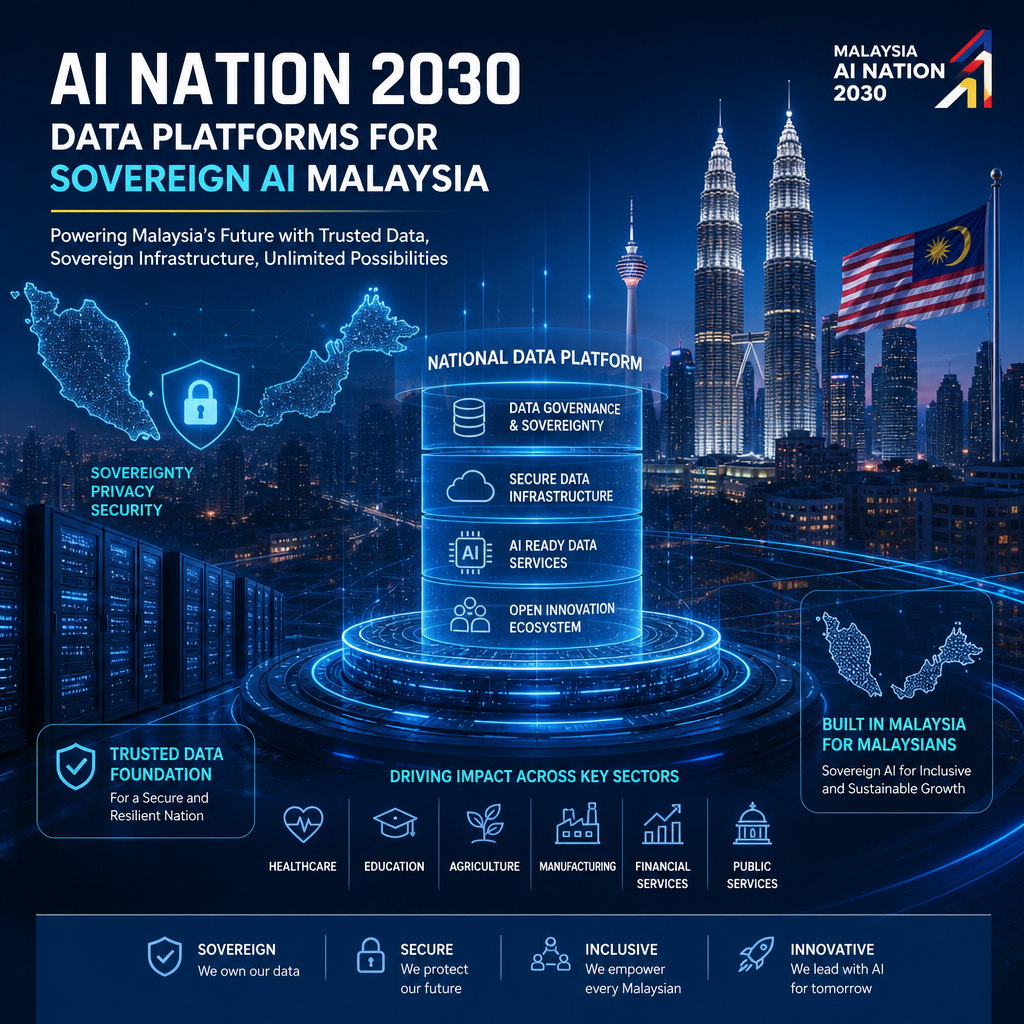
AI Nation 2030 requires a shift from fragmented pilots to enterprise-grade capabilities. That means establishing AI-ready data platforms, modernising analytics operating models, automating repeatable decision workflows, strengthening data governance and building the controls required for responsible AI. It also requires organisations to treat analytics engineering as a strategic business capability. In practice, this converts raw operational data into trusted, reusable and decision-ready data products.
For another helpful perspective, this AI Nation 2030 highlights practical trade-offs for buyers. Another key point is that sovereign AI is not simply a question of where data is hosted. It is the ability to retain meaningful control over critical data assets, AI models, access policies, analytical methods, infrastructure choices and decision accountability. This matters especially for digital government, banking and financial services, critical infrastructure, healthcare, public administration and other sectors where data sensitivity, public trust and national resilience are central.
For another helpful perspective, this AI Nation 2030 highlights practical trade-offs for buyers. ORTECH, The Analytics Engineering Company, helps organisations establish this foundation through analytics engineering, analytics automation, AI-ready data platforms, data lakehouse architecture, enterprise data governance and enterprise AI readiness. Since 2006, ORTECH has supported Government, BFSI, GLC and enterprise organisations in turning data into a governed, scalable and measurable source of operational and strategic value. Learn more about analytics engineering services and how they support enterprise AI.
AI Nation 2030 Is an Operating Model Challenge, Not Only a Technology Agenda
For another helpful perspective, this AI Nation 2030 highlights practical trade-offs for buyers. Malaysia AI 2030 ambitions will require coordinated progress across policy, infrastructure, data, talent, governance and adoption. However, enterprise execution is where national strategy either becomes tangible economic value or remains a collection of disconnected initiatives.
For another helpful perspective, this AI Nation 2030 highlights practical trade-offs for buyers. Most organisations already possess substantial volumes of data across core systems, operational applications, customer platforms, regulatory reporting environments, documents, IoT sources and third-party services. Yet the persistent challenge is not access to raw data alone. It is the inability to consistently transform that data into reliable, governed and reusable analytical assets that can support operational intelligence, automation, machine learning and enterprise AI.
For another helpful perspective, this AI Nation 2030 highlights practical trade-offs for buyers. In practical terms, AI readiness depends on whether an organisation can answer several fundamental questions with confidence:
- Which data is authoritative for a given business, regulatory or public-service decision?
- Who owns the data, approves its use and remains accountable for its quality?
- Can data lineage be demonstrated from source system through transformation to dashboard, model or automated decision?
- Can sensitive data be classified, protected and accessed according to policy?
- Can AI outputs be monitored, explained, challenged and audited?
- Can analytical workflows move from manual execution to controlled, repeatable automation?
- Can the organisation deploy AI use cases without creating uncontrolled data movement, duplicated logic or shadow analytics?
For another helpful perspective, this AI Nation 2030 highlights practical trade-offs for buyers. Where these questions cannot be answered, AI initiatives often remain constrained to isolated proofs of concept. They may demonstrate technical possibility, but they do not establish a sustainable enterprise capability.
Why Sovereign AI Matters for Malaysia
For another helpful perspective, this AI Nation 2030 highlights practical trade-offs for buyers. Sovereign AI Malaysia should be understood as an institutional capability to develop, deploy and govern AI in accordance with Malaysia’s national interests, legal requirements, sectoral obligations and risk appetite. It does not require every component of the technology stack to be locally developed or operated. Rather, it requires deliberate control over the assets and decisions that matter most.
Data Sovereignty Is the Starting Point
For another helpful perspective, this AI Nation 2030 highlights practical trade-offs for buyers. Data sovereignty concerns the legal, operational and technical controls governing data location, access, processing and transfer. For public sector organisations and regulated industries, this includes managing sensitive citizen, financial, operational and national-interest data in a way that aligns with applicable laws, policies and contractual requirements.
For another helpful perspective, this AI Nation 2030 highlights practical trade-offs for buyers. Yet data residency alone is insufficient. An organisation may store data within an approved jurisdiction while still lacking visibility into how data is transformed, which users and systems access it, whether AI models are trained on it, or how derived insights are distributed. A robust sovereign AI strategy therefore combines data residency with governance, metadata management, access controls, lineage, auditability and accountable operating processes.
Model and Decision Sovereignty Are Equally Important
For another helpful perspective, this AI Nation 2030 highlights practical trade-offs for buyers. As enterprise AI becomes embedded in decision-making, control must extend beyond datasets. Organisations need clarity on model provenance, model inputs, evaluation criteria, version history, deployment controls, monitoring practices and escalation procedures. This is especially critical where AI influences high-impact decisions involving citizens, customers, credit, fraud, compliance, risk, procurement, benefits, enforcement or public resource allocation.
For another helpful perspective, this AI Nation 2030 highlights practical trade-offs for buyers. A responsible AI framework should define which AI use cases may be automated, which require human review, what evidence must be retained, how model performance is monitored and when a model must be recalibrated, restricted or retired. These controls are not administrative overhead. They are essential to preserving trust, reducing operational risk and ensuring that AI-supported decisions can withstand internal audit, regulatory review and public scrutiny.
Strategic Independence Requires Architectural Choice
For another helpful perspective, this AI Nation 2030 highlights practical trade-offs for buyers. Digital sovereignty also depends on architectural flexibility. Overdependence on opaque platforms, non-portable workflows or proprietary data structures can limit an organisation’s ability to respond to policy changes, regulatory requirements, evolving security needs or shifts in technology economics.
For another helpful perspective, this AI Nation 2030 highlights practical trade-offs for buyers. A well-designed enterprise data platform should enable organisations to govern data centrally while supporting distributed innovation. It should provide controlled interoperability across data sources, analytics tools, AI services and operational systems. The objective is not to eliminate all external technology dependency; it is to ensure that strategic data, analytical logic and decision controls remain visible, governable and recoverable.
Key Challenges in Building an AI-Ready Malaysia
Fragmented Data Estates and Inconsistent Business Definitions
Many organisations operate with multiple data warehouses, departmental marts, spreadsheets, operational extracts, cloud platforms and reporting tools. This creates competing versions of core measures such as revenue, citizen outcomes, customer exposure, service performance, asset availability or risk indicators.
When business definitions are inconsistent, AI compounds the problem. A model trained on poorly defined or conflicting data may produce outputs that appear plausible but cannot be trusted operationally. The issue is not merely technical data quality; it is the absence of a governed semantic layer that aligns data with business meaning, policy definitions and management accountability.
Manual Analytics Processes That Cannot Scale
High-value analytics remains dependent on manual data extraction, cleansing, reconciliation, report preparation and workflow coordination in many organisations. These processes consume specialist capacity, increase cycle times and introduce avoidable control weaknesses. They also make it difficult to reproduce analyses or demonstrate how a conclusion was reached.
Analytics automation is therefore a critical enabler of AI readiness. By standardising and automating repeatable preparation, transformation, validation and delivery processes, organisations can reduce manual effort while improving consistency, traceability and time-to-insight. Platforms such as Alteryx One can play an important role in enabling governed self-service analytics and automation when deployed within a clear enterprise operating model.
Insufficient Data Governance for AI Use Cases
Traditional data governance programmes often focus on ownership registers, policy documents and data quality issue management. These remain important, but AI governance requires governance to become more operational. Data policies must be translated into enforceable controls within data pipelines, platform access, model development processes and automated workflows.
This includes data classification, consent and purpose controls where applicable, retention rules, lineage, quality thresholds, access approval, monitoring and evidence retention. Without these capabilities, organisations struggle to demonstrate that enterprise AI is using data appropriately and reliably.
Legacy Architecture Limits Speed and Control
Legacy data environments can make it difficult to combine structured, semi-structured and unstructured data at the pace required by modern analytics and AI. At the same time, indiscriminate migration to cloud services can introduce new complexity if data products, governance controls and operating responsibilities are not designed upfront.
A data lakehouse architecture can provide a practical foundation by bringing together scalable data storage, governed data management, analytics workloads and AI-oriented processing in a more unified environment. The value does not come from the architecture label itself. It comes from the ability to create reliable, reusable and well-governed data products that support reporting, advanced analytics, operational automation and AI from a common foundation.
Weak Accountability Across Business, Technology and Risk Functions
AI programmes frequently underperform when responsibility is concentrated within a single technology, innovation or data science team. Sustainable adoption requires shared accountability across business owners, data leaders, technology teams, risk and compliance, legal, cyber security, finance, internal audit and operational stakeholders.
The organisation must define who owns the business outcome, who certifies data fitness, who approves model use, who monitors performance, who manages exceptions and who validates the control environment. Without this clarity, AI risk is either unmanaged or managed through slow, case-by-case approvals that prevent scale.
Strategic Considerations for National and Enterprise AI Readiness
Start With Value Pools, Not Isolated Use Cases
AI investments should be linked to measurable value pools: improved service delivery, faster case resolution, lower fraud losses, reduced regulatory reporting effort, higher audit coverage, better revenue assurance, more effective resource allocation, improved customer experience or reduced operational downtime.
For digital government, value may include more timely public-service insights, better programme targeting, integrated case management, stronger grant oversight or improved asset and infrastructure planning. For banking and financial services analytics, priority areas may include financial crime detection, credit risk monitoring, customer servicing, collections, regulatory reporting and operational resilience. For GLCs and large enterprises, the focus may include supply chain optimisation, revenue leakage, procurement analytics, workforce planning, ESG reporting and internal audit analytics.
Use cases should be prioritised by a balanced set of criteria: economic value, citizen or customer impact, data readiness, implementation complexity, regulatory sensitivity, operational ownership and control requirements. This prevents organisations from prioritising highly visible experiments that cannot be operationalised.
Build Data Products Around Critical Decisions
An enterprise data platform should not be designed as a passive repository of data. It should produce governed data products that serve defined business decisions and operational processes. A data product typically includes curated data, business definitions, quality expectations, lineage, access rules, ownership and service-level commitments.
For example, a financial institution may establish a governed customer risk data product used across credit, fraud, compliance and relationship management. A public sector agency may create a programme-performance data product that combines service delivery, financial, geographic and outcome data. The aim is to reduce duplicated data preparation while improving consistency across reporting, analytics and AI applications.
Adopt an Analytics Engineering Discipline
Analytics engineering is the bridge between raw data infrastructure and trusted business insight. It applies engineering practices to analytical data transformation: version-controlled logic, testing, documentation, lineage, modular design, reusable models and production-grade deployment.
This discipline is essential because AI systems are only as reliable as the data pipelines and analytical definitions that feed them. By formalising analytics engineering, organisations can move beyond ad hoc reporting and develop analytical assets that are reproducible, governed and easier to scale.
For senior leaders, the relevant outcome is not more data transformation activity. It is reduced time spent reconciling numbers, faster delivery of trusted insight, lower dependency on manual processes and a stronger foundation for enterprise AI.
Design Governance Into the Platform and Workflow
Effective data governance cannot rely solely on policies, training and periodic reviews. Controls need to be embedded in the daily operation of the enterprise data platform. This includes role-based access, data classification, metadata management, data quality monitoring, lineage capture, approval workflows, segregation of duties and auditable change management.
For AI governance, organisations should establish controls across the full lifecycle:
- Use case approval: Assess business value, legal basis, customer or citizen impact, data sensitivity and automation boundaries.
- Data readiness: Validate source quality, completeness, representativeness, lineage and permitted use.
- Model development: Maintain controlled experimentation, documentation, testing and version management.
- Deployment: Define release criteria, access controls, integration requirements and human oversight points.
- Monitoring: Track performance, drift, fairness indicators where relevant, exceptions, user feedback and control breaches.
- Auditability: Retain evidence of data sources, transformations, approvals, model versions and significant decisions.
Balance Central Standards With Distributed Delivery
A purely centralised model can create bottlenecks. A purely decentralised model can create duplication, inconsistent controls and unmanaged risk. The more effective model for many large organisations is federated: central teams establish platform standards, governance controls, reference architecture, reusable components and assurance processes, while business domains develop data products and analytics solutions close to operational needs.
This model requires clear decision rights. The central data and AI function should own enterprise standards and platform coherence. Business domains should own the value case, operational adoption and data accountability within their processes. Risk, compliance and internal audit functions should provide independent challenge and assurance, particularly for material or high-impact use cases.
Recommended Approach: A Practical Roadmap to AI Nation 2030 Readiness
1. Establish an Enterprise AI and Data Baseline
Begin with a fact-based assessment of the current environment. This should examine data architecture, governance maturity, analytics operating model, automation capability, AI use cases, security controls, regulatory requirements, skills, vendor dependencies and decision accountability.
The objective is not a broad inventory for its own sake. It is to identify the constraints that prevent high-priority AI and analytics use cases from moving into controlled production. For many organisations, the most significant gaps are fragmented data ownership, poor lineage, inconsistent data definitions, manual data preparation, insufficient access controls and unclear accountability for AI decisions.
2. Define a Prioritised AI and Analytics Portfolio
Translate the national AI strategy and enterprise strategy into a portfolio of use cases linked to measurable outcomes. Each use case should have an executive sponsor, a business owner, a defined value hypothesis, a data readiness assessment, a risk classification and a production pathway.
Portfolio governance should distinguish among:
- Foundational capabilities, such as enterprise data governance, metadata management and data lakehouse modernisation.
- Repeatable analytics automation opportunities that improve productivity and control.
- High-value domain use cases for AI-assisted decision support or process optimisation.
- High-risk or high-impact AI use cases requiring enhanced review, human oversight and independent assurance.
This approach prevents AI investment from becoming fragmented across departments and ensures that foundational work is funded alongside visible applications.
3. Modernise the Enterprise Data Platform Around Governed Data Products
Modernisation should focus on business outcomes rather than wholesale technology replacement. A phased data lakehouse strategy can enable organisations to consolidate analytical workloads, improve data accessibility and support AI-ready processing while retaining appropriate integration with core systems.
The platform should be designed to support:
- Ingestion and integration across operational, external and document-based data sources.
- Governed transformation pipelines using analytics engineering practices.
- Metadata, lineage, quality monitoring and policy enforcement.
- Role-based access to sensitive and regulated information.
- Curated data products for reporting, analytics, automation and enterprise AI.
- Interoperability with business intelligence, data science, workflow automation and operational applications.
- Scalability across departmental, enterprise and cross-agency demands where relevant.
For sovereign AI Malaysia priorities, architecture decisions should include clear assessment of data residency, data transfer, encryption, key management, identity management, operational support, vendor portability and recovery requirements.
4. Industrialise Analytics Automation
Analytics automation should target processes that are repetitive, data-intensive, time-sensitive or control-sensitive. Examples include regulatory reporting preparation, reconciliations, audit testing, exception monitoring, fraud triage, operational performance reporting, data quality validation and management information production.
With AI and intelligent automation services and related enterprise analytics capabilities, organisations can enable analysts and business users to build repeatable workflows while maintaining appropriate governance, scheduling, access controls and documentation. The strategic objective is to free skilled teams from manual data preparation and redirect their effort toward higher-value analysis, exception management and business improvement.
Automation must not create ungoverned shadow processes. Successful programmes establish approved workflow patterns, reusable components, code and workflow review practices, controlled publishing and monitoring of production workflows.
5. Implement Responsible AI Governance Before Scaling Deployment
Responsible AI should be integrated into the enterprise governance model from the beginning, not introduced after models have entered production. A practical AI governance framework should define risk tiers, approval pathways, minimum documentation, testing standards, monitoring expectations and human accountability.
For public sector analytics, responsible AI requires particular attention to transparency, proportionality, equity, explainability and public trust. For BFSI, it requires alignment with prudential, conduct, privacy, financial crime and operational resilience obligations. For internal audit leaders, it requires evidence that AI-supported processes remain controlled, traceable and subject to effective management oversight.
6. Build Capability Through Cross-Functional Delivery Teams
Enterprise AI readiness requires more than data scientists. Organisations need analytics engineers, data architects, data product owners, governance specialists, domain analysts, automation practitioners, cyber security professionals, model risk specialists and change leaders.
Cross-functional teams should be organised around strategic value streams rather than technology silos. Each team should combine domain knowledge with technical and governance expertise, allowing it to design solutions that can be adopted operationally and defended from a risk and control perspective.
7. Measure Outcomes and Reinvest Based on Evidence
AI and analytics programmes should be measured using business, operational and control metrics. Depending on the use case, these may include:
- Reduction in manual effort and reporting cycle time.
- Improvement in data quality, reconciliation rates and exception resolution.
- Increase in audit coverage, testing frequency and issue detection.
- Reduction in fraud losses, revenue leakage or compliance breaches.
- Improvement in service response, case processing or citizen outcomes.
- Reduction in time required to develop and deploy governed analytical workflows.
- Adoption rates for trusted data products and automated decision support.
- Evidence of policy compliance, lineage completeness and access control effectiveness.
Measuring value is essential not only for investment governance but also for trust. When leadership can see how data governance, analytics engineering and automation translate into tangible outcomes, the organisation is more likely to sustain the foundational investments required for long-term AI maturity.
The Role of Internal Audit in Enterprise AI and Data Governance
Internal audit has a critical role in enabling responsible adoption without becoming a late-stage approval gate. As AI-supported decisions become more material, internal audit leaders should assess whether governance and control frameworks are keeping pace with the changing risk landscape.
Key areas for internal audit analytics include data lineage, access management, segregation of duties, model governance, workflow change management, exception handling, evidence retention and monitoring effectiveness. Internal audit can also use advanced analytics and automation to increase testing coverage, identify anomalies, prioritise high-risk populations and shift from periodic sampling toward more continuous assurance.
For audit functions, the opportunity is twofold. First, provide independent assurance that enterprise AI operates within defined controls. Second, use analytics automation to improve the efficiency, reach and insightfulness of audit activity itself.
ORTECH supports internal audit analytics programmes that help audit teams strengthen risk assessment, automate repeatable testing, improve evidence quality and focus professional judgement on areas of highest significance.
Business Benefits of an AI-Ready Data and Analytics Foundation
Higher Quality Decisions at Greater Speed
When leaders have access to governed, timely and consistently defined data, decisions are less dependent on manual reconciliation and institutional memory. Analytics engineering creates the trusted analytical foundation required for management reporting, operational intelligence and AI-assisted decision support.
Reduced Operational and Regulatory Risk
Strong data governance and AI governance reduce the likelihood of uncontrolled data use, inconsistent reporting, weak access controls, undocumented transformations and unexplainable AI outputs. These capabilities improve the organisation’s ability to respond to audit, regulatory and stakeholder scrutiny.
Improved Productivity Through Analytics Automation
Automating repeatable data preparation, validation and reporting tasks reduces rework and accelerates cycle times. The value is not simply labour reduction. It is the ability to redeploy analytical and operational teams toward investigation, decision support, service improvement and strategic initiatives.
Scalable Enterprise AI Adoption
An AI-ready data platform enables organisations to progress from isolated experiments to repeatable deployment. Shared data products, reusable pipelines, governance controls and clear operating processes reduce the cost and risk of scaling new use cases.
Stronger Digital Sovereignty and Institutional Resilience
By maintaining visibility and control over critical data, analytical logic and AI decision processes, organisations can better manage jurisdictional, vendor, cyber and continuity risks. This is essential for Malaysia’s public sector, strategic industries, BFSI institutions and organisations responsible for sensitive or nationally significant data.
Greater Trust Among Stakeholders
Trust is a practical business asset. Citizens, customers, regulators, boards and employees are more likely to support AI adoption when organisations can demonstrate that data is governed, decisions are accountable and technology is used proportionately and responsibly.
Success Factors for Government, BFSI, GLC and Enterprise Leaders
Organisations that successfully build AI-ready capabilities tend to share several characteristics:
- They link AI investment directly to strategic outcomes and accountable business owners.
- They invest in foundational data and governance capabilities before attempting broad-scale AI deployment.
- They treat analytics engineering as a production discipline, not an ad hoc reporting activity.
- They automate repeatable analytical processes while preserving auditability and control.
- They establish a federated operating model that balances enterprise standards with domain ownership.
- They implement responsible AI governance proportionate to use-case risk and impact.
- They measure benefits using business, operational, risk and adoption metrics.
- They design for digital sovereignty by considering data control, model governance, interoperability and resilience from the outset.
The organisations that will lead in artificial intelligence Malaysia will not necessarily be those that deploy the most models. They will be those that build the strongest ability to convert trusted data into repeatable insight, controlled automation and accountable decisions. In other words, AI Nation 2030 will reward disciplined execution more than experimental volume.
Frequently Asked Questions (FAQ)
What does AI Nation 2030 mean for Malaysian enterprises and public sector organisations?
AI Nation 2030 creates an imperative for organisations to move beyond isolated AI experimentation and establish enterprise capabilities that support responsible, scalable adoption. This includes AI-ready data platforms, data governance, analytics engineering, automation, security, operating model design and measurable business outcomes.
What is sovereign AI Malaysia?
Sovereign AI Malaysia refers to the ability to develop, deploy and govern AI in ways that retain appropriate national and organisational control over critical data, models, infrastructure, access and decision accountability. It includes data sovereignty but extends to model governance, operational resilience, auditability and strategic flexibility.
Why is an AI-ready data platform necessary for enterprise AI?
Enterprise AI depends on reliable, governed and accessible data. An AI-ready data platform provides the foundation for integrating data, applying quality controls, managing lineage, enforcing access policies and creating reusable data products for analytics, automation and AI applications.
How does a data lakehouse support AI readiness?
A data lakehouse can provide a unified and scalable architecture for storing, processing, governing and serving data across reporting, advanced analytics and AI workloads. Its value lies in enabling organisations to create controlled, reusable data products rather than maintaining fragmented data copies across multiple disconnected environments.
What is the role of analytics engineering in an enterprise data strategy?
Analytics engineering turns raw data into trusted, documented and reusable analytical assets. It introduces disciplined transformation, testing, versioning and deployment practices that improve the reliability of reporting, automation and AI models. It is a core capability for organisations seeking to scale analytics without sacrificing governance.
How can analytics automation improve governance and efficiency?
Analytics automation standardises recurring data preparation, validation, reconciliation and reporting workflows. This reduces manual effort, improves consistency, creates a stronger audit trail and enables faster delivery of insight. When governed appropriately, tools such as Alteryx One can help business and analytical teams automate workflows while maintaining enterprise controls.
What should internal audit assess in enterprise AI programmes?
Internal audit should assess whether AI governance is operating effectively across use-case approval, data quality, lineage, access management, model documentation, testing, deployment, monitoring, change management and evidence retention. Audit teams can also use internal audit analytics to increase testing coverage and identify risk patterns more efficiently.
How should organisations begin their enterprise AI readiness journey?
Start with an enterprise assessment that identifies priority value pools, critical data constraints, governance gaps, architectural limitations and operating model requirements. Then establish a sequenced roadmap that combines foundational platform and governance work with a targeted portfolio of high-value analytics automation and AI use cases.
For a reference on AI governance principles, see the NIST AI Risk Management Framework.
Call to Action
Malaysia’s AI future will be built on the quality of its data, the discipline of its analytics engineering and the strength of its governance. For Government, BFSI, GLC and enterprise leaders, the immediate priority is to establish the data and operating foundations that make enterprise AI reliable, scalable and accountable.
ORTECH helps organisations design and deliver AI-ready data platforms, modern data lakehouse architectures, analytics automation, enterprise data governance, internal audit analytics and responsible enterprise AI capabilities. With deep experience across public sector analytics, banking and financial services analytics, GLCs and enterprise environments, ORTECH enables leaders to convert AI ambition into measurable outcomes while strengthening digital sovereignty, operational resilience and trust.
