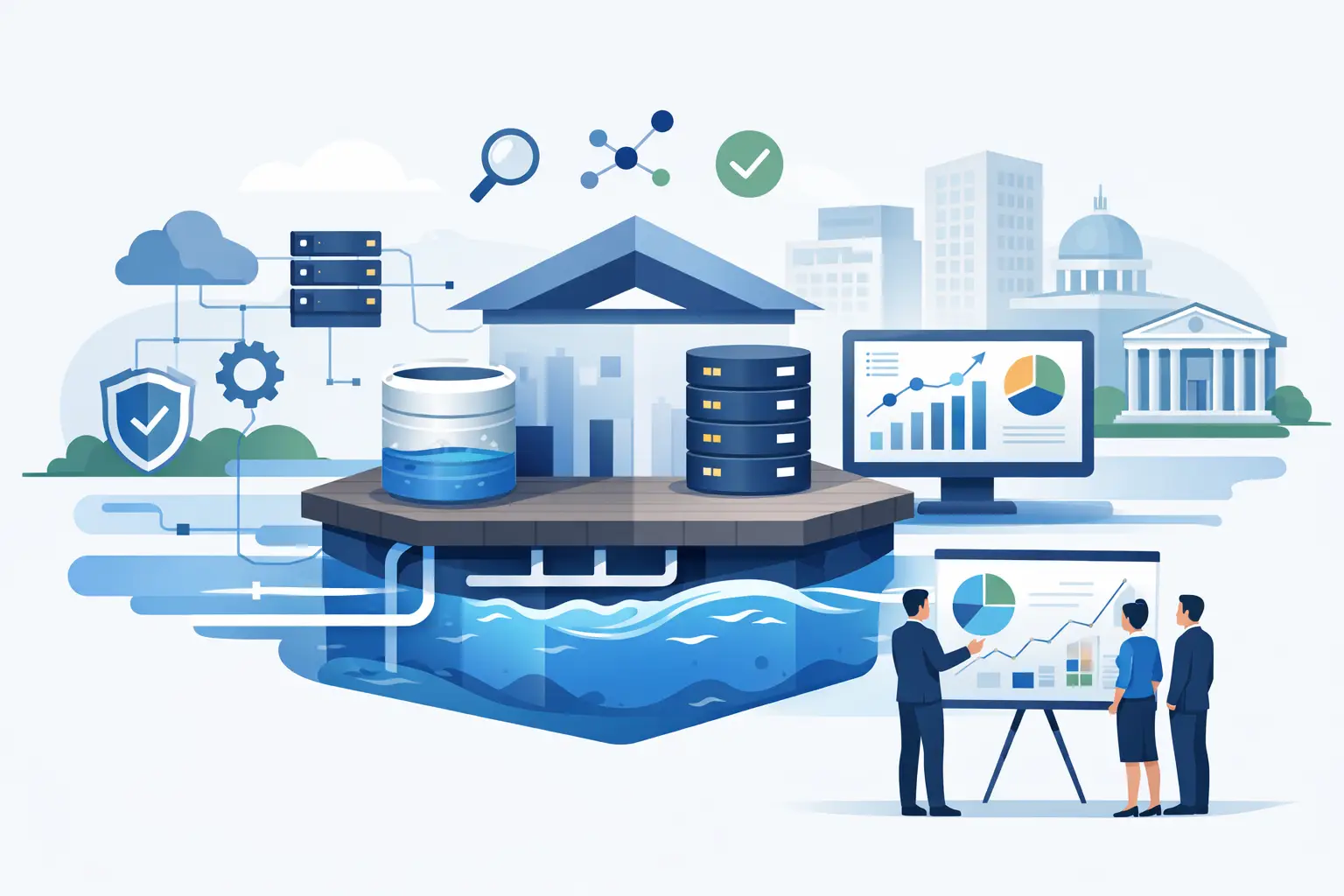
When a bank has five versions of the same customer, or a government agency needs weeks to reconcile operational data before reporting, the issue is rarely analytics alone. It is architecture. Data lakehouse architecture has become a serious consideration for enterprises that need both scale and control without multiplying platforms, pipelines, and governance overhead.
For CIOs, CDOs, and enterprise architects, the appeal is straightforward. Traditional data warehouses still serve governed reporting well, while data lakes remain useful for low-cost storage and large-scale ingestion. The problem appears when organizations try to support both BI and AI, structured and unstructured data, batch and near-real-time workloads, all under strict compliance expectations. That is where a lakehouse model starts to make strategic sense.
What data lakehouse architecture actually means
A lakehouse combines elements of a data lake and a data warehouse into a unified architecture. In practice, that means keeping the scale, flexibility, and lower-cost storage profile associated with a lake, while introducing warehouse-style capabilities such as ACID transactions, schema enforcement, performance optimization, and governed access.
This distinction matters because many enterprises already have both a lake and a warehouse, yet still struggle with fragmentation. Data moves repeatedly across environments, logic gets duplicated, and governance becomes harder with each new copy. A lakehouse is not just another storage layer. It is an attempt to reduce architectural sprawl by creating a more consistent foundation for data engineering, analytics, and machine learning.
That said, the label is often used too loosely. Not every modern platform qualifies simply because it stores large volumes of data or supports SQL. A credible lakehouse design should address transaction reliability, metadata management, workload isolation, data quality controls, and policy enforcement. Without those controls, the organization may simply be renaming a data lake with the same old problems.
Why enterprises are moving toward data lakehouse architecture
The shift is less about trend and more about operating reality. Most large organizations now manage data across core systems, SaaS platforms, files, streaming feeds, partner exchanges, and external data services. They also need to serve very different consumers, from finance teams and risk officers to data scientists and AI teams.
In a fragmented architecture, each requirement tends to create a new layer. A reporting mart is added for finance. A separate sandbox is created for data science. Another pipeline is built for regulatory reporting. Over time, this increases latency, operating cost, and control gaps. Leaders then discover that the architecture designed to improve access has actually made trust harder to maintain.
A well-designed lakehouse addresses this by consolidating how data is stored, curated, and served. Instead of moving data through multiple disconnected stacks, teams can manage raw, refined, and business-ready data products on a shared platform with common governance and metadata patterns. The business benefit is not only technical simplification. It is faster delivery of trusted analytics and a stronger foundation for AI readiness.
For regulated sectors such as banking, insurance, and government, this also creates a more manageable control environment. Lineage, retention, access policies, and auditability become easier to standardize when data products are built on a coherent architectural model rather than scattered across loosely integrated tools.
The core design principles that matter
The strongest lakehouse architectures are built around discipline, not convenience. The first principle is separation of storage and compute, which allows organizations to scale workloads independently and avoid tying every use case to a single performance profile. This supports cost control, but more importantly, it enables operational flexibility across reporting, engineering, and AI workloads.
The second principle is open and governed metadata. If metadata is incomplete, siloed, or dependent on one team’s tribal knowledge, the platform becomes difficult to trust at enterprise scale. A lakehouse should make it easier to understand what data exists, where it came from, how it changed, and who is accountable for it.
The third principle is layered data design. Raw ingestion should not be confused with business-ready consumption. Enterprises need clear patterns for landing, standardizing, validating, and publishing data so that downstream teams are not repeatedly interpreting the same source in different ways. This is especially important in BFSI and public sector environments, where definitional consistency directly affects reporting, risk, and compliance outcomes.
The fourth principle is embedded governance. Governance cannot be added after the platform is built. Access controls, quality rules, data classification, policy enforcement, and lineage should be part of the operating model from the start. If governance remains external to the architecture, scale will expose the weakness quickly.
Where a lakehouse delivers measurable value
The most immediate value often appears in analytics modernization. Teams that previously managed separate platforms for ETL, reporting, and data science can reduce data duplication and shorten the path from ingestion to insight. Business users see more consistent metrics. Engineering teams spend less time reconciling competing logic. Platform leaders gain a more controlled operating model.
A second area is AI readiness. Many organizations want to operationalize AI, but their data environment is still fragmented, undocumented, and difficult to govern. A lakehouse does not automatically make an enterprise AI-ready, but it creates a stronger base for feature engineering, model input management, and ongoing monitoring. AI programs tend to fail less from algorithm choice than from weak data foundations.
A third area is regulatory and operational reporting. In institutions where reporting depends on data stitched together from core banking, claims, ERP, CRM, and external systems, a lakehouse can support more traceable and reusable data pipelines. That reduces manual intervention and helps improve confidence in reported outputs.
There is also value in sovereignty and deployment flexibility. For organizations operating across hybrid or controlled environments, lakehouse patterns can support architecture consistency across cloud, on-premises, and sovereign deployment models. This matters in ASEAN markets where data residency, institutional control, and security requirements can shape platform decisions as much as performance considerations.
The trade-offs leaders should understand
A lakehouse is not the answer to every data problem. If an organization has a narrow set of reporting requirements, stable source systems, and a well-performing enterprise warehouse, a wholesale shift may add complexity rather than remove it. Architecture should follow operating needs, not market language.
There is also a skills and governance burden. A lakehouse introduces flexibility, but flexibility without standards creates disorder. Teams need clear conventions for data modeling, quality validation, orchestration, access management, and lifecycle controls. Without analytics engineering discipline, the platform can become a larger, more expensive version of the fragmentation it was meant to solve.
Performance expectations should be handled carefully as well. Some workloads will perform extremely well in a lakehouse design. Others may still require specialized optimization or dedicated serving layers. Executives should resist any assumption that one platform eliminates every architectural decision. It reduces fragmentation, but it does not eliminate the need for architecture.
Migration is another practical challenge. Many enterprises cannot replace legacy estates in one move. The more realistic path is phased modernization, where high-value use cases are prioritized first, governance patterns are established early, and the operating model evolves alongside the platform. This takes more planning, but it reduces disruption and improves adoption.
How to evaluate whether the architecture fits your organization
The right question is not whether a lakehouse is modern. The right question is whether your current architecture can support trusted analytics, governed self-service, and AI-scale data operations without creating more copies, delays, and control gaps.
If business teams depend on conflicting reports, if data science teams cannot access governed data quickly, or if compliance and lineage reviews require manual reconstruction, those are not isolated process problems. They are signals that the architecture is no longer aligned with enterprise demand.
A useful evaluation starts with operating outcomes. What decisions need to be improved, what regulatory obligations must be supported, what data domains are most critical, and what level of traceability is required? From there, leaders can assess whether a lakehouse model will simplify the estate, strengthen governance, and improve delivery speed – or whether a more targeted modernization approach is the better choice.
For organizations pursuing analytics modernization at scale, the strongest results usually come from treating data lakehouse architecture as an enterprise capability, not a platform project. That means aligning architecture, governance, engineering standards, and workforce readiness around the same outcome: trusted data that can be used repeatedly, confidently, and with less friction across the business.
The real advantage is not having a newer stack. It is creating a data foundation that makes better decisions easier to produce and easier to trust.