Home / Services / Analytics Solutions for Enterprise Transformation
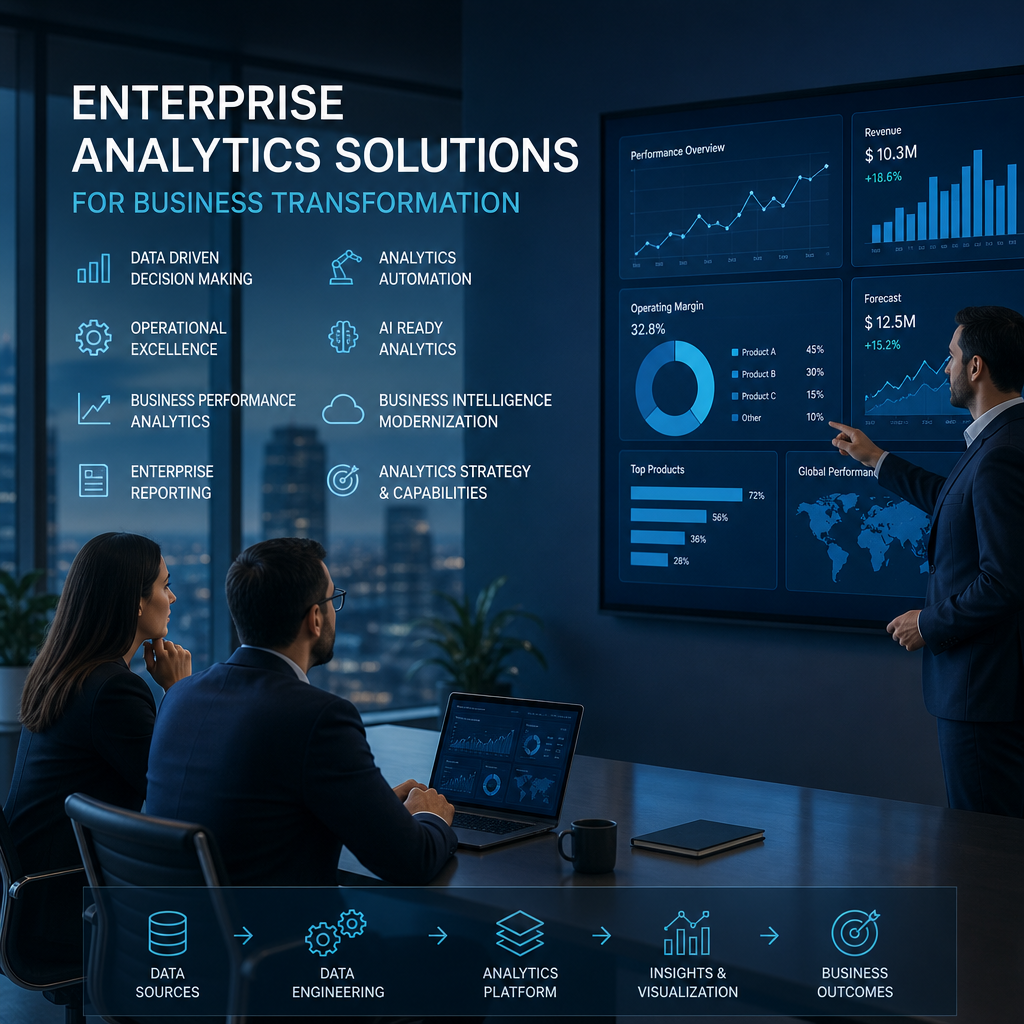
Business team reviewing analytics dashboards with Kuala Lumpur cityscape in the background

Analytics Solutions for Enterprise Transformation

Analytics solutions help organizations turn trusted information into timely, defensible decisions. They go beyond dashboards and isolated data projects, because they connect strategy, governance, delivery, and operating models so teams can use data consistently across the enterprise.

For Government, BFSI, GLC, and enterprise organizations, the goal is not just more reporting. Instead, leaders need analytics capabilities that improve planning, monitor execution, identify risk, and support AI-ready decision-making. As a result, analytics transformation must align data architecture, analytics engineering, analytics automation, governance, and business ownership.

OR Technologies Sdn Bhd (ORTECH), The Analytics Engineering Company, helps organizations establish and modernize analytics solutions that create measurable business value. Established in 2006, ORTECH combines advisory, architecture, implementation, and enablement services to support data-driven decision making across Malaysia’s most demanding operating environments.

Our approach focuses on building analytics solutions that are governed by design, scalable across business domains, aligned to enterprise priorities, and ready to support advanced analytics and Enterprise AI initiatives. For a broader view of the data foundation behind this work, see our Data Engineering services.

Analytics Solutions: Business Challenges

analytics solutions - Business team reviewing enterprise analytics dashboards with AI-powered insights for transformation

Many organizations have invested substantially in data platforms, reporting tools, and digital transformation programmes. However, they still struggle to realize value from data. Common challenges include:

  • Fragmented analytics delivery. Business units develop reports, dashboards, and data extracts independently, so metrics become inconsistent and effort gets duplicated.
  • Slow time to insight. Critical decisions depend on manual data preparation, spreadsheet reconciliation, and lengthy reporting cycles that cannot keep pace with operational requirements.
  • Low trust in management information. Different functions use different definitions for the same measures, which weakens confidence in enterprise reporting and performance management.
  • Analytics initiatives disconnected from strategy. Technology investments are made without a clear analytics strategy, business value framework, or prioritised capability roadmap.
  • Insufficient governance at scale. Organizations struggle to establish clear accountability for data ownership, quality, lineage, access, and policy enforcement across complex environments.
  • Limited analytics adoption. Analytics outputs are available, but teams do not always embed them into management routines, operational workflows, or decision rights.
  • Legacy business intelligence constraints. Traditional reporting environments are costly to maintain, difficult to change, and poorly suited for self-service analytics, real-time decisioning, or AI-ready analytics.
  • Rising regulatory and audit expectations. Banking, financial services, Government, and GLC organizations require traceability, evidence-based reporting, controlled access, and transparent analytical processes.
  • Unclear AI readiness. Organizations may explore Enterprise AI without sufficiently governed, accessible, and reusable data foundations to support reliable outcomes.
  • Digital sovereignty considerations. Sensitive data, national interests, and regulatory obligations require architecture and operating models that preserve control over data assets, deployment choices, and access governance.

Addressing these issues requires more than a technology upgrade. It requires an enterprise-level approach to analytics transformation.

ORTECH Approach

ORTECH approaches analytics solutions as an enterprise capability, not a collection of reporting projects. We work with leadership teams, business functions, data organizations, and technology teams to define the decisions that matter, identify the data and analytical capabilities required, and establish a practical roadmap for implementation.

Our methodology combines strategic advisory with hands-on analytics engineering and implementation.

1. Align Analytics with Enterprise Priorities

We begin by linking analytics investments to strategic objectives, operational performance requirements, risk priorities, and transformation outcomes. This creates a clear basis for prioritisation, funding, and executive sponsorship.

2. Assess Current-State Maturity and Constraints

ORTECH evaluates the current analytics landscape across data architecture, reporting, governance, operating model, skills, tooling, adoption, and controls. The assessment identifies capability gaps, duplication, delivery bottlenecks, and high-value opportunities for modernization.

3. Define a Target Analytics Operating Model

We help organizations determine how analytics should be governed, delivered, and sustained. This includes decision rights, data ownership, domain accountability, delivery roles, demand management, quality controls, and adoption mechanisms.

4. Establish Scalable Data and Analytics Foundations

Our teams design and implement data lakehouse architecture, AI-ready data platforms, open data architectures, and governed analytical environments that support enterprise reporting, self-service analytics, automation, and future AI initiatives.

5. Deliver Incremental Value Through Prioritised Analytics Initiatives

Rather than pursuing large, isolated programmes with delayed returns, ORTECH structures delivery around practical value increments. We create reusable data products, automated analytical workflows, and governed reporting capabilities that can expand across the enterprise.

6. Embed Governance, Adoption, and Continuous Improvement

Analytics transformation succeeds when new capabilities become part of how the organization operates. ORTECH supports governance implementation, user enablement, performance measurement, and continuous improvement to ensure analytics investments deliver sustained value.

Analytics Solutions and Service Capabilities

Analytics Strategy and Transformation Roadmap

ORTECH helps organizations define an enterprise analytics strategy that translates business priorities into a sequenced portfolio of capabilities, investments, and delivery initiatives.

This service addresses the strategic questions facing CIOs, CDOs, CFOs, and digital transformation leaders:

  • Which decisions and business outcomes should analytics improve?
  • What analytical capabilities must be standardized, modernized, or established?
  • Which data domains should be prioritised?
  • How should analytics investments be governed and measured?
  • What is required to become AI-ready without compromising control, compliance, or value realization?

The resulting roadmap provides a practical path from current-state constraints to a target analytics operating model. It covers business performance analytics, enterprise reporting, data governance, platform modernization, analytics automation, talent, and adoption requirements.

Enterprise Analytics Architecture and Modernization

ORTECH designs modern enterprise analytics architecture that supports governed access to trusted data while reducing dependency on fragile, manually managed reporting environments.

Our architecture services address the modernization of business intelligence platforms, enterprise reporting processes, data integration patterns, and analytical data stores. We help organizations transition from disconnected reporting environments toward scalable data lakehouse architecture and AI-ready data platforms.

Key considerations include:

  • Enterprise data domain design and reusable data products
  • Semantic and metric consistency across reporting and analytics
  • Data lineage, observability, and quality control
  • Security, access management, and policy enforcement
  • Performance, scalability, and workload optimization
  • Open architecture and interoperability requirements
  • Cloud, on-premises, and hybrid deployment considerations
  • Digital sovereignty and data residency requirements

The objective is not technology replacement for its own sake. Rather, it is to create an architecture that supports faster business change, trusted analytics, and a controlled path toward Enterprise AI.

Analytics Engineering and Data Product Delivery

Analytics engineering turns raw and operational data into governed, reusable, and decision-ready analytical assets. ORTECH applies analytics engineering practices to create data products that business functions can trust.

This capability includes the design and delivery of:

  • Curated analytical datasets and domain data products
  • Standardized business metrics and semantic models
  • Automated data transformation and validation pipelines
  • Reusable reporting and dashboard foundations
  • Governed self-service analytics environments
  • Audit-ready analytical evidence and traceability
  • Performance management and executive reporting structures

By applying engineering discipline to analytics delivery, organizations can reduce recurring reconciliation work, improve metric consistency, and accelerate the delivery of new analytical requirements. In addition, teams can reuse the same foundations across multiple analytics solutions.

Analytics Automation and Decision Process Improvement

Analytics automation improves the speed, consistency, and control of recurring analytical work. It is particularly relevant where business teams depend on manual data extraction, preparation, reconciliation, exception analysis, or report production.

ORTECH helps organizations identify and automate high-effort analytics processes across finance, risk, operations, internal audit, compliance, customer functions, and management reporting. Automation is designed not only to reduce cycle time, but also to improve process transparency, strengthen controls, and free teams to focus on higher-value analysis.

Using platforms such as Alteryx where appropriate, ORTECH enables governed analytics automation that supports repeatability, collaboration, and operational resilience. This can help organizations reduce spreadsheet dependency, improve auditability, and establish more reliable enterprise reporting processes.

Enterprise Data Governance and Analytics Control

Data governance is essential to trusted analytics, effective risk management, and sustainable AI readiness. ORTECH helps organizations establish governance practices that are practical for business and technology teams to operate, rather than policy documents that sit unused.

Our enterprise data governance services address:

  • Data ownership, stewardship, and accountability
  • Critical data elements and business glossary management
  • Data quality rules, monitoring, and remediation processes
  • Metadata, lineage, and traceability
  • Access governance and information classification
  • Metric governance for enterprise reporting
  • Analytics controls for internal audit and compliance
  • Governance operating models and data councils
  • Policy alignment for regulatory, security, and digital sovereignty requirements

For organizations in regulated sectors, governance must support evidence, accountability, and control without unnecessarily slowing delivery. ORTECH helps balance these requirements through proportionate, embedded governance mechanisms.

AI-Ready Analytics and Enterprise AI Readiness

AI readiness is fundamentally a data, governance, and operating model challenge. Before organizations scale Enterprise AI, they need reliable data foundations, governed access patterns, quality controls, clear accountability, and suitable analytical workflows.

ORTECH helps organizations assess and strengthen the capabilities required for AI-ready analytics, including:

  • Availability of governed and reusable data products
  • Quality, lineage, and transparency of source data
  • Secure access patterns for sensitive enterprise information
  • Data lakehouse and open data architecture readiness
  • Responsible AI governance considerations
  • Analytical process automation and reproducibility
  • Integration of AI outputs into business decision processes
  • Measurement frameworks for value, risk, and adoption

This approach allows leaders to make informed decisions about where and how to apply Enterprise AI, while preserving control over data assets and ensuring that AI initiatives are grounded in business value.

Business Outcomes

A well-designed analytics solution delivers outcomes that organizations can track through operational, financial, risk, and adoption measures. ORTECH works with clients to define value measures at the outset and sustain them through the analytics operating model.

Typical outcomes include:

  • Faster and more reliable enterprise reporting
  • Improved consistency of business performance analytics
  • Reduced manual effort in analytics preparation and reconciliation
  • Stronger data governance and audit readiness
  • Better decision support for leadership and operational teams
  • Higher adoption of governed analytical assets
  • Improved readiness for AI-enabled transformation

These outcomes matter because analytics solutions should do more than inform. They should improve execution, reduce friction, and help the enterprise respond with confidence.

Why Organizations Need Analytics Solutions

Organizations need analytics solutions when they want to move from fragmented reporting toward a disciplined decision-making capability. Moreover, these solutions help teams standardize data definitions, reduce manual work, and align reporting with business priorities.

When analytics capabilities mature, leaders gain a clearer view of performance and risk. At the same time, operational teams can act faster because they rely on governed information instead of ad hoc extracts. This is why analytics transformation often becomes a foundation for broader digital transformation.

For organizations that are already modernizing data platforms, the next step is usually not another dashboard. Instead, it is a connected model for analytics engineering, governance, automation, and adoption. That is the point where analytics solutions begin to create durable value.

If you are comparing enterprise readiness and market direction, our article on top data analytics companies in Malaysia provides additional context on how the market is evolving.

How ORTECH Supports Analytics Transformation

ORTECH supports analytics transformation by combining strategy, architecture, delivery, and enablement in one practical approach. First, we clarify the business outcomes that matter. Then we design the target capabilities needed to support them.

After that, we help clients implement the right foundations, including governed data products, analytics automation, and enterprise reporting improvements. Because adoption matters, we also help organizations embed new ways of working so analytics solutions become part of everyday decision-making.

In complex environments, this integrated model helps clients move beyond pilot projects and toward enterprise-scale analytics capability. As a result, analytics investments become easier to govern, easier to measure, and easier to sustain.

Scroll to Top