
Modernizing Graph Architecture
Scale graph queries with distributed compute while keeping data in your current storage and governance model.

Modernize the stack with a separated architecture
Data remains in your warehouse/lakehouse, while a distributed graph compute layer handles traversals at scale
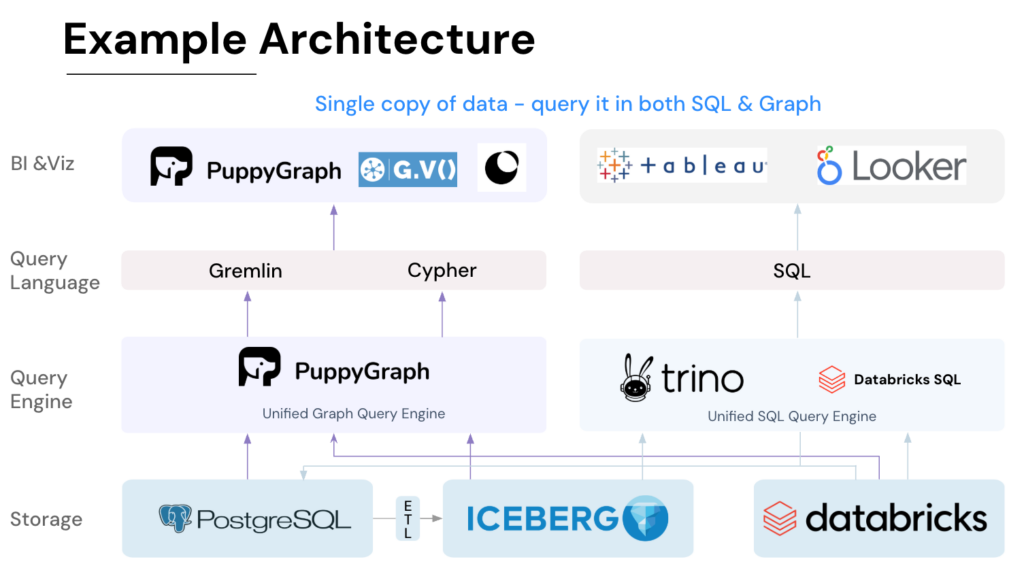
With PuppyGraph, you modernize your architecture by keeping your relational databases and warehouse/lakehouse as the system of record, while adding PuppyGraph as a graph query layer on top. Instead of copying data into a separate graph database, PuppyGraph connects directly to one or multiple data sources and maps existing tables or views into a logical graph model through a defined schema of nodes and edges. Graph traversals and multi-hop queries are then executed by a distributed compute layer that scales horizontally, performance increases by adding compute nodes, while storage, permissions, and governance remain in your current platforms. This creates a separated architecture where data stays in place, operations are simplified, and users or tools can run real-time graph queries across unified, cross-source relationships without ETL pipelines or data migration.

From ETL-Heavy Graph Databases to a
Unified Query-in-Place Graph Architecture

The diagram highlights a core architectural change: instead of building an ETL-heavy pipeline into a graph database, PuppyGraph becomes the graph access layer that federates multiple data platforms. In the traditional model, every new dataset or change requires new ingestion logic, reprocessing, and ongoing monitoring, leading to bloated architecture and high TCO.
In the PuppyGraph model, connectors link each data source to the graph engine, allowing teams to define a graph schema over existing data and run graph traversals immediately. This approach improves freshness, reduces failures caused by ETL, and supports large-scale relationship analysis without a dedicated graph storage tier.