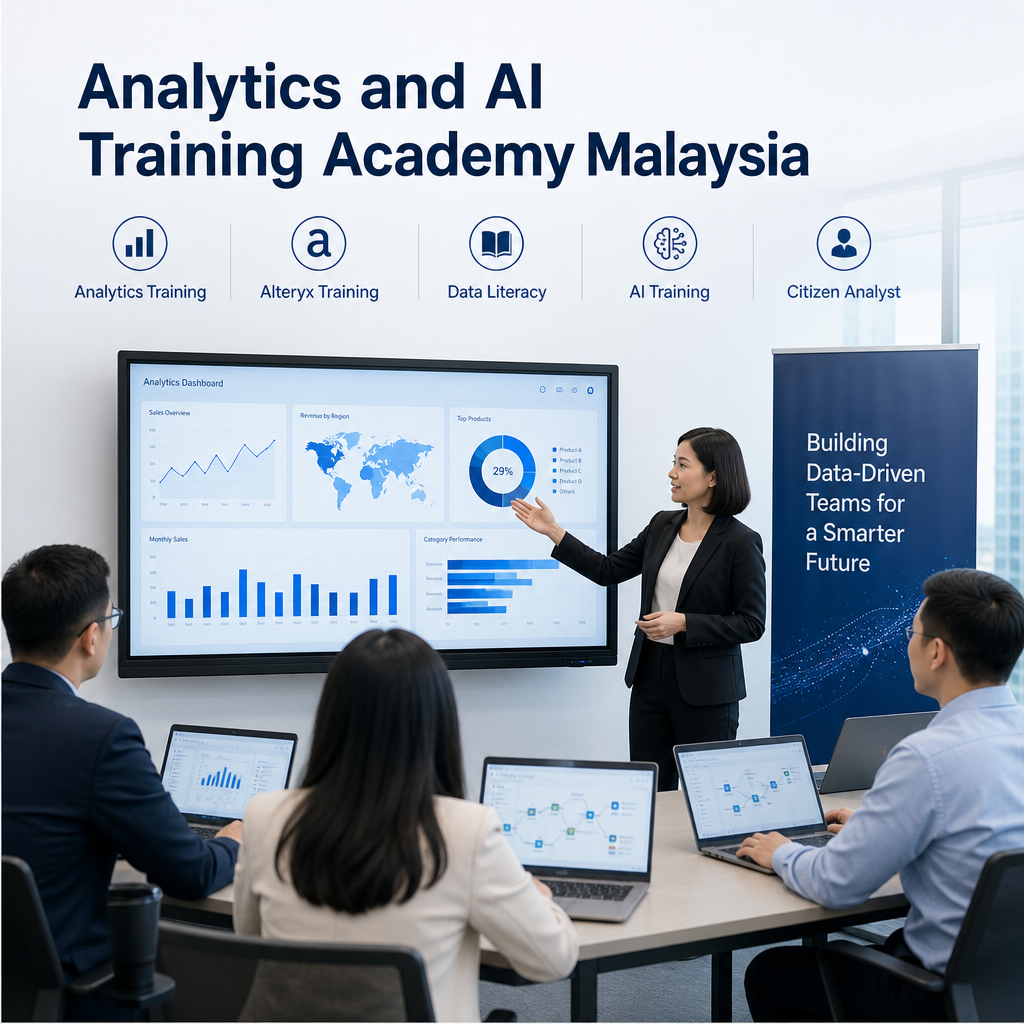
ORTECH Academy delivers analytics training, Alteryx training, data literacy, and AI training programmes designed to build durable organisational capability. The focus is not on isolated tool adoption. Instead, it helps business and technical teams work within a governed analytics operating model, improve decision-making, and accelerate the return on data investments.
Enterprise transformation depends on more than modern data platforms, analytics tools, and AI investments. It also depends on whether leaders, analysts, operational teams, and governance functions can apply data responsibly, consistently, and at scale.
For Government agencies, BFSI institutions, GLCs, and enterprise organisations across Malaysia, the need is increasingly clear. Data and AI capability must extend beyond central data teams. Business functions need the confidence to interpret information, automate repeatable analytical work, collaborate with data specialists, and apply AI within appropriate governance boundaries.
As The Analytics Engineering Company, OR Technologies Sdn Bhd (ORTECH) combines practical delivery experience with structured learning pathways. ORTECH Academy helps organisations develop the competencies required for analytics automation, citizen analyst enablement, enterprise AI readiness, data governance, and modern data platform adoption. Learn more about our AI & Intelligent Automation services.
Business Challenges in Analytics Training

Many organisations have made substantial investments in data warehouses, data lakehouse platforms, BI tools, automation capabilities, and AI initiatives. Yet adoption often remains uneven across the enterprise. Common challenges include:
- Limited data literacy among business users, which results in inconsistent interpretation of metrics and low confidence in analytical decision-making.
- Dependence on a small group of data scientists, analysts, or IT specialists for routine reporting, data preparation, and analysis.
- Low adoption of analytics platforms because training is generic, disconnected from business processes, or not aligned to employees’ roles.
- Manual and spreadsheet-driven processes that create inefficiency, control weaknesses, and limited auditability.
- Inconsistent use of analytical methods, business definitions, and data quality standards across functions.
- Difficulty scaling citizen analyst programmes without introducing data security, governance, and compliance risks.
- AI initiatives that lack sufficient business readiness, trusted data foundations, responsible AI practices, or workforce capability.
- Skills gaps in internal audit, finance, risk, operations, and compliance teams that prevent the wider use of audit analytics and continuous monitoring.
- Limited capability transfer from implementation partners to internal teams after technology deployment.
- Fragmented learning programmes that do not translate into measurable changes in operational performance or analytics adoption.
These issues are particularly significant in regulated and public-sector environments. Therefore, the benefits of self-service analytics must be balanced with strong controls, digital sovereignty, data protection, and accountable decision-making.
ORTECH Analytics Training Approach
ORTECH Academy applies an enterprise capability-building approach that connects training to operating model design, governance requirements, priority use cases, and business outcomes.
Rather than treating analytics training as a standalone event, ORTECH works with leadership teams to assess the organisation’s current capability, identify priority personas, and establish practical learning pathways. The resulting programme can support executive awareness, functional data literacy, technical skill development, citizen analyst enablement, and advanced analytics engineering capability.
Our approach typically includes five stages:
Capability Assessment and Workforce Segmentation
We assess current skills, role requirements, adoption barriers, analytical maturity, and strategic priorities. Learners are grouped by business role, data responsibility, and required depth of capability rather than by a one-size-fits-all curriculum.Learning Architecture and Role-Based Pathways
ORTECH Academy designs learning journeys for executives, business users, citizen analysts, analysts, data engineers, internal auditors, governance teams, and platform administrators. Training aligns with real business workflows, approved data sources, and organisational policies.Applied, Use-Case-Led Learning
Participants work with realistic enterprise scenarios such as regulatory reporting, financial planning, operational performance management, customer analytics, risk monitoring, and audit exception analysis. As a result, knowledge transfer improves, and post-training adoption becomes easier.Governed Enablement and Community Development
For organisations building self-service analytics capability, ORTECH helps define guardrails for access, data certification, reusable assets, quality controls, model oversight, and escalation paths. This supports a scalable citizen analyst model without weakening enterprise governance.Adoption Measurement and Continuous Capability Development
Training effectiveness is measured beyond attendance and completion rates. ORTECH can help track utilisation, automation rates, time saved, adoption of approved data assets, quality improvements, reusable workflow development, and business impact.
This methodology enables organisations to build an internal analytics capability that remains effective as platforms, data products, and AI priorities evolve.
Service Capabilities in Analytics Training
Enterprise Data Literacy Programmes
ORTECH Academy develops data literacy programmes for business and leadership audiences who need to make better use of enterprise information without becoming technical specialists.
The programme focuses on practical decision intelligence: understanding trusted metrics, interpreting analytical outputs, recognising data quality limitations, challenging assumptions, and using data responsibly in operational and strategic decision-making. It also addresses accountability for data use, data ownership, and governance responsibilities.
For senior leaders, the emphasis is on using data and AI to set priorities, evaluate investments, establish operating model expectations, and oversee risk. For business teams, the focus is on improving the quality, consistency, and speed of everyday decisions.
Alteryx Training and Analytics Automation
ORTECH provides structured Alteryx training for organisations seeking to reduce manual data preparation, strengthen repeatable analytical processes, and enable governed self-service analytics.
Training can be tailored for new users, business analysts, finance teams, risk professionals, internal audit teams, and advanced analytics practitioners. Participants learn how to develop documented, repeatable, and auditable workflows that reduce reliance on spreadsheets and fragmented manual processes.
The programme supports the effective use of Alteryx One within an enterprise environment, including workflow design, data preparation, analytics automation, governance considerations, reusable assets, and deployment practices. Where relevant, ORTECH also helps organisations establish an Alteryx Centre of Excellence model to support standards, prioritisation, reuse, and sustainable adoption.
Citizen Analyst Enablement
A citizen analyst programme should expand business capability while preserving data governance, security, and trust. ORTECH helps organisations define the practical boundaries, competencies, and controls required to scale citizen analytics responsibly.
This capability includes role definition, approved data access patterns, certified datasets, analytical standards, workflow review processes, community support structures, and escalation routes to central data teams. Training is designed around the business domains where decentralised analytics can create measurable value, including finance, operations, procurement, compliance, HR, and customer management.
The objective is not unrestricted self-service. It is a governed model in which business users can address appropriate analytical needs independently while complex, sensitive, or enterprise-wide requirements remain under the stewardship of specialist teams.
AI Training and Enterprise AI Readiness
AI training from ORTECH Academy is designed for organisations moving from experimentation to accountable enterprise adoption. Programmes address the business, governance, and workforce dimensions of AI readiness, with a focus on responsible implementation rather than ungoverned experimentation.
Training pathways can cover AI strategy awareness for executives, responsible AI principles for business and governance teams, AI-assisted analytics for analysts, data readiness requirements, model risk considerations, and operating model implications for enterprise AI.
For technical and data teams, ORTECH can align learning with AI-ready data platforms, data lakehouse architecture, open data architectures, and the controls required for secure and scalable AI deployment. The outcome is a workforce that understands not only how to use AI capabilities, but also when to apply them, how to validate outputs, and how to manage associated business risk.
Internal Audit Analytics and Risk Capability Development
Internal audit, risk, and compliance functions require stronger analytical capability to shift from periodic testing towards more continuous, data-informed assurance.
ORTECH Academy delivers specialised training for internal audit and assurance professionals, enabling them to apply analytics to audit planning, population analysis, exception detection, control monitoring, fraud risk assessment, and management reporting. Programmes can incorporate Alteryx training, Tableau visualisation, data quality assessment, and automation of recurring audit procedures.
The training supports the audit function’s independence and control obligations, while it also improves coverage, consistency, and efficiency. It also helps audit leaders build a practical roadmap for internal audit analytics, from foundational skills and pilot use cases to reusable workflows and governed continuous auditing practices.
Business Outcomes from Analytics Training
A well-designed analytics academy creates enterprise value when capability development is tied to strategic priorities and operational use cases. ORTECH Academy helps organisations achieve outcomes such as:
- Faster decision-making through improved access to trusted information, stronger analytical confidence, and more consistent interpretation of business metrics.
- Improved operational efficiency through analytics automation, reduced manual data preparation, and reusable analytical workflows.
- Reduced business risk through better data handling practices, improved control monitoring, greater audit coverage, and more disciplined AI use.
- Enhanced governance and compliance through role-based training, approved analytical practices, stronger data stewardship, and auditable processes.
- Increased analytics adoption by aligning learning to real business processes, user roles, and deployed enterprise platforms.
- Improved AI readiness through stronger data literacy, responsible AI awareness, governance capability, and workforce preparedness.
- Better return on data investments by increasing utilisation of Alteryx One, data lakehouse platforms, Tableau, enterprise AI platforms, and governed data products.
- Reduced dependency on scarce specialist resources by enabling business teams and citizen analysts to address appropriate analytical needs independently.
- Greater organisational resilience through internal capability transfer, reusable knowledge assets, and sustainable communities of practice.
Industry Applications for Analytics Training
Government
Government agencies require analytical capability that supports public service delivery, policy development, programme performance monitoring, financial stewardship, and accountable use of public data.
ORTECH Academy helps public-sector organisations establish data literacy and analytics training programmes that are aligned to governance, security, and digital sovereignty requirements. Training can support policy analysts, operations teams, finance functions, audit units, and digital transformation offices in using trusted data more effectively.
For agencies modernising their data environments, ORTECH can align capability development with AI-ready data platforms, data lakehouse architecture, and the controls needed for secure adoption. In addition, agencies can benchmark practices against the OECD data governance resources.
BFSI, GLCs and Enterprise Teams
In BFSI and large enterprise environments, analytics training must support governed scale. ORTECH Academy helps teams build capability across finance, risk, compliance, operations, customer analytics, and management reporting.
That capability supports more reliable analysis, better process control, and faster response to business change. It also helps organisations move from isolated analytics use cases to repeatable enterprise adoption.
Building a Sustainable Analytics Academy
Analytics training works best when organisations treat it as part of a broader capability strategy. ORTECH Academy supports that strategy by combining role-based learning, practical use cases, and governance-aware adoption planning.
As a result, organisations can build a sustainable analytics academy that develops people, strengthens process discipline, and supports measurable business outcomes. The same approach also creates a stronger foundation for AI training, citizen analyst expansion, and long-term analytics maturity.
If your organisation is looking to strengthen analytics training in Malaysia, ORTECH can help design a pathway that fits your operating model, risk profile, and strategic priorities.