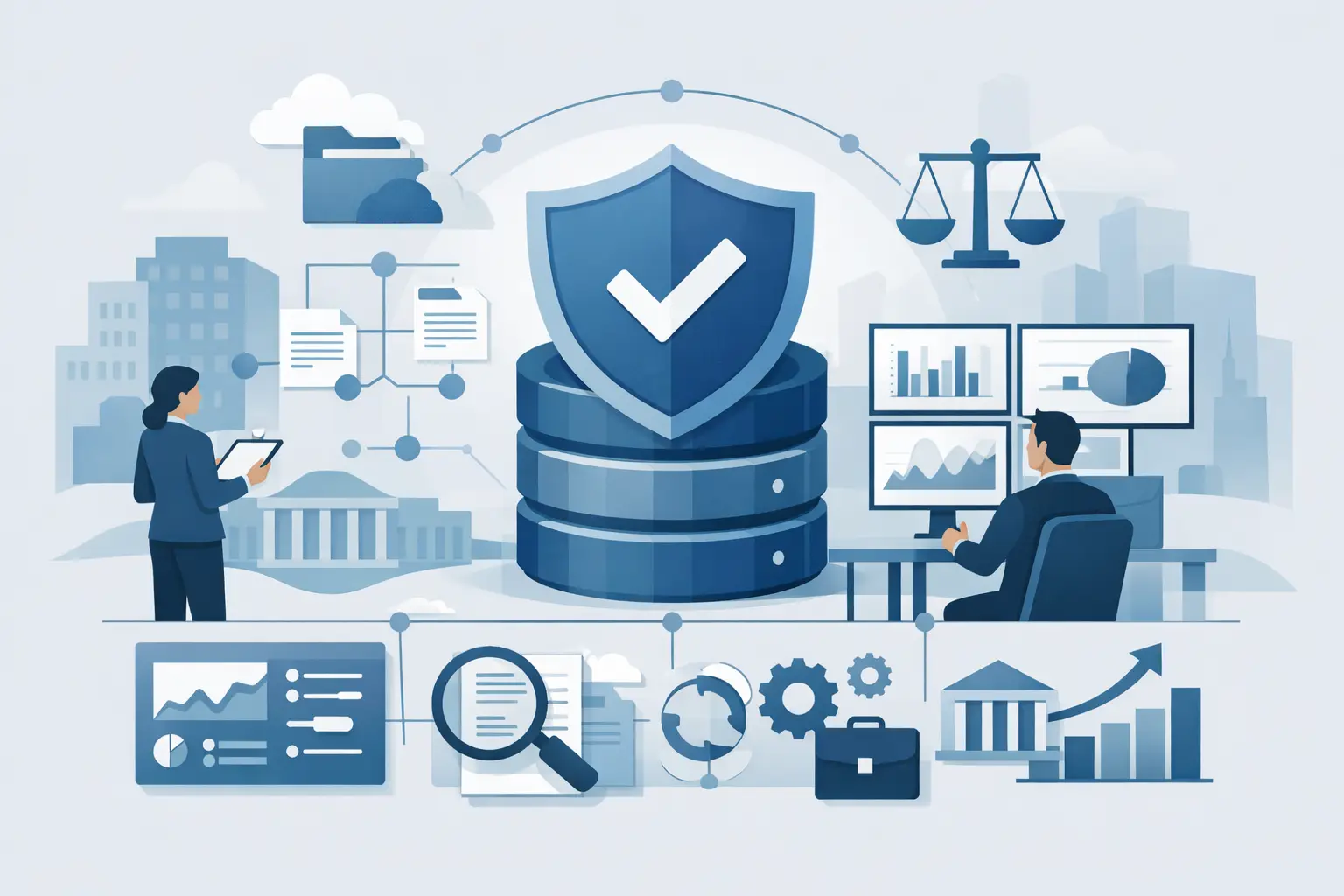
A governance program usually fails long before the first policy is approved. It fails when business leaders expect trust, compliance, lineage, and AI readiness from data that still lives across disconnected platforms, inconsistent definitions, and manual controls. That is why evaluating the best enterprise data governance tools is not a software exercise. It is an operating model decision.
For CIOs, CDOs, enterprise architects, and risk leaders, the market can look crowded for the wrong reasons. Many platforms promise cataloging, policy management, and lineage. Fewer can support enterprise-scale governance across hybrid environments, regulated workflows, multiple business domains, and growing AI use cases without creating another layer of complexity. The right choice depends less on feature volume and more on architectural fit, stewardship maturity, and how governance must operate across your institution.
What the best enterprise data governance tools actually need to do
At the enterprise level, governance is not just about documenting datasets. It must establish accountability, standardize meaning, make controls enforceable, and give decision-makers confidence that critical data can be used safely. In banking, insurance, government, and large diversified enterprises, that usually means the platform must support policy definition, metadata management, business glossaries, lineage, stewardship workflows, access controls, auditability, and integration with existing data platforms.
Just as important, the platform has to work across organizational reality. Most enterprises are not starting clean. They have legacy warehouses, cloud data platforms, reporting estates, operational systems, and growing AI initiatives. A governance tool that works well in a narrow cloud-native environment may struggle when lineage must extend into on-prem systems, or when compliance teams need evidence that policies are actually being applied.
The strongest platforms tend to balance three capabilities. They create visibility through metadata and lineage, they create control through policy and workflow, and they create adoption through a business-friendly user experience. If one of those is weak, governance often remains technical, fragmented, or underused.
9 best enterprise data governance tools to evaluate
Collibra
Collibra is often shortlisted by large enterprises because it approaches governance as an operating model, not just a metadata layer. It is well suited for organizations that need business glossary management, stewardship workflows, policy alignment, and broad governance collaboration across business and technical teams.
Its strength is structure. If your institution needs clear ownership, standardized terms, issue management, and a governed process around critical data elements, Collibra is usually a strong fit. The trade-off is that it requires disciplined implementation. Without executive sponsorship and clearly defined stewardship roles, organizations can end up with a well-configured platform that still lacks active adoption.
Informatica Axon and Enterprise Data Catalog
Informatica remains highly relevant in complex enterprise estates, especially where governance must align closely with data integration, data quality, and master data initiatives. Axon, combined with Enterprise Data Catalog, gives organizations a broad governance environment tied to a mature enterprise data management stack.
This can be a major advantage for regulated organizations that want governance integrated with operational controls rather than treated as a separate program. The trade-off is complexity. Informatica is powerful, but it generally delivers the most value when an enterprise is prepared for a broader platform strategy rather than a lightweight governance deployment.
Microsoft Purview
For enterprises already invested in Azure and Microsoft data services, Purview has become a serious governance option. Its value comes from native alignment with the Microsoft ecosystem, including data discovery, classification, lineage, and compliance-oriented capabilities across cloud services.
Purview is especially attractive for organizations trying to build governance into a modern data estate without introducing too many disconnected tools. However, the fit depends on how heterogeneous your environment is. If your architecture spans multiple clouds, legacy systems, and non-Microsoft platforms, you need to validate how complete the metadata coverage and lineage depth will be in practice.
Alation
Alation is widely recognized for making data governance more usable for business teams. It has a strong reputation in data cataloging, search, stewardship, and knowledge-sharing, which makes it appealing to organizations that need to improve data discovery and trust without leading with heavy governance bureaucracy.
This is often useful in enterprises where governance has struggled to gain traction because users cannot easily find or understand trusted data. The limitation is that catalog adoption alone does not equal governance maturity. Alation can be very effective, but institutions with strict policy enforcement, multi-layered controls, and formal compliance obligations may need to assess how it fits into a wider governance architecture.
IBM Knowledge Catalog and broader IBM governance capabilities
IBM remains a credible option for large enterprises with complex, regulated environments, particularly where governance, security, and data fabric initiatives intersect. Its governance capabilities are often considered in organizations that need enterprise-grade metadata management, policy control, and integration with broader IBM data and AI environments.
IBM tends to suit institutions that value depth, scale, and formal control models. The trade-off is that implementation can be substantial, and value depends heavily on architecture planning and operating model clarity. It is rarely the best choice for organizations looking for a fast, narrow deployment.
SAP Data Intelligence and SAP Metadata solutions
For SAP-centric enterprises, governance decisions should not ignore the operational core. SAP’s governance-related capabilities are most relevant where critical processes, finance, supply chain, and master data already run heavily on SAP platforms. In that context, metadata visibility and policy alignment inside the SAP landscape can be strategically important.
The question is whether SAP is your governance center of gravity or only one major domain among many. If the enterprise data estate extends well beyond SAP, leaders should assess whether SAP-led governance can provide enough cross-platform consistency.
Ataccama
Ataccama stands out when governance, data quality, and trust need to move together. Many enterprises underestimate how quickly a governance initiative loses credibility if definitions are documented but data quality issues remain unresolved. Ataccama addresses that gap by combining metadata, governance, and quality capabilities more tightly than some catalog-first platforms.
This makes it a strong candidate for organizations focused on operationalizing trusted data for analytics, regulatory reporting, and AI readiness. The trade-off is that success depends on how well business ownership and remediation workflows are established. Technology can expose quality issues, but it cannot assign accountability on its own.
OneTrust Data Governance
OneTrust is often associated with privacy and compliance, but its governance capabilities are increasingly relevant for enterprises managing policy, data use, and regulatory obligations across sensitive information domains. This can be particularly valuable where governance is being driven by risk, privacy, and control requirements rather than analytics modernization alone.
That focus can be a strength or a limitation. If your governance program is primarily motivated by privacy operations and data handling obligations, OneTrust deserves attention. If your priority is broad metadata-driven enterprise governance across analytics, engineering, and platform modernization, it may need to sit alongside other capabilities.
Talend Data Catalog and governance capabilities
Talend is often considered where data integration and governance need to stay closely linked. Its governance value is strongest in environments where lineage, quality, and movement of data across pipelines are as important as glossary and policy management.
This can work well for organizations building stronger control over data flows while improving trust in reporting and downstream analytics. Still, leaders should assess whether Talend’s governance capabilities match the level of formal stewardship, enterprise workflow, and cross-domain governance required by their operating model.
How to choose the best enterprise data governance tools for your environment
The best platform is rarely the one with the longest feature sheet. It is the one that fits the institution’s architecture, regulatory obligations, and governance maturity. A bank managing model risk, customer data, and regulatory reporting has very different needs from a government agency focused on sovereignty, access control, and cross-department data sharing.
Start with operating model questions before product evaluation. Who owns data by domain? How are policies approved and enforced? What evidence is needed for compliance and audit? Where does metadata live today, and how fragmented is it? If those questions are unclear, tool selection becomes guesswork.
The next issue is architectural reach. Governance tools should be evaluated against real enterprise conditions, not ideal-state diagrams. That means testing support for hybrid environments, lineage across legacy and cloud platforms, integration with data quality and access controls, and the ability to serve both business stewards and technical teams.
Adoption also matters more than many programs admit. A platform can be technically complete and still fail if business users do not trust it, stewards cannot maintain it, or workflows become too administrative. This is where implementation discipline matters as much as software design. In practice, the strongest outcomes usually come from pairing platform deployment with governance design, stewardship enablement, and measurable domain-based rollout.
For many organizations, especially across regulated sectors in ASEAN, the real differentiator is not buying a governance tool. It is building a governance capability that can support analytics modernization, cross-functional decision-making, and AI-ready data foundations at scale. That is the lens ORTECH brings to these programs: governance not as documentation, but as institutional control that makes trusted data usable.
A useful next step is to shortlist two or three tools based on architecture fit, then run a focused evaluation around lineage depth, policy execution, stewardship workflow, and integration effort. Governance platforms create value when they reduce ambiguity, improve control, and help the enterprise move faster with trusted data. If a tool cannot do that in your operating reality, it is the wrong tool no matter how strong the demo looks.
The right governance platform should make trusted data easier to use, not harder to govern.