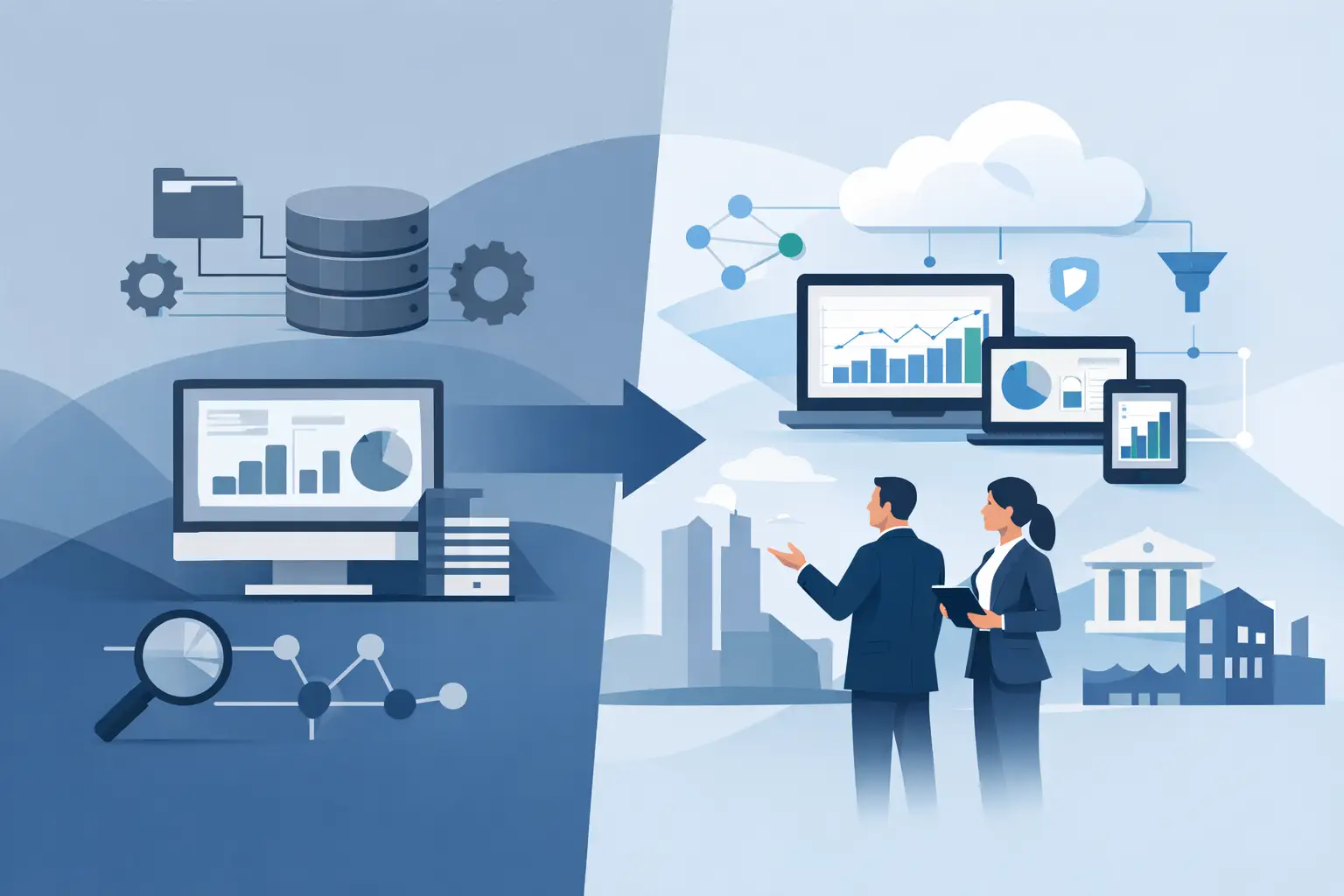
A quarterly board review should not depend on manual spreadsheet stitching, overnight batch jobs, and three different definitions of the same KPI. Yet that is still the operating reality in many enterprises. When leaders ask how to modernize legacy analytics, they are rarely asking for a dashboard refresh. They are asking how to reduce decision latency, improve trust in data, and build an analytics foundation that can support governance, automation, and AI.
For large enterprises, banks, insurers, government agencies, and GLCs, legacy analytics is not simply old technology. It is an accumulation of reporting logic, local workarounds, duplicated data pipelines, and institutional assumptions that have hardened over time. That complexity is why modernization cannot be treated as a lift-and-shift exercise. It requires architectural change, operating model change, and a clear view of what outcomes matter most.
How to modernize legacy analytics without disrupting operations
The first mistake organizations make is treating analytics modernization as a tool replacement project. A new BI platform on top of fragmented source systems does not solve inconsistency. Moving old ETL jobs to the cloud does not make data trusted. Rebuilding reports faster does not create decision intelligence.
Modernization starts with identifying where the current environment is creating business friction. In some organizations, the real problem is slow regulatory reporting. In others, it is unreliable finance and risk metrics, poor cross-functional visibility, or an inability to operationalize machine learning because foundational data is incomplete or poorly governed. The target state should be defined by these operational constraints, not by architecture diagrams alone.
A practical approach is to focus on three priorities at the same time. First, improve data trust. Second, reduce time-to-insight. Third, create an architecture that can scale across domains without multiplying complexity. If one of these is ignored, the program usually stalls. Fast analytics without governance creates risk. Strong governance without usability creates avoidance. Scalable platforms without business adoption become expensive infrastructure.
Start with the data products that matter most
Not every analytics asset deserves to be modernized first. Many legacy environments contain reports no one uses, pipelines no one wants to touch, and marts that survive mainly because they are familiar. Modernization works better when it begins with a small number of high-value data products tied to measurable decisions.
For a financial institution, that may be credit risk, liquidity reporting, fraud monitoring, or customer profitability. For a government agency, it may be service delivery performance, budget controls, or citizen outcome reporting. For a large enterprise, it may be supply chain visibility, revenue assurance, or working capital intelligence.
The point is to define modernization around business-critical use cases where poor data quality or delayed reporting has a visible cost. This creates sponsorship, clarifies priorities, and gives architecture decisions a clear test. If the new design does not improve the quality, timeliness, or usability of those critical data products, it is not modernization in any meaningful sense.
Separate reporting symptoms from platform causes
Executives often experience legacy analytics as a reporting issue. Reports arrive late, reconciliations are painful, and different teams tell different stories. But those symptoms usually originate deeper in the stack. Common causes include tightly coupled ETL pipelines, undocumented business logic, inconsistent master data, weak metadata, and limited lineage across systems.
That is why technical assessment matters. Before rebuilding, organizations need to know which pipelines are business-critical, which transformations can be standardized, where governance controls are missing, and which dependencies create the most operational fragility. This is less glamorous than selecting a modern platform, but it is where most of the risk actually sits.
Redesign the architecture for trust and scale
A modern analytics architecture should support both governed reuse and controlled flexibility. In practice, that means moving away from siloed marts and opaque reporting layers toward an architecture where curated data can be shared, traced, and versioned across functions.
For many institutions, a lakehouse-oriented approach is effective because it supports structured and semi-structured data, enables broader analytical workloads, and reduces the separation between engineering, analytics, and AI use cases. But architecture choices still depend on regulatory constraints, sovereignty requirements, latency needs, and the current skills of the internal team. Cloud-native is not automatically the right answer. In regulated sectors, hybrid and on-premises models may remain important for good reasons.
What matters more than the label is whether the architecture supports a few non-negotiables. Data should be discoverable. Transformations should be governed and testable. Business definitions should be standardized. Security controls should follow the data, not rely on manual workarounds. And platform operations should be observable enough to detect failures before they affect business users.
This is where analytics engineering becomes central. Legacy environments often bury business logic inside reports, stored procedures, or manual extracts. A modern model externalizes that logic into managed, testable transformation layers so that data quality, lineage, and semantic consistency can be controlled systematically.
Governance cannot be added later
Many modernization programs postpone governance because it is seen as slowing delivery. In reality, delaying governance usually creates rework. When ownership is unclear and policy enforcement is weak, new pipelines replicate the same trust problems as the old environment.
Governance in a modern analytics context should be operational, not ceremonial. Data owners need defined accountability. Critical data elements need agreed definitions. Access controls need to reflect regulatory and business requirements. Lineage needs to support auditability. Quality rules need to be built into pipelines, not documented in a separate committee deck.
This is especially important in BFSI and public sector environments where analytics outputs can influence regulatory reporting, risk decisions, public accountability, and financial controls. In those settings, modernization is not only about speed. It is about confidence, traceability, and institutional resilience.
Build for AI readiness, not AI theater
Organizations increasingly connect analytics modernization with AI ambitions, and that is reasonable. But AI readiness is a result of disciplined data foundations, not a parallel initiative. If source data is inconsistent, permissions are fragmented, and feature logic cannot be reproduced, advanced models will amplify existing problems rather than solve them.
A better way to think about AI readiness is this: can your organization produce governed, reusable, high-quality data products that are suitable for both human decision-making and machine-driven workflows? If not, legacy analytics is still the bottleneck.
This is why modernization should include metadata discipline, reusable semantic models, data quality monitoring, and platform patterns that support both analytics and operational intelligence. The goal is not to overengineer for hypothetical future use cases. The goal is to ensure today’s modernization decisions do not block tomorrow’s automation and AI initiatives.
Change the operating model, not just the technology
Technology modernization without operating model change tends to recreate old problems on newer platforms. Teams continue to work in silos. Definitions drift. Delivery queues grow. Business users bypass governed channels because they still cannot get timely answers.
A stronger model brings data engineering, analytics engineering, governance, and business ownership into a shared delivery structure. That does not mean centralizing every decision. It means defining who owns source-aligned data, who curates cross-domain business logic, who approves access, and who is accountable for the quality of strategic metrics.
Many enterprises benefit from a federated model with centralized standards. Domain teams stay close to business context, while enterprise data leadership sets platform guardrails, quality expectations, metadata standards, and governance controls. The trade-off is that federated models require stronger discipline. Without it, they can become a new form of fragmentation.
Measure progress in business terms
If the success of modernization is measured only by migration milestones, the business case will weaken quickly. Leaders should track whether critical reporting cycles are faster, whether reconciliation effort has declined, whether data incidents are reduced, and whether decision-makers trust the outputs more than they did before.
Technical measures still matter. Pipeline reliability, test coverage, lineage completeness, and platform utilization are useful indicators. But executive support is sustained by operational outcomes. Has finance closed faster? Has risk reporting improved? Are frontline teams acting on more timely intelligence? Can auditors trace data more efficiently? Those are the signals that modernization is changing how the institution operates.
For organizations taking this journey now, the most effective programs are rarely the loudest. They are deliberate, governed, and tied to high-value decisions. They modernize legacy analytics by improving trust, architecture, and accountability together. That is the difference between a platform upgrade and a genuine shift in enterprise intelligence.
A useful test is simple: if your analytics environment cannot reliably support today’s decisions, it will not support tomorrow’s AI ambitions either. Modernization should begin there – with the hard work of making data dependable enough to run the business with confidence.