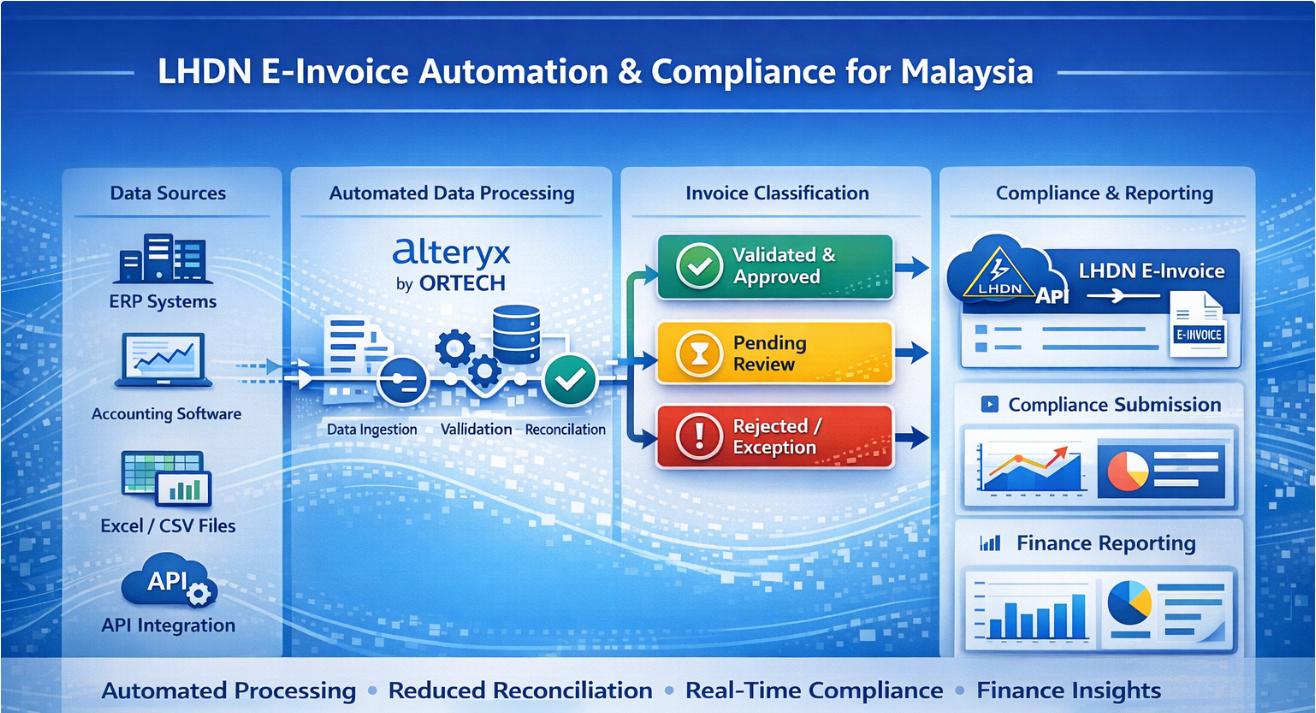
A regulatory submission can be materially wrong even when every individual spreadsheet appears reasonable. A changed source-system code, an undocumented manual adjustment, or a late data extract can alter a capital, liquidity, risk, claims, or finance return without creating an obvious failure. To reduce regulatory reporting errors, Malaysian institutions need to redesign reporting as a controlled data product, not simply improve the final review of a report.
For banks, insurers, takaful operators, government bodies, and GLCs, this is an operational and governance issue as much as a technology issue. Regulatory reporting teams work across finance, risk, compliance, operations, actuarial, and IT. Their challenge is not a lack of data. It is that data definitions, controls, ownership, and evidence often do not travel reliably from source to submission.
Why regulatory reporting errors persist
Most recurring errors originate before the reporting team begins its final compilation. A finance team may use one definition of an account balance, risk may use another, and a product system may contain classifications that have not been mapped consistently to the reporting taxonomy. Teams can still reconcile totals at a high level while misclassifying individual records or applying an outdated business rule.
In Malaysia, the consequences are especially significant for regulated financial institutions. Reporting obligations to Bank Negara Malaysia, the Securities Commission Malaysia, Bursa Malaysia, and other authorities vary by institution and reporting purpose. The relevant policy documents, submission templates, data definitions, and reporting timetables also change over time. A control environment that depends on people remembering each change is inherently fragile.
Insurers and takaful operators face a related challenge. Actuarial, underwriting, claims, reinsurance, and finance data may be prepared in separate environments, with manual consolidation occurring late in the reporting cycle. Government agencies and GLCs encounter similar problems when consolidating data from multiple departments, subsidiaries, or legacy systems. In each case, a report can be numerically complete but still difficult to defend because its lineage is unclear.
The executive question is straightforward: can the organization explain where each reported figure came from, which rule transformed it, who approved an exception, and whether the same process can be repeated next month? If the answer requires searching emails and reconstructing spreadsheet edits, the reporting process carries avoidable risk.
Build reporting on governed, reusable workflows
The most effective way to reduce regulatory reporting errors is to move repeated preparation work out of unmanaged spreadsheets and into governed analytical workflows. This does not eliminate expert judgment. It makes judgment visible, reviewable, and consistently applied.
Alteryx can play a central role in this model by allowing finance, risk, compliance, audit, and actuarial teams to prepare, blend, validate, and document data workflows without rebuilding the same logic for every reporting period. Rather than passing files through sequential manual steps, teams can establish reusable workflows for ingestion, standardization, reconciliation, exception handling, and output preparation.
For example, a bank preparing a periodic risk or finance return may need to combine general ledger extracts, customer reference data, product classifications, and risk attributes. A governed Alteryx workflow can apply approved mappings, flag missing or invalid values, compare record counts between stages, and produce exception outputs for investigation. The purpose is not merely to automate extraction. It is to embed the reporting control logic into a process that can be rerun and inspected.
Alteryx One extends this operating model through a cloud-oriented environment for analytics automation and governance, subject to an institution’s edition, licensing, architecture, and data-residency requirements. For Malaysian enterprises with on-premises or hybrid constraints, workflow design should account for where sensitive data is processed, how credentials are managed, and what evidence must remain available for audit. Platform choice should follow the control requirement, not the other way around.
Design controls into the workflow, not around it
A reporting workflow should contain controls at the points where errors are most likely to arise. Four controls are particularly valuable:
- Completeness checks compare record counts, totals, and key populations between source extracts and reporting-ready datasets.
- Validity checks test mandatory fields, permitted values, date ranges, thresholds, and reference-data mappings.
- Reconciliation checks compare calculated outputs with approved finance, risk, or actuarial control totals and isolate material variances.
- Exception evidence records failed records, rule outcomes, reviewer actions, and approved adjustments in a form that can be retained and examined.
These controls need agreed tolerances and accountable owners. An automated check that produces hundreds of unexplained warnings is not a control. It is noise. Reporting owners, risk and compliance specialists, and data engineers should define which exceptions block publication, which require documented approval, and which indicate a broader data-quality issue.
Treat data definitions as regulated assets
Automation can reproduce inconsistent logic faster if data definitions are not governed. A common reporting issue is the silent use of different business meanings for terms such as customer, exposure, delinquency, active policy, or related party. These differences can arise across business lines, legal entities, and acquired systems.
A practical data governance model assigns ownership to critical reporting data elements, documents their approved definition, and links each definition to source fields, transformation rules, and report outputs. This is where an AI-ready data platform and modern lakehouse architecture become relevant. A lakehouse built on open table formats such as Apache Iceberg can help organizations maintain governed, scalable datasets while preserving historical context and supporting multiple analytical workloads.
The objective is not to centralize every data asset before improving reporting. That approach can delay value. Instead, prioritize the high-risk data domains that feed regulated reports: customer and counterparty data, accounts and balances, product hierarchies, transaction classifications, policies and claims, and organizational reference data. Establish trusted reporting datasets for these domains, then expand according to regulatory and business priority.
For organizations handling personal data, governance must also align with applicable obligations under Malaysia’s Personal Data Protection Act 2010. Access, minimization, retention, and handling practices should be designed into reporting workflows and platforms. Reporting accuracy and responsible data use are connected: uncontrolled copies of sensitive data create both quality and privacy risk.
Use AI carefully to improve investigation, not to bypass accountability
AI can assist regulatory reporting teams, but it should not become an unreviewed decision-maker for regulated outputs. The most useful near-term applications are investigative and operational: summarizing exception patterns, helping analysts locate relevant workflow documentation, classifying recurring data-quality issues, or assisting users in understanding approved analytical processes.
Within the Alteryx ecosystem, capabilities such as Ask Alteryx, AI-assisted tools, Agents, Agent Studio, Skills, and MCP Server-related options should be assessed against the organization’s licensed environment, availability, security architecture, and governance requirements. Product capabilities evolve, and institutions should confirm what is generally available and appropriate for their tenancy before incorporating them into controlled processes.
The governing principle is simple: AI may help a reporting analyst find, explain, or prioritize an issue, but approved business rules and accountable human review must determine the submitted result. For a bank or takaful operator, an AI-generated explanation is not audit evidence by itself. The underlying source data, transformation logic, control result, and reviewer decision remain the evidence.
This distinction matters when designing enterprise AI. A controlled approach uses curated reporting knowledge, role-based access, prompt and output safeguards where appropriate, and clear records of human approvals. It does not expose sensitive reporting datasets broadly or allow a conversational interface to change production logic without change control.
Make the reporting process observable to executives
Senior leaders do not need a detailed view of every transformation. They do need visibility into whether the reporting process is stable. A Tableau dashboard or equivalent decision-intelligence layer can provide a concise operational view: report status, unresolved exceptions, reconciliation breaks, late source feeds, manual adjustments, and recurring root causes.
This creates a more useful management conversation. Instead of asking whether a report was submitted on time, the CFO, CRO, CIO, or Chief Compliance Officer can ask which controls failed, whether the same data issue is recurring, and whether remediation has reduced dependency on manual intervention. The answer should be supported by workflow evidence rather than informal assurance.
There is a trade-off. Excessive controls can slow a reporting cycle, while insufficient controls create false confidence. The right design is risk-based. High-impact calculations, sensitive classifications, and manual adjustments deserve stringent validation and approval. Lower-risk operational checks can be monitored through thresholds and trend analysis.
Start with one material reporting journey
Organizations should avoid launching a broad transformation program without proving the operating model. Select one material report or reporting domain with clear pain points, repeated manual work, and engaged business ownership. Map the current data journey from source to submission, including offline adjustments and review steps. Then identify the minimum viable set of standardized datasets, workflow controls, evidence requirements, and ownership decisions.
Measure progress through operational indicators: the number of manual handoffs, unresolved exceptions, late source feeds, repeat adjustments, reconciliation breaks, and time spent assembling evidence. These measures are more defensible than generic automation claims because they show whether the process is becoming more controlled and repeatable.
ORTECH approaches this as an analytics engineering challenge: integrate fragmented data, encode approved logic into governed workflows, and enable business teams to operate the process with IT, risk, and audit oversight. The lasting outcome is not a faster spreadsheet. It is a reporting capability that can withstand scrutiny, absorb regulatory change, and give decision-makers greater confidence in the numbers they use.