Automating Digital Invoice Processing &
LHDN E-Invoice Compliance
Many organizations struggle to handle large volumes of electronic invoices. First, they deal with scattered data and manual cross-checking. As a result, finance teams often fail to track invoice status quickly. However, this use case explains how LHDN e-invoice automation solves these very problems. Specifically, our solution standardizes how you collect and report your invoices. Therefore, you can speed up your workflows and gain much better control without hiring extra staff.
Where It Breaks Down
Finance teams frequently face major hurdles when they rely on manual processing steps or disconnected systems.
High manual effort
First of all, manual tasks require too much time. Teams spend hours fixing and checking data by hand.
Error-prone reporting cycles
Furthermore, manual reporting leads to inevitable mistakes. Staff members often miss records or classify items poorly.
Delayed issue identification
In addition, teams spot errors far too late. Because of this, they delay critical follow-up actions.
Fragmented input data
Also, scattered data creates major confusion. Systems pull records from many different sources, which requires extra work to combine.
Limited visibility
Finally, staff lack clear oversight. They must check multiple files just to see if an invoice is pending, processed, or rejected.
How We Elevate It
How ORTECH Powers This Use Case
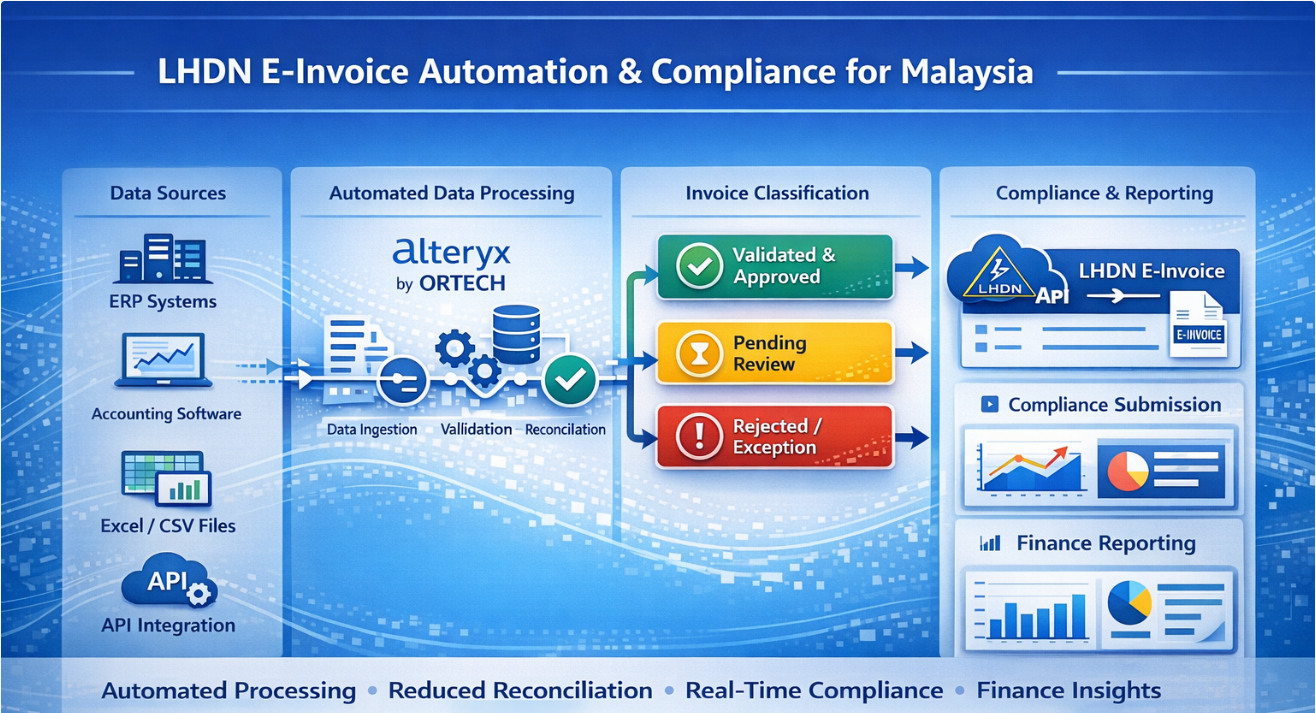
ORTECH uses Alteryx to simplify your digital invoice tracking. Instead of piecing together scattered data, your finance team can rely on repeatable workflows. As a result, they no longer have to check records line by line. Ultimately, ORTECH builds a highly structured approach so your team can focus on real outcomes rather than tedious data prep.
What this means in practice:
- First, we gather and prepare your invoice data consistently.
- Next, the system applies clear rules to treat every reporting cycle the same way.
- Then, the software highlights exactly what needs your immediate attention.
- Consequently, reviews become faster with far fewer manual checks.
- Lastly, the entire process runs reliably on a set schedule.
Key Capabilities Delivered
Analytics automation
The platform handles everything from data collection to final outcome classification.
Standardised validation
Furthermore, the software uses rule-based logic to process all invoices consistently.
Structured outputs
Also, the system generates working files and clear exception reports automatically.
Operational transparency
Ultimately, you gain crystal-clear visibility into unresolved items so you can follow up faster.
From Raw Data to Operational Insight
Your data inputs
- E-invoice transaction files from multiple sources.
- Processing status outputs and reference datasets.
What ORTECH does
- Automates ingestion and standardisation of incoming data.
- Applies reconciliation and validation rules consistently.
- Classifies invoices by processing outcome.
- Generates structured working files and exception outputs.
How does it work for you
- No manual data preparation or consolidation.
- Issues identified earlier in the process.
- Clear, repeatable visibility into processing results.
- Faster and more predictable reporting cycles.
What It Delivers
Business Value & ROI
• First, you easily reduce manual effort during high-volume processing.
• Second, you improve your data accuracy by using standard validation rules.
• Furthermore, you increase your visibility into exception handling.
• Ultimately, you support growing invoice numbers easily without increasing your overhead costs.