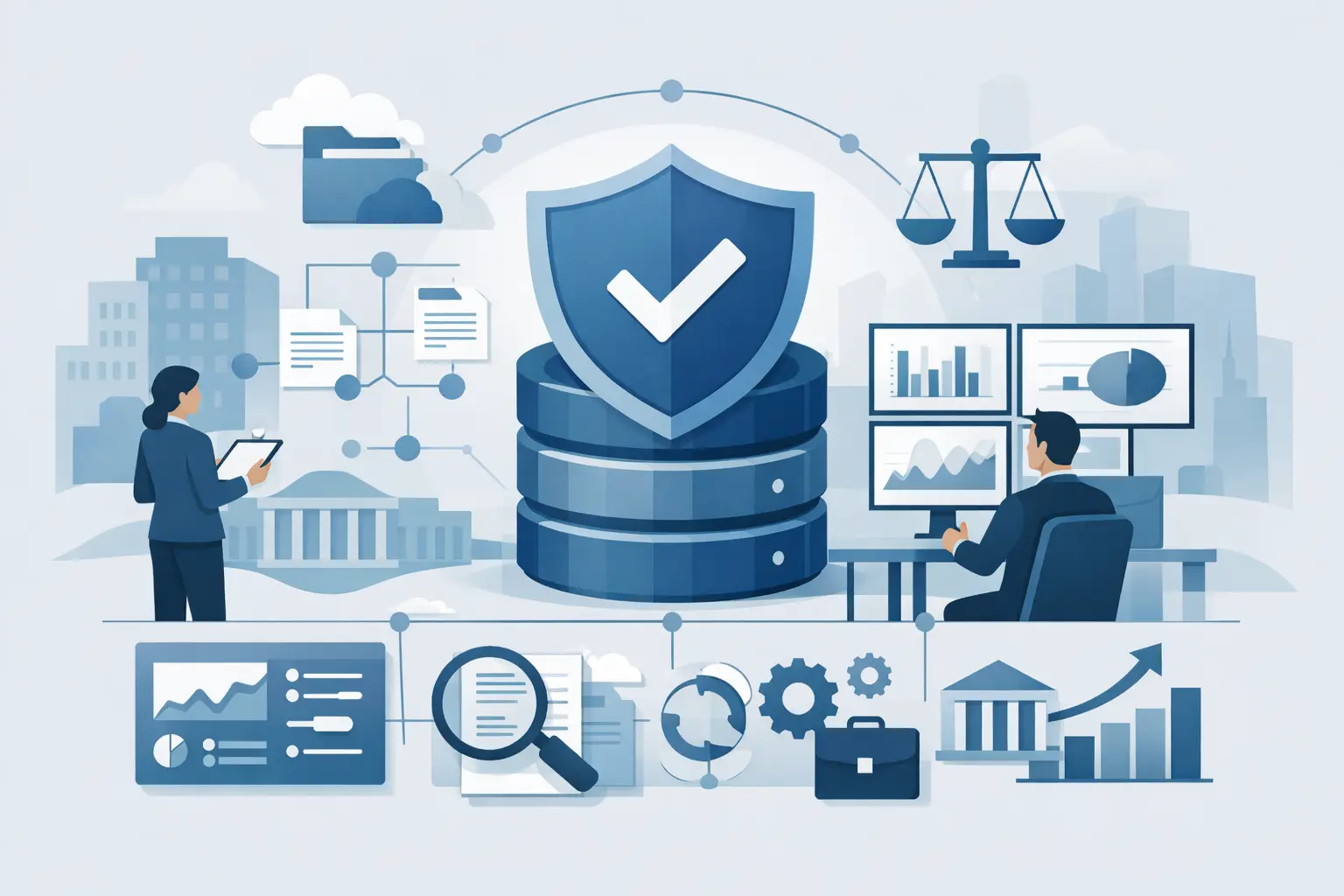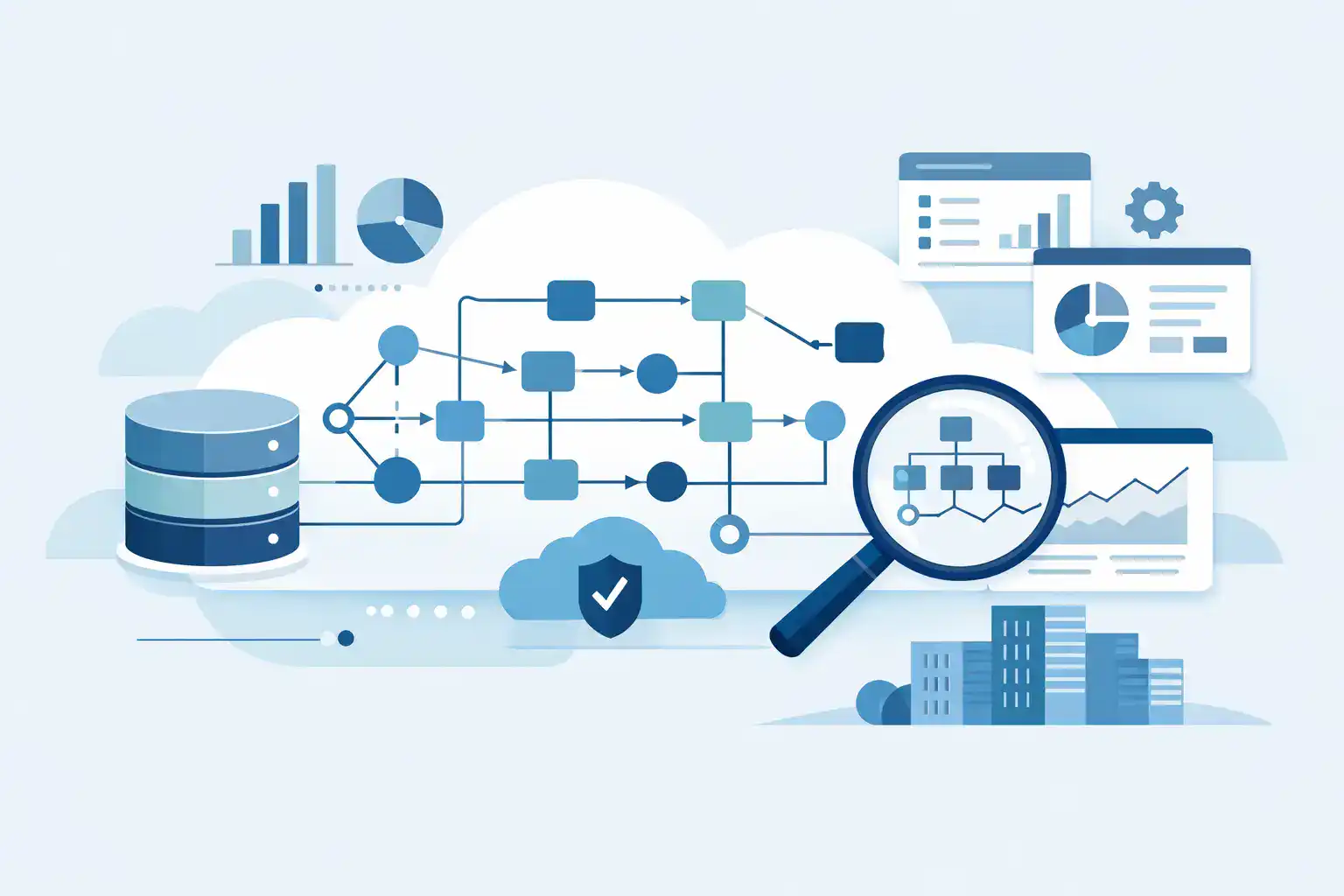
A lakehouse can reduce the distance between operational data, analytics, and AI. It can also concentrate risk if security is treated as a platform feature to configure after data has already been onboarded. This lakehouse security FAQ addresses the questions enterprise leaders should resolve before expanding access, connecting sensitive domains, or scaling AI workloads.
For regulated institutions, the issue is not simply whether a platform offers encryption or role-based access control. The harder question is whether security, governance, and operational accountability can remain consistent as data moves across teams, environments, and use cases. A secure lakehouse must support faster insight without weakening policy enforcement, auditability, or data sovereignty.
Lakehouse Security FAQ: Core Enterprise Questions
What makes lakehouse security different from traditional data warehouse security?
Traditional data warehouses generally centralize structured, curated data and operate within a relatively controlled set of reporting and analytics workflows. A lakehouse extends that model by bringing together structured, semi-structured, and unstructured data, often supporting data engineering, business intelligence, machine learning, and AI from the same foundation.
That flexibility changes the security challenge. More users, tools, workloads, and data types may interact with the platform. Raw data may be retained alongside refined datasets. A data scientist may require a different access pattern than a financial analyst, while an AI application may retrieve governed data through a service identity rather than a human account.
Security therefore needs to operate at several layers: identity, compute, storage, network, metadata, data classification, and monitoring. A lakehouse is not secure merely because its storage layer is encrypted. It is secure when policy is consistently applied across the full data lifecycle.
Which security controls should be designed first?
Enterprises should begin with identity and data classification, because both determine how every later control will operate. Without a reliable understanding of who is accessing data and what sensitivity level that data carries, permissions become broad, manual, and difficult to review.
A practical baseline includes centralized identity federation, multi-factor authentication, least-privilege access, role or attribute-based authorization, encryption in transit and at rest, and centralized audit logging. The design should also separate duties among platform administrators, data owners, data engineers, and security teams. No single technical account should be able to change policies, access sensitive data, and erase evidence of those actions.
The right starting point depends on the organization. A bank handling customer and transaction data may prioritize fine-grained access, masking, and evidence for regulatory review. A government agency may place greater emphasis on data residency, sovereign hosting, and controlled cross-agency sharing. The common requirement is that controls are designed as part of the data architecture, not layered on after production deployment.
How granular should access control be?
Granularity should reflect risk and business purpose. Broad, environment-level access is easier to administer initially, but it increases exposure and creates weak audit boundaries. At the other extreme, highly customized permissions for every dataset and user can become operationally expensive and slow delivery.
For most enterprises, the appropriate model combines role-based access for standard job functions with attribute-based rules for sensitive domains. A finance user may have access to approved profitability datasets by role, while access to personally identifiable information is further restricted by business unit, location, clearance, or approved purpose.
Controls should extend beyond tables. Column-level security, row-level filters, dynamic masking, and controlled access to files are often necessary when datasets contain mixed sensitivity levels. Service accounts for pipelines, dashboards, APIs, and AI applications deserve the same discipline as human identities. Their permissions should be narrowly scoped, rotated, monitored, and tied to an accountable owner.
Is data masking enough to protect sensitive information?
No. Masking is valuable, but it is one control within a broader protection model. It can reduce exposure in analytics, development, and self-service scenarios by concealing values such as identification numbers, account details, or contact information. However, masking does not replace access approval, encryption, data minimization, or logging.
The organization must also consider re-identification risk. A masked field may still be inferred when combined with other attributes, particularly in small populations or highly detailed datasets. Data owners and governance teams should classify data, define permitted uses, and evaluate whether a dataset can be safely shared at the required level of detail.
For high-risk use cases, tokenization, anonymization, aggregation, or privacy-preserving synthetic data may be more appropriate than masking alone. The correct choice depends on whether the recipient needs to identify an individual, analyze a pattern, test a process, or train a model.
Governance Is a Security Control, Not a Separate Program
Why does metadata matter to lakehouse security?
Metadata provides the context that makes security enforceable. It identifies what a dataset contains, who owns it, where it originated, how it has been transformed, and which policies apply. Without trusted metadata, security teams may know that an object exists but cannot reliably determine whether it contains regulated data, whether it is approved for AI use, or whether its access is justified.
A governed catalog should capture classification, lineage, retention expectations, business definitions, ownership, and sensitivity labels. This enables policy to follow the data as it moves from ingestion through transformation and consumption. It also improves incident response. When a source is compromised or a policy changes, teams can identify affected downstream datasets, reports, and models more quickly.
For executives, the value is operational as well as regulatory. Better metadata reduces duplicated datasets, shortens approval cycles, and gives decision-makers greater confidence that metrics and AI outputs are based on authorized, understood data.
How should a lakehouse support data sovereignty and residency requirements?
Data sovereignty is not solved by selecting a region for storage. It requires a clear understanding of where data is stored, processed, backed up, logged, and accessed from. It also requires visibility into third-party services, support processes, disaster recovery arrangements, and cross-border replication.
Organizations should define which data domains must remain within a specific jurisdiction, which may be processed across approved locations, and which require additional approval before movement. These policies need to be translated into technical controls such as regional deployment patterns, network boundaries, encryption key management, replication restrictions, and controlled administrative access.
This is especially relevant for financial institutions, public-sector organizations, and GLCs operating across ASEAN. Requirements can vary by jurisdiction and by data classification. The architecture should support these differences without forcing teams to build unmanaged local copies of data outside the governed platform.
What logging and monitoring evidence should leaders expect?
A defensible lakehouse generates evidence across authentication, authorization, data access, policy changes, administrative actions, pipeline execution, and exports or sharing events. Logs should be centralized, retained according to policy, protected from alteration, and available to security operations and audit functions.
Monitoring should focus on meaningful behaviors, not only system availability. Examples include unusually large data reads, access to sensitive domains outside normal working patterns, repeated authorization failures, changes to privileged roles, and service identities accessing data beyond their stated purpose. Alerts require ownership and response procedures. A dashboard without an accountable team is not a control.
Leaders should also require periodic access reviews. These reviews confirm that permissions still match current roles, projects, and business need. They are particularly important after reorganizations, mergers, vendor changes, and large-scale data migrations.
Securing AI and Advanced Analytics Workloads
Does AI create new lakehouse security risks?
Yes. AI expands the number of ways data may be retrieved, transformed, exposed, or inferred. Retrieval-based applications can surface sensitive content if source permissions are not enforced at query time. Model training can incorporate data that was approved for reporting but not for automated decisioning. Prompt inputs, model outputs, and evaluation datasets can all create new records that require governance.
An AI-ready lakehouse should apply the same ownership, classification, lineage, and access requirements to AI data products as it does to conventional analytics assets. Teams need clear rules for which datasets are approved for experimentation, model development, production inference, and human review.
Security teams should also assess whether model outputs could reveal restricted information, whether prompts are retained, and whether external model services create data transfer or residency concerns. The answer is not to prohibit AI use. It is to establish controlled patterns that allow experimentation while protecting institutional data and customer trust.
How can an enterprise migrate securely to a lakehouse?
Migration is a security redesign opportunity, not a lift-and-shift exercise. Before moving data, organizations should inventory source systems, classify data, identify owners, map lineage, and remove obsolete extracts where possible. Moving unknown or unnecessary data into a modern platform simply modernizes the risk.
A phased approach usually works best. Start with a defined domain where business value, ownership, and security requirements are clear. Establish reusable patterns for ingestion, access control, quality checks, logging, and release management. Then extend those patterns across additional domains rather than allowing each project to create its own security model.
Security testing should include misconfiguration scenarios, privilege escalation, data exfiltration paths, and recovery procedures. Resilience matters as much as prevention. Teams must know how to revoke access, isolate compromised workloads, restore trusted data, and demonstrate what happened.
The strongest lakehouse security programs treat trust as an operating capability. When policy, architecture, data ownership, and workforce practices mature together, the organization can expand analytics and AI use with greater speed and far fewer unmanaged exceptions.