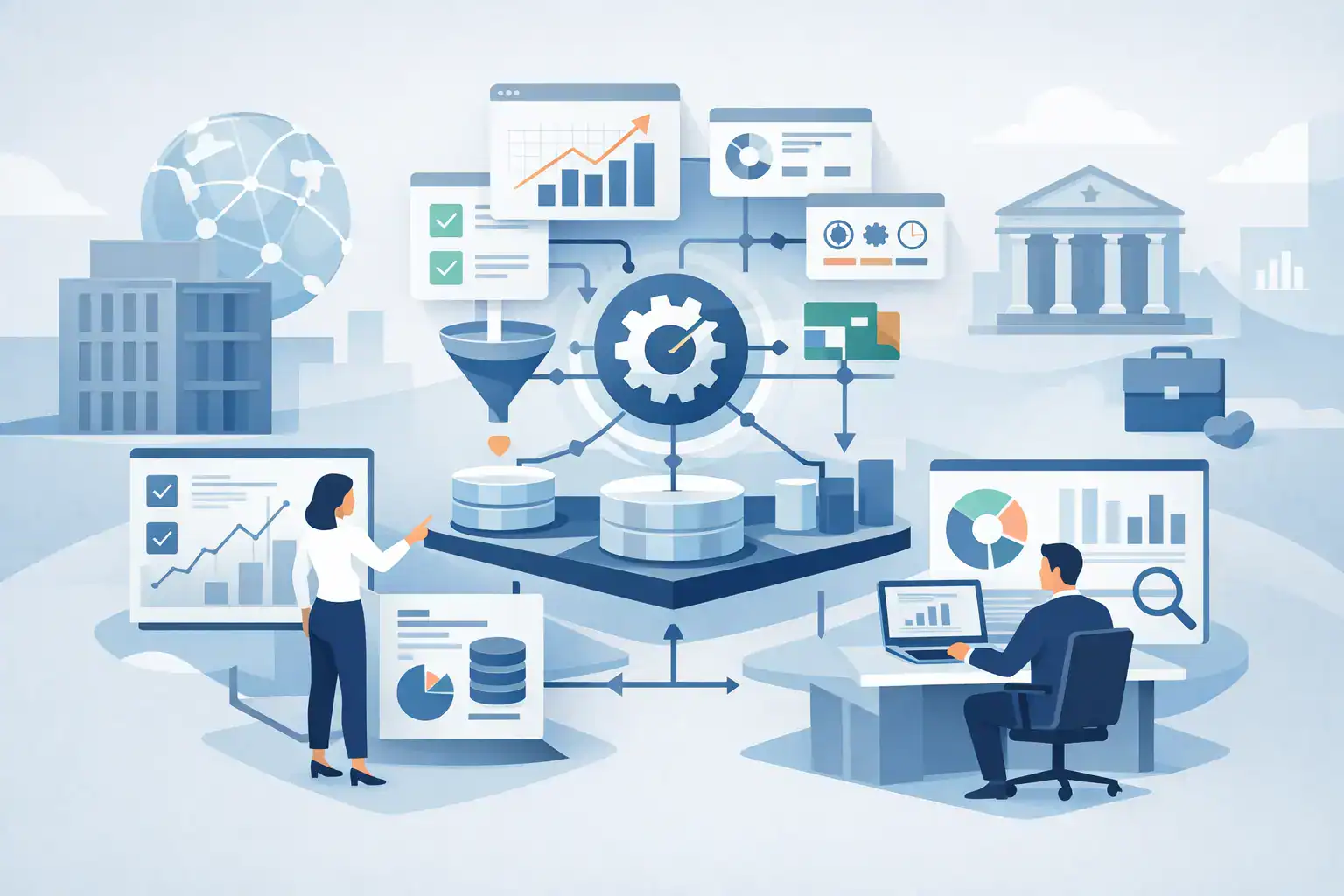
A GLC can have capable people, established systems, and years of operational data, yet still struggle to answer a basic executive question: what is happening across the organization right now? GLC data transformation addresses that gap by turning fragmented operational records into trusted, governed intelligence that supports action.
For Government-Linked Companies, the challenge is rarely a lack of data. It is the reality that finance, procurement, operations, customer service, asset management, risk, and subsidiary teams often hold different versions of the same business fact. Reports can be manually assembled, definitions can vary by department, and decision cycles can depend on reconciliation rather than insight. Transformation must therefore be treated as an institutional capability, not a dashboard project.
Why GLC data transformation requires a different approach
GLCs operate with a dual responsibility. They must deliver commercial performance while meeting public-interest, governance, and accountability expectations. This raises the standard for data programs. A fast proof of concept that cannot be audited, scaled, secured, or adopted across business units may demonstrate technical potential, but it does not create enterprise value.
The complexity is also organizational. Many GLCs manage diverse portfolios, legacy applications, semi-autonomous subsidiaries, and critical operational processes that cannot simply be interrupted for a technology replacement. Data transformation must work around these realities while progressively improving the underlying architecture.
This is why a platform-first approach alone is insufficient. A modern lakehouse, cloud environment, or analytics tool can provide essential capabilities, but outcomes depend on how data is modeled, governed, owned, and embedded in decision processes. Leaders should ask not only whether data can be centralized, but whether it can be trusted for finance, regulatory reporting, operational planning, and AI-supported use cases.
Start with decisions, not data migration
The most effective programs begin with the decisions that need to improve. For example, a transport, utilities, property, or services GLC may need earlier visibility into asset reliability, project delivery risk, cash flow exposure, supplier performance, or customer service bottlenecks. A transformation initiative should identify the decisions that matter, the data required for each one, and the operational actions that follow.
This focus prevents a common failure mode: moving large volumes of data into a new environment without a clear business model for its use. Data migration can be necessary, particularly where legacy platforms limit access or scale. But migration is an engineering activity. Transformation occurs when trusted data changes how leaders allocate capital, manage risk, prioritize work, or improve service delivery.
A practical starting point is to define a small number of high-value decision domains. Each domain should have an accountable business owner, measurable outcome, agreed definitions, source-system lineage, and a realistic adoption path. This creates a disciplined bridge between executive priorities and data engineering work.
Establish a common language for critical metrics
Terms such as revenue, active customer, project completion, operating cost, and asset availability may appear straightforward. Across a complex organization, they often are not. Different cutoff dates, calculation logic, organizational hierarchies, or exclusions can produce conflicting results that erode confidence in reporting.
A governed semantic layer resolves this problem by establishing reusable business definitions and applying them consistently across reports, analytics, and operational applications. It does not eliminate legitimate differences in perspective. Instead, it makes those differences explicit, approved, and traceable.
For senior leadership, this reduces time spent debating whose report is correct. For data teams, it reduces repetitive reconciliation work. For audit, risk, and compliance functions, it creates clearer evidence of how important figures were produced.
Build an AI-ready data foundation in stages
AI readiness is often described as a technology choice. In practice, it is a data discipline. Predictive models, document intelligence, and generative AI applications depend on accessible, high-quality, well-classified information. If source data is incomplete, poorly governed, or disconnected from operational context, AI can amplify inconsistency rather than improve decisions.
An AI-ready foundation should bring together several capabilities: reliable ingestion from core systems, scalable storage and processing, analytics engineering to create usable data products, governance controls, and monitored delivery into business tools. The architecture may operate in cloud, on-premises, or hybrid environments depending on security, sovereignty, latency, and existing investment considerations.
The right sequence depends on the organization. A GLC with severe reporting fragmentation may first prioritize a governed finance and performance data product. Another with extensive field operations may focus on asset, maintenance, and work-order data. The objective is not to centralize every dataset immediately. It is to establish repeatable patterns that make each subsequent use case faster, safer, and less dependent on manual intervention.
Treat data products as managed enterprise assets
A useful data product is more than a table in a warehouse. It has a defined purpose, business owner, data owner, quality expectations, refresh schedule, access rules, documentation, and consumers. It is engineered for reuse rather than created once for a single report.
For instance, a supplier performance data product may combine procurement transactions, contract milestones, delivery records, quality incidents, and payment status. Procurement leaders can use it to manage vendor performance, finance can assess exposure, and risk teams can identify concentration or delivery risk. The same governed asset supports multiple decisions without recreating logic in separate spreadsheets.
This approach also supports capability transfer. Internal teams learn how to manage data as a product, rather than relying indefinitely on specialized external resources to sustain every report or pipeline.
Governance must enable delivery, not delay it
In regulated and publicly accountable environments, governance cannot be deferred until after data has been consolidated. Access control, data classification, retention, lineage, quality monitoring, and approval workflows need to be built into the delivery model from the start.
However, governance that is detached from engineering can become a bottleneck. Policies that require excessive manual review for routine access or changes can encourage workarounds, shadow spreadsheets, and uncontrolled data extracts. The better model is policy-driven governance: standards are defined centrally, then enforced consistently through platform controls, reusable templates, and automated checks.
Data stewardship is especially important. Technology teams can implement controls, but business owners must remain accountable for meaning, fitness for use, and acceptable quality thresholds. A practical operating model distinguishes between executive sponsorship, domain ownership, stewardship, platform engineering, and analytics delivery. Without that clarity, issues are identified but not resolved because no one owns the decision.
Measure progress through operational outcomes
Platform adoption metrics matter, but they are not sufficient. A higher number of dashboards or users does not necessarily indicate better decisions. GLC leadership should track transformation through outcomes tied to institutional priorities.
Relevant measures may include reduced reporting-cycle time, fewer manual reconciliations, improved data-quality scores for critical elements, faster exception resolution, stronger audit traceability, better forecast accuracy, or reduced time required to prepare regulatory and management reporting. For operational domains, measures may include improved asset uptime, lower project variance, shorter procurement cycle times, or earlier risk detection.
These outcomes should be baselined before major implementation activity begins. Otherwise, teams may successfully deploy technology without being able to demonstrate the value of change. Baselines also make trade-offs visible. A broad enterprise program may take longer to establish common foundations, while a narrowly targeted use case may deliver benefits faster but create another isolated solution if not aligned to enterprise standards.
Create the operating model alongside the platform
The lasting constraint in many transformation programs is not infrastructure. It is the gap between what the platform can do and what the organization is prepared to operate. Data engineers, analytics engineers, architects, stewards, security teams, and business leaders need shared ways of working.
This includes clear intake and prioritization processes, engineering standards, release management, quality controls, ownership models, and training pathways. It also requires leaders to make data responsibilities part of normal management practice. When business teams see data quality as solely an IT issue, source problems persist. When data teams work without business context, technically correct outputs can fail to answer the question that matters.
ORTECH approaches this work as both a data architecture and organizational capability challenge. The goal is not only to implement modern data foundations, but to help institutions establish the practices required to sustain governed analytics and AI adoption over time.
The practical test for leadership
A credible transformation roadmap should allow leaders to answer a few direct questions. Which decisions will improve first? Which data domains are most critical? Who owns the definitions and quality of that data? How will access, lineage, and compliance be managed? What capability will remain with internal teams after implementation?
If those answers are vague, the program is likely still technology-led rather than outcome-led. If they are clear, the organization can sequence investment with greater confidence, deliver early value, and build toward an integrated intelligence capability.
The most useful next step is often not a large-scale migration mandate. It is a focused assessment of one decision domain where fragmented data is creating measurable operational friction. Solve that domain with sound engineering and governance, then use the resulting pattern to build institutional momentum.