

ORTECH’s analytics strategy consulting helps Malaysian organisations turn data ambition into a practical roadmap. We align priorities, governance, funding and delivery so analytics investments support measurable business outcomes.
Analytics Strategy Consulting: Executive Overview
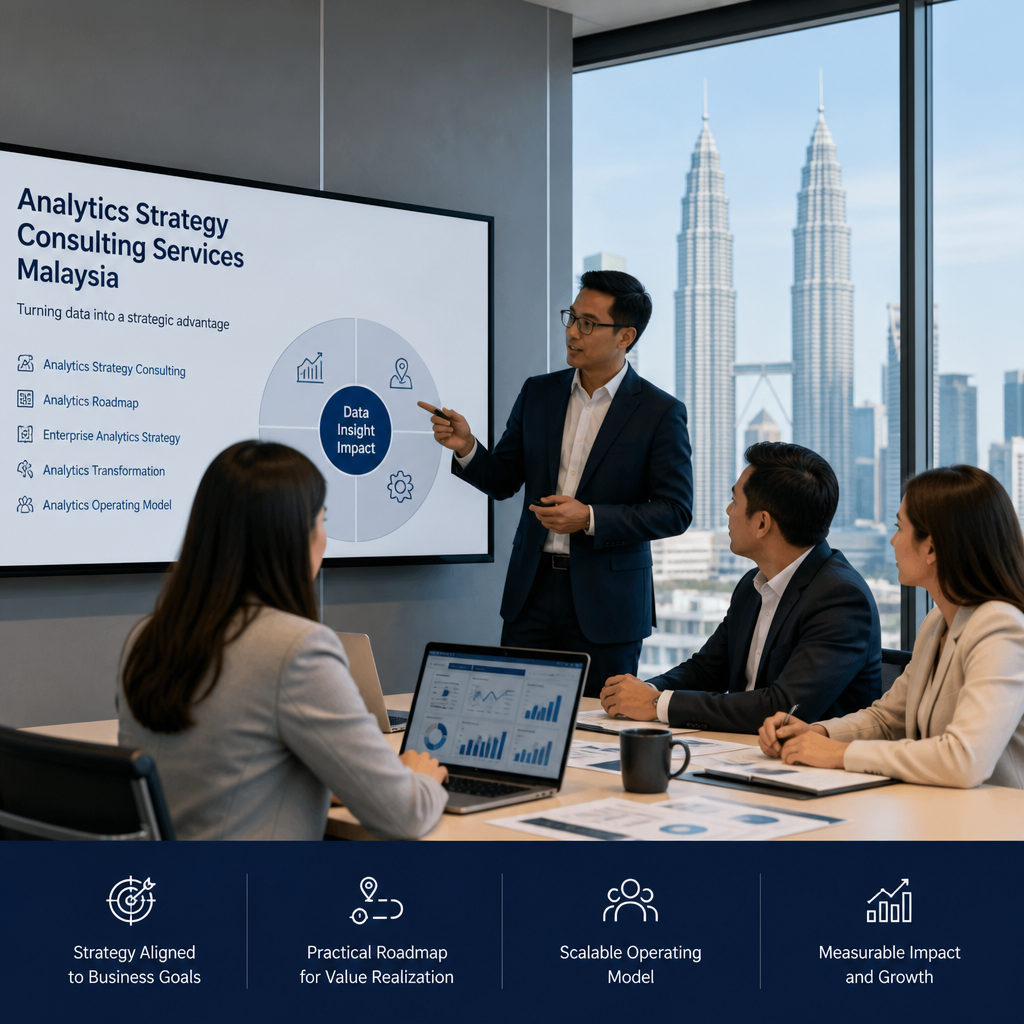
For another helpful perspective, this Analytics Strategy Consulting highlights practical trade-offs for buyers. Analytics has become a board-level capability because it supports operating efficiency, regulatory confidence, customer outcomes and enterprise AI readiness. However, many organisations still invest in data platforms, reporting tools and automation initiatives without a unified enterprise analytics strategy to guide priorities, governance, funding and adoption.
OR Technologies Sdn Bhd (ORTECH) provides analytics strategy consulting and analytics roadmap services for Government, BFSI, GLC and enterprise organisations across Malaysia. We help leadership teams translate strategic objectives into a practical, governed and measurable analytics transformation agenda.
For another helpful perspective, this Analytics Strategy Consulting highlights practical trade-offs for buyers. An effective analytics roadmap is not a technology procurement plan. Instead, it serves as an enterprise blueprint for how data, analytics, automation and AI will create sustained business value. It defines the target operating model, priority business domains, data governance requirements, platform architecture, delivery sequencing, investment rationale and performance measures needed to move from fragmented analytics activity to an accountable enterprise capability.
Established in 2006, ORTECH combines Analytics Engineering expertise with deep experience in Analytics Automation, AI-Ready Data Platforms, Data Lakehouse Architecture, Enterprise AI and Enterprise Data Governance. As a result, organisations can make disciplined investment decisions, accelerate value delivery and build the foundations required for scalable, trustworthy analytics.
Analytics Strategy Consulting: Business Challenges
Enterprise leaders are under pressure to deliver better decisions, more efficient operations and stronger governance while managing a growing data estate. Common challenges include:
- Fragmented analytics investments across business units, departments and subsidiaries, resulting in duplicated tools, datasets and reporting effort.
- Unclear strategic priorities, where analytics initiatives are selected based on immediate requests rather than enterprise value, risk exposure or long-term capability needs.
- Low confidence in data, caused by inconsistent definitions, weak ownership, incomplete lineage and limited controls over critical data elements.
- A disconnect between business and technology, where platform modernisation proceeds without a clear operating model, adoption plan or measurable business use case portfolio.
- Limited scalability of analytics delivery, with heavy dependence on manual reporting, specialist teams and one-off data preparation processes.
- AI initiatives without sufficient data readiness, including insufficient data quality, limited governance, unclear accountability and fragmented access controls.
- Regulatory and audit pressure, particularly in Government, banking and financial services, where traceability, data privacy, model oversight and evidence-based reporting are essential.
- Uncertain return on investment, with difficulty demonstrating how analytics spending contributes to revenue, cost efficiency, risk reduction, service outcomes or strategic performance.
- Lack of digital sovereignty considerations, where data residency, architecture choices, access governance and vendor dependency must be evaluated in the context of national, sectoral and organisational requirements.
These challenges cannot be resolved through platform deployment alone. They require an integrated enterprise analytics strategy, supported by a clear governance model, a disciplined implementation roadmap and an operating model designed for sustained adoption.
Analytics Strategy Consulting: ORTECH Approach
ORTECH applies a business-led, architecture-informed approach to analytics transformation. We work with executive sponsors, business leaders, data owners, technology teams, internal audit and risk functions to establish a roadmap that is practical, investment-ready and aligned to organisational priorities.
Our methodology is structured around five dimensions:
Strategic alignment
We connect analytics priorities to corporate strategy, regulatory obligations, public service mandates, customer objectives, financial performance and operational transformation goals.Value and use-case prioritisation
We identify, assess and sequence high-value analytics, automation and AI opportunities based on business impact, feasibility, data readiness, risk profile and time to value.Target operating model
We define the roles, decision rights, governance forums, service delivery structures, funding mechanisms and performance measures needed to operate analytics as an enterprise capability.Data and platform architecture
We assess the current data landscape and define a pragmatic target state that may incorporate AI-Ready Data Platforms, Data Lakehouse Architecture, open data architectures, analytics automation and governed self-service analytics.Roadmap execution and capability uplift
We translate strategy into an actionable, phased delivery plan covering quick wins, foundational initiatives, platform evolution, governance implementation, capability development and change adoption.
The result is an enterprise analytics roadmap that executives can use to make informed decisions about investment, delivery accountability, technology direction and expected outcomes.
Service Capabilities
Enterprise Analytics Strategy Development
ORTECH develops enterprise analytics strategies that establish a common direction across data, reporting, advanced analytics, automation and AI. We assess the organisation’s current maturity, strategic objectives, business demand, operating constraints and technology landscape to define a clear future-state vision.
The strategy addresses the questions leadership teams need answered:
- Which business outcomes should analytics enable?
- Which data domains and use cases should be prioritised?
- What capabilities must be centralised, federated or embedded within business units?
- What governance and accountability model is required?
- Which platforms and architectural principles will support scale, interoperability and digital sovereignty?
- How should investment be sequenced to demonstrate value while building long-term enterprise capability?
Our analytics strategy consulting engagements produce an executive-level decision framework rather than a generic maturity assessment. Moreover, recommendations are tailored to the organisation’s mandate, risk profile, operating model and investment horizon.
Analytics Roadmap and Investment Prioritisation
A robust analytics roadmap converts strategic ambition into a delivery sequence that is realistic, measurable and fundable. ORTECH creates multi-horizon roadmaps that balance immediate business value with the foundational work required for enterprise scale.
We prioritise initiatives using a structured assessment of:
- Strategic alignment and business value
- Revenue, cost, service delivery and risk impact
- Data availability, quality and governance readiness
- Regulatory, security and audit requirements
- Delivery complexity and organisational dependency
- Platform and integration implications
- Change management and adoption requirements
- Estimated investment, benefits and time to value
The resulting roadmap provides a clear view of quick wins, foundational enablers, priority domains, transformation milestones, governance actions and required capability investments. Therefore, it gives CFOs, CIOs, CDOs and transformation leaders a defensible basis for allocating budgets and tracking benefits.
Analytics Operating Model Design
Technology alone does not create an effective analytics function. Organisations require a defined analytics operating model that clarifies how analytics demand is governed, how work is delivered, who owns critical data and how value is measured.
ORTECH designs operating models that address:
- Enterprise, domain and business-unit responsibilities
- Centralised, federated and hybrid delivery structures
- Data ownership, stewardship and accountability
- Demand intake, prioritisation and portfolio management
- Analytics product ownership and lifecycle management
- Self-service analytics guardrails
- Collaboration between business, data, technology, risk and audit teams
- Talent, skills and capability development requirements
- Performance measures for adoption, quality, value and operational effectiveness
The objective is to create a model that enables local business responsiveness without compromising enterprise standards, governance or reuse.
Data Governance and AI Readiness Assessment
Enterprise AI readiness begins with trusted, governed and accessible data. ORTECH assesses the governance, data management and architectural conditions required to support responsible analytics automation and AI adoption.
Our assessment covers:
- Data governance structure, policies and decision rights
- Critical data element ownership and data quality management
- Metadata, cataloguing, lineage and business glossary maturity
- Data access, privacy, classification and retention controls
- Data product and domain management practices
- Model governance, explainability and oversight requirements
- Data integration, interoperability and open architecture principles
- AI use-case readiness and responsible AI controls
- Data residency and digital sovereignty considerations
This capability helps organisations identify the specific barriers preventing scalable AI adoption and prioritise the governance and platform improvements that will have the greatest impact.
Analytics Modernisation and Architecture Advisory
ORTECH provides vendor-neutral advisory for analytics modernisation, including the transition from fragmented reporting environments and legacy data warehouses to scalable, governed analytics architectures.
For a deeper view of modernisation patterns, see our Analytics Modernization Roadmap Guide for Leaders.
We help organisations define the architectural principles and target-state capabilities required for modern enterprise analytics, including:
- Data Lakehouse Architecture
- AI-Ready Data Platforms
- Open data architectures and interoperable data products
- Governed semantic and analytics layers
- Analytics Automation pipelines
- High-performance data access and query acceleration
- Scalable storage and data lifecycle management
- Enterprise reporting and visual analytics environments
- Secure hybrid and cloud deployment models
- Architecture patterns that support digital sovereignty and regulatory requirements
Our recommendations are based on business requirements, governance needs, workload profiles and long-term operating considerations, not on a predetermined technology stack.
Business Outcomes
ORTECH’s analytics strategy and roadmap services are designed to create measurable enterprise outcomes.
Faster Decision-Making
A defined analytics strategy improves access to trusted information, aligns reporting priorities and reduces time spent reconciling inconsistent data. As a result, leaders gain clearer performance visibility and more confidence in the decisions they make.
Improved Operational Efficiency
By prioritising high-impact analytics automation opportunities, organisations can reduce manual data preparation, reporting cycles, spreadsheet-based processes and repetitive control activities. Teams can then redirect capacity toward analysis, exception management and business improvement.
Reduced Business Risk
A disciplined enterprise analytics strategy strengthens oversight of critical data, improves visibility into operational and financial risks, and establishes better controls for data access, lineage, quality and use.
Enhanced Governance and Compliance
Clear data ownership, governance processes and auditability improve compliance with internal policies, sector requirements and regulatory expectations. This is particularly important for Government, BFSI and GLC environments where data accountability is non-negotiable.
Increased Analytics Adoption
A well-designed analytics operating model ensures that capability is built around real business demand. It defines how users access governed data, how analytics products are supported and how adoption is measured across the enterprise.
Improved AI Readiness
By addressing data quality, governance, architecture, operating model and responsible AI requirements, organisations are better positioned to move from isolated AI experimentation to scalable enterprise AI deployment.
Better Return on Data
When analytics investments follow a clear roadmap, leaders can link spending to business outcomes more directly. For example, they can track value from service improvement, cost reduction, risk mitigation and new revenue opportunities.
Related Insight
Teams that want to strengthen analytics foundations can also review What Is Analytics Engineering? to understand how modern data preparation supports reliable analytics delivery.
Reference Source
For a recognised overview of governance and information management principles, see the ISO 8000 data quality standard.