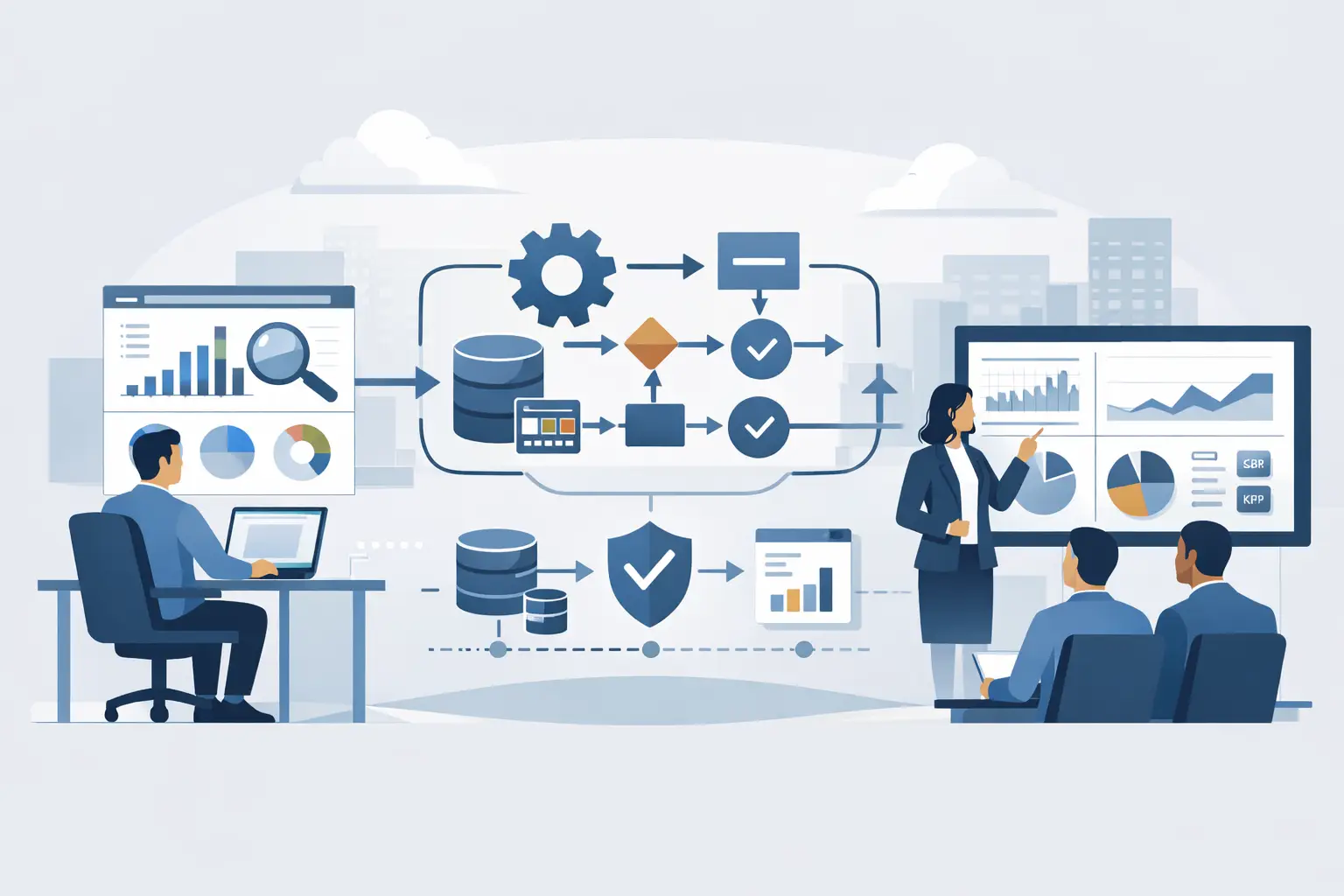
A risk model approves a customer who should have been escalated. A finance team spends three days reconciling two versions of revenue. A public agency cannot explain why a service-demand report changed overnight. These are not simply reporting problems. They are consequences of unreliable data. Why does data quality matter? Because every operational decision, control, model, and customer interaction is only as trustworthy as the information beneath it.
For enterprise leaders, data quality is not a cleansing exercise delegated to IT after a dashboard fails. It is a business capability that determines whether an organization can act with confidence, meet regulatory obligations, and scale analytics or AI without multiplying risk.
Why Does Data Quality Matter for Enterprise Decisions?
Decision intelligence depends on a shared understanding of what the data represents, where it came from, and whether it is fit for a stated purpose. When customer, transaction, asset, or case data differs between systems, senior teams may receive competing answers to the same question. The result is slower decisions, avoidable reconciliation work, and declining confidence in the analytics function.
The cost is often hidden at first. Teams create spreadsheets to compensate for inconsistent source systems. Analysts rebuild logic independently because published datasets are not trusted. Business users export data and apply manual adjustments that cannot be audited or reused. What appears to be flexibility becomes a fragmented operating model, with different decisions based on different versions of the truth.
In banking, a poor address, incorrect customer relationship, or delayed transaction status can affect onboarding, fraud monitoring, credit assessment, and regulatory reporting. In insurance and takaful, incomplete policy or claims data can distort reserving, claims prioritization, and customer service. For government agencies and GLCs, inconsistent master data can weaken program measurement, resource planning, and the ability to demonstrate accountable use of public funds.
Not every defect has the same consequence. A missing optional marketing preference may be inconvenient; an incorrect legal entity, policy status, or exposure value can create material financial and compliance risk. Data quality must therefore be assessed in context. The central question is not whether data is perfect. It is whether it is sufficiently reliable for the decision, process, or regulatory obligation it supports.
Quality is more than accuracy
Accuracy receives the most attention, but a record can be accurate and still be unusable. Enterprise data quality usually includes completeness, timeliness, consistency, validity, uniqueness, and integrity.
Completeness asks whether the required values are present. Timeliness asks whether information is available when the process needs it. Consistency asks whether the same business concept has the same value and definition across systems. Validity checks whether a value conforms to an accepted format or business rule. Uniqueness prevents duplicate records from inflating counts or fragmenting a customer view. Integrity confirms that relationships between records, such as a loan and its borrower or a claim and its policy, remain intact.
These dimensions can conflict. A team may publish data quickly before all validation checks are complete, improving timeliness while reducing confidence in accuracy. A highly restrictive validation rule may prevent bad records from entering a platform, but it can also interrupt critical operations if legitimate exceptions are not handled well. Effective quality management makes such trade-offs explicit rather than leaving them to individual teams.
The Compounding Impact of Poor Data Quality
Data defects rarely remain isolated. A flawed source field can move through ingestion pipelines, lakehouse tables, semantic models, dashboards, operational workflows, and machine learning features. Each downstream transformation can make the defect harder to identify and more expensive to correct.
This is why modern data architecture does not eliminate the quality challenge. A lakehouse can consolidate data and improve engineering discipline, but it will not automatically resolve conflicting definitions, missing reference data, or weak ownership. In fact, modernization can expose long-standing defects that were previously contained within departmental systems. That visibility is valuable, provided the organization has a structured way to prioritize and remediate issues.
Poor quality also changes organizational behavior. When people do not trust a KPI, they question every report. When a risk team cannot trace a figure to its source, review cycles lengthen. When frontline users must correct records repeatedly, adoption of new tools declines. The organization loses more than data accuracy. It loses speed, accountability, and confidence.
AI readiness depends on trusted inputs
AI initiatives make the stakes more visible. Models learn patterns from available data, including inconsistencies, gaps, outdated classifications, and historical process errors. A model can appear technically sound in testing while producing unreliable outcomes in production because the data feeding it has changed, drifted, or never represented the business process accurately.
For regulated institutions, explainability and traceability are as important as model performance. Leaders need to know which sources informed an outcome, which transformations were applied, who approved the business logic, and whether critical data controls operated as intended. Without this evidence, an AI use case may be difficult to scale beyond experimentation.
The objective is not to delay AI until every dataset is flawless. That standard is unrealistic. The objective is to establish quality thresholds, lineage, monitoring, and accountable ownership for the data that matters to a given use case. A customer service assistant may tolerate some noncritical profile gaps. A credit, fraud, or benefits decision process requires much stricter controls.
From Data Cleanup to Data Quality Management
Organizations often begin with a cleanup program: remove duplicates, standardize formats, and repair missing values. These actions can produce immediate value, but they do not address why defects enter the environment. Sustainable improvement requires data quality management embedded in the operating model and data lifecycle.
It begins with critical data elements. Rather than trying to measure every field across the enterprise, identify the data that drives high-value decisions, material risks, key reports, customer journeys, and statutory obligations. Assign measurable rules to those elements. For example, a customer identifier may need to be unique and present; a transaction date may need to fall within a permitted range; a reporting measure may need to reconcile to an approved source.
Each rule needs an owner who understands the business impact of failure, not only the technical implementation. Data stewards, domain owners, engineers, and control teams have different responsibilities. Business owners define fitness for purpose and prioritize remediation. Engineers implement checks and observability. Governance functions set policy, thresholds, evidence requirements, and escalation paths. Clear accountability prevents quality from becoming everyone’s concern and no one’s responsibility.
Design controls into the data lifecycle
The strongest controls occur close to where defects originate. If a source application permits invalid values, downstream teams will continually absorb the cost. Some issues must be corrected at ingestion or transformation, but recurring defects should trigger a review of source processes, reference data, training, and application controls.
Automated testing should be part of analytics engineering, not an afterthought. Pipelines can test schema changes, null rates, duplicate volumes, referential relationships, freshness, and reconciliation results before data reaches executive dashboards or operational consumers. Monitoring then detects degradation after deployment. These controls should produce understandable alerts tied to business impact, not a volume of technical notifications that teams learn to ignore.
Metadata and lineage provide the context that makes quality issues actionable. When a metric fails a check, teams need to identify the affected source, transformation, owner, downstream reports, and decision processes. This shortens investigation time and gives leaders a clearer view of exposure. It also supports auditability in hybrid, cloud, and sovereign data environments where information may cross several platforms and teams.
Measuring Value Without Reducing Quality to a Score
A single enterprise data quality score can be useful for executive reporting, but it can also conceal meaningful risk. An overall score may look healthy while one critical regulatory field is failing at an unacceptable rate. Leaders should pair aggregate measures with domain-level indicators that show materiality, trend, root cause, remediation status, and business impact.
Useful measures include the percentage of critical elements meeting agreed thresholds, time to detect and resolve incidents, recurrence of known defects, reconciliation breaks, and the number of decisions or reports affected. Where possible, connect these measures to operational outcomes: reduced manual review, faster financial close, fewer customer corrections, improved risk-control coverage, or reduced reporting rework.
The target should evolve with the organization. A newly consolidated platform may initially focus on visibility and baseline measurement. A mature data product environment may enforce service-level expectations for freshness, availability, and quality. Different domains will need different thresholds because the consequences of error differ.
Data quality becomes a strategic advantage when it is treated as part of how the enterprise operates, not as a periodic remediation campaign. Start with the decisions that carry the greatest value or risk, make quality expectations explicit, and build controls where data is created and transformed. Over time, trusted data gives leaders something more valuable than cleaner reports: the ability to move faster without losing control.