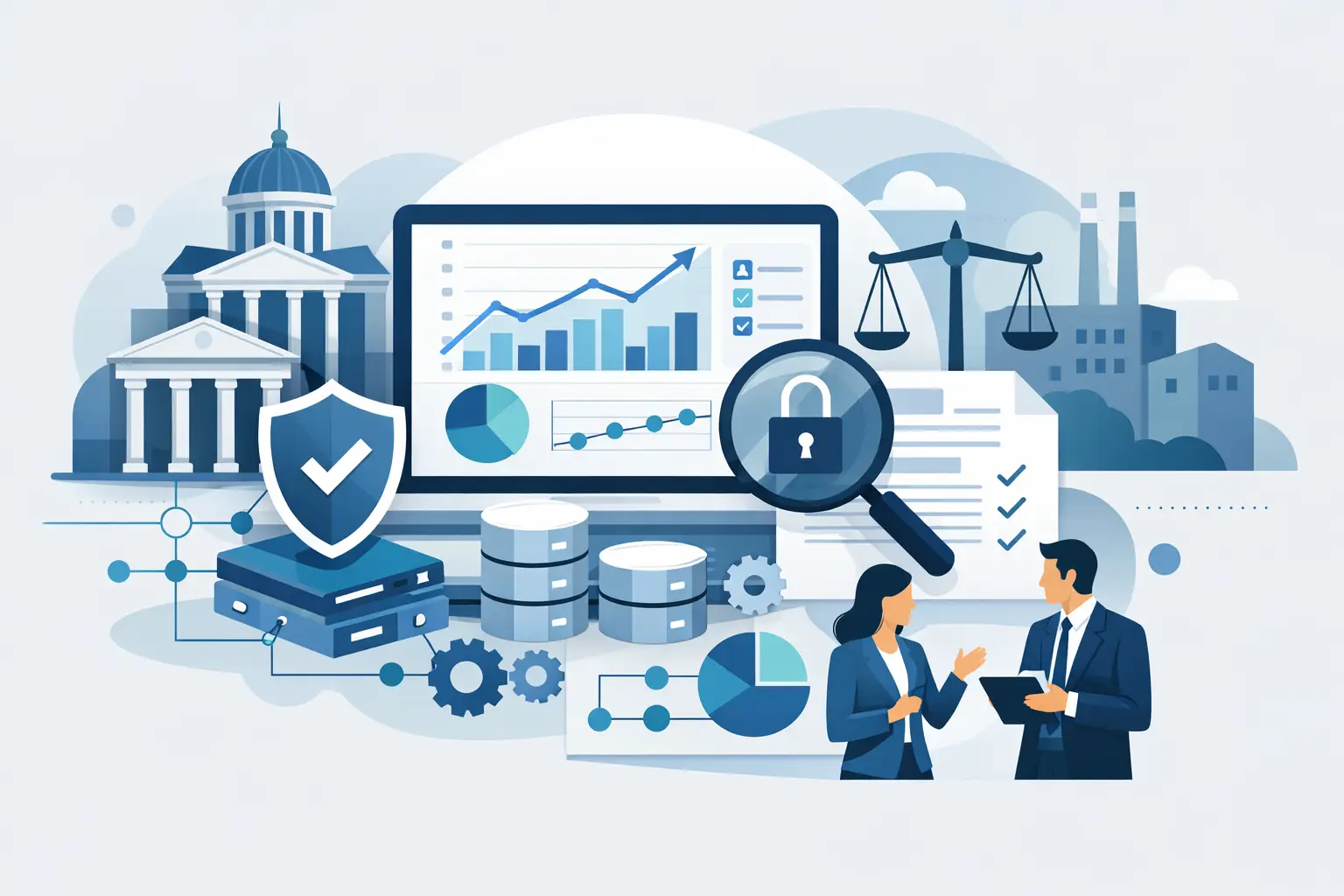
A finance team may spend days reconciling source files before a risk committee sees a dashboard. In that situation, Alteryx One vs Tableau is not a choice between two versions of reporting. It is a decision about where analytical work happens, who can repeat it, and how leaders can trust the result.
For Malaysian banks, insurers, takaful operators, government agencies, and GLCs, the most effective answer is often not an either-or deployment. Alteryx One and Tableau address different points in the analytics lifecycle. One prepares, automates, and governs analytical processes; the other communicates metrics and enables users to explore performance. The architecture around them – including a governed lakehouse or enterprise data platform – determines whether that division of labor scales.
Alteryx One vs Tableau: The Core Difference
Alteryx One is centered on analytics automation. It gives analysts and technical teams a visual, code-friendly environment to ingest, profile, join, cleanse, transform, and analyze data through repeatable workflows. The emphasis is on turning manual analytical procedures into managed processes that can be reviewed, scheduled, reused, and operationalized.
Tableau is primarily a visual analytics and business intelligence platform. It helps business users explore curated data through dashboards, reports, and interactive visualizations. Its strength is helping decision-makers identify patterns, monitor operational performance, and ask follow-up questions without waiting for a static reporting cycle.
Put simply, Alteryx One is typically closer to the analytical production line; Tableau is closer to the decision interface. Tableau can perform calculations and data preparation within its own environment, while Alteryx can produce outputs and visual insights. Yet treating either product as a full substitute for the other can create avoidable gaps.
A treasury reporting team, for example, may use Alteryx workflows to standardize inputs from core banking extracts, finance systems, spreadsheets, and approved reference data. The team can then publish validated datasets for Tableau dashboards used by finance leaders. The value is not merely a faster chart. It is a traceable route from raw inputs to management information.
Why Malaysian Regulated Enterprises Need Both Layers
In banking and financial services, reporting processes often cross multiple systems, product lines, and control owners. Credit risk, liquidity monitoring, financial close, reconciliations, fraud analysis, and internal audit can all depend on data that is fragmented or delivered on inconsistent schedules. A dashboard can expose a discrepancy, but it does not necessarily resolve the upstream process that caused it.
That distinction matters where organizations must demonstrate data lineage, controlled access, and repeatable processes. Bank Negara Malaysia’s expectations for sound risk management and technology controls, alongside obligations under the Personal Data Protection Act 2010 when personal data is processed, make informal spreadsheet-driven workflows increasingly difficult to defend. The specific control design depends on the institution, its systems, and applicable policy requirements, but the operational principle is clear: critical metrics require an explainable chain of evidence.
For an insurer or takaful operator, the same pattern appears in claims, underwriting, actuarial, reinsurance, and regulatory reporting. Analysts may receive policy, claims, channel, and third-party data in different formats. Alteryx One can help standardize and document the preparation logic. Tableau can make approved loss ratios, claims turnaround trends, or portfolio movements visible to underwriting and executive teams. Neither capability removes the need for actuarial review, data ownership, or formal sign-off.
Government agencies and GLCs face a related challenge. Service delivery and performance reporting can be slowed by manual consolidation across departments and agencies. An automated workflow can make the preparation process more consistent, while governed dashboards can make indicators accessible to authorized stakeholders. However, public-sector use cases must be designed with appropriate data classification, retention, access, and hosting requirements rather than assuming a cloud-only model.
Where Alteryx One Creates Enterprise Value
The strongest case for Alteryx One begins with a process that is frequent, error-prone, and difficult to reproduce. Common examples include monthly finance reconciliation, regulatory data assembly, audit sampling, exception detection, or claims data enrichment. These are not glamorous use cases, but they are often where analytical modernization produces the clearest operational improvement.
Its visual workflows allow domain specialists to express preparation and analytical logic in a form that is easier to inspect than a chain of manually edited files. Engineering teams can apply standards for connections, credentials, scheduling, testing, documentation, and promotion across development and production environments. This helps preserve business ownership without treating self-service analytics as uncontrolled self-service.
Alteryx One also has a growing AI-assisted direction. Capabilities and access can vary by edition, licensing, region, and release, so enterprise teams should validate availability against their planned deployment. Features associated with the platform include Ask Alteryx, AI-assisted workflow capabilities, and an AI Tool Palette. Alteryx has also introduced capabilities and concepts around Agent Studio, Alteryx Agents, Skills, and an MCP Server. These should be assessed as part of a governed operating model, not as a reason to allow autonomous access to sensitive enterprise data.
For a Malaysian financial institution, a sensible approach is to begin with bounded tasks: explaining an approved workflow, assisting with documentation, identifying data quality exceptions, or helping analysts construct a controlled analytical process. Human review remains essential for regulatory interpretation, credit decisions, fraud investigations, model outputs, and any use involving confidential or personal data.
Tableau’s Role in Decision Intelligence
Tableau is most valuable after an organization has defined trusted metrics and made curated data available. It gives executives and operational teams an accessible way to monitor KPIs, compare segments, and explore exceptions. A chief financial officer may need a consolidated view of close progress; a head of operations may need to examine service levels by branch, region, or product; a risk leader may need to inspect trends before initiating a deeper investigation.
The limitation is not Tableau itself. The limitation arises when dashboards become the only analytics strategy. If each dashboard contains separate calculations, extracts, and business definitions, the organization can create multiple versions of the truth. Analysts then spend more time reconciling reports than interpreting what the data means.
A stronger pattern is to centralize critical transformation and metric logic in governed workflows and data platforms, then use Tableau to distribute and interrogate approved information. This does not require every calculation to leave Tableau. Lightweight, audience-specific calculations may belong in the visualization layer. Material business rules, recurring transformations, and cross-functional definitions generally deserve stronger engineering discipline.
The Lakehouse and AI-Ready Data Question
Neither Alteryx One nor Tableau should be expected to replace the enterprise data platform. Large Malaysian organizations increasingly need an architecture that can accommodate on-premises, cloud, and hybrid workloads while respecting sovereignty, security, and performance requirements.
A modern lakehouse approach can provide shared storage, governed tables, scalable compute, and controlled access to structured and semi-structured data. Technologies such as Apache Iceberg can support open table management patterns, while query and data-access layers can help organizations work across distributed sources. The technology choice should follow the operating model, not the reverse.
Within this architecture, Alteryx One becomes an analytics engineering and automation layer. It can connect governed source data to repeatable analytical workflows, with controls for access and operational execution. Tableau becomes a consumption layer for trusted information. Enterprise AI services can then be introduced against approved, well-described data and knowledge assets, with retrieval, access controls, logging, and evaluation designed into the solution.
This separation matters because AI readiness is fundamentally a data and governance issue. A conversational interface cannot compensate for unclear definitions, unowned datasets, or uncontrolled access. The more consequential the decision, the more important it is to establish trusted data products before adding AI assistance.
A Practical Evaluation Framework
An executive evaluation should start with the workflow, not a feature checklist. Ask where time is lost, where manual intervention introduces risk, and where leaders lack timely information. Then evaluate Alteryx One and Tableau against the roles they must play.
Alteryx One is the stronger fit when the priority is repeatable preparation, blending complex data, analytical automation, and governed workflows across business and technical teams. Tableau is the stronger fit when the priority is interactive visualization, broad information access, and decision-oriented exploration of curated data.
The most difficult question is governance. Teams should determine who owns business definitions, who approves workflow changes, how credentials are managed, where sensitive data is allowed to move, and how results are monitored over time. They should also decide which data products belong on a lakehouse or sovereign platform and which are appropriate for departmental analysis.
ORTECH approaches this as an engineering and adoption challenge rather than a software deployment. The objective is to connect platform design, workflow modernization, governance, and workforce capability so that analytics can operate as an enterprise discipline.
For leaders choosing between Alteryx One and Tableau, the practical next step is to select one high-value process with measurable control and decision pain – such as reconciliation, claims exception management, or regulatory reporting. Map its data lineage, automate the preparation work, publish approved outputs, and give decision-makers an appropriate visual interface. That small architecture decision often reveals the blueprint for a more trusted analytics operating model.