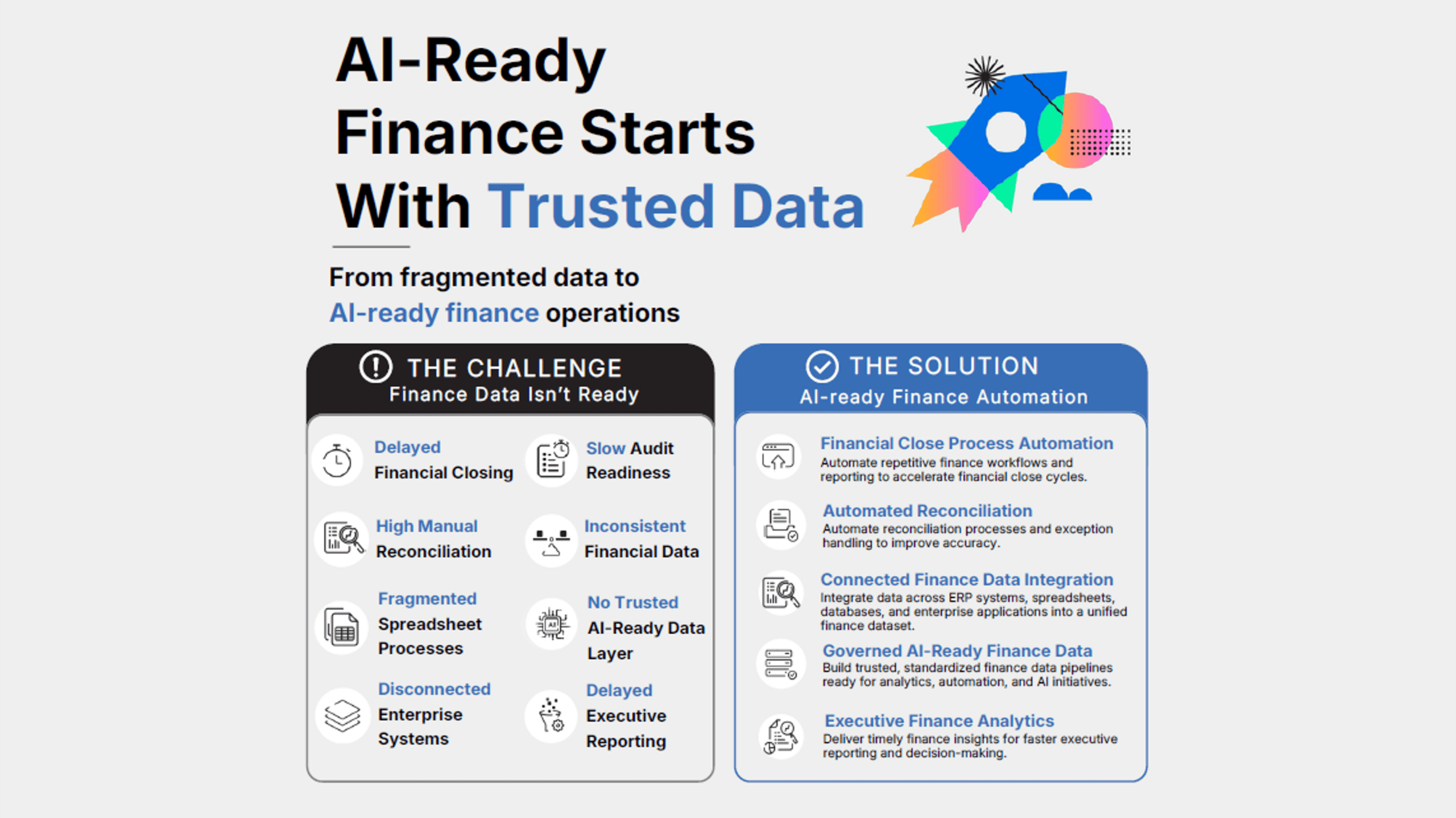
For Singapore institutions, data governance is no longer satisfied by a policy document, a data catalog, or a quarterly compliance review. Singapore data governance consulting must address a harder operating reality: data is distributed across core systems, cloud platforms, partner ecosystems, analytics environments, and increasingly, AI use cases. Leaders need confidence that critical data is accurate, understood, protected, and usable when a business decision depends on it.
That requirement is particularly acute in banking, insurance, government, and large enterprises. A finance team may reconcile performance measures differently from a business unit. A risk model may depend on data whose lineage cannot be demonstrated quickly. A generative AI initiative may expose gaps in data classification, access control, and ownership that were previously hidden. Governance becomes valuable when it resolves these operational issues, not when it creates another layer of administrative work.
What Singapore Data Governance Consulting Should Solve
Effective governance consulting begins with the decisions the organization needs to make and the risks it needs to manage. It does not begin by selecting a tool or attempting to document every data element across the enterprise.
For a regulated organization, the initial focus is usually its critical data domains: customer, account, transaction, policy, product, finance, risk, and regulatory reporting data. These domains support consequential decisions and therefore require defined ownership, common business meaning, quality controls, retention rules, and traceable movement across systems.
The objective is to establish a practical control environment. Business leaders should be able to answer what a metric means, who is accountable for it, where it originated, how it was transformed, and whether it is fit for the intended purpose. Technology teams should be able to apply those requirements consistently through platform design, metadata management, access controls, data pipelines, and monitoring.
This distinction matters. Governance is neither solely a compliance function nor solely a data engineering function. It is an enterprise operating model supported by architecture and automation.
Governance Must Work Across Regulation, Operations, and AI
Singapore’s data environment requires organizations to balance privacy obligations, sector-specific expectations, cybersecurity, business continuity, and data-driven innovation. Requirements under the Personal Data Protection Act, along with supervisory expectations relevant to financial institutions, make accountability and evidence central to the governance agenda. Organizations should validate their obligations with appropriate legal, risk, and compliance stakeholders rather than treating a generic governance framework as a substitute for regulatory interpretation.
The operational challenge is that governance requirements often arrive in separate streams. Privacy teams focus on personal data. Risk teams focus on controls and reporting. Security teams focus on access. Data teams focus on quality and availability. AI teams focus on training data and model performance. If these efforts remain disconnected, the enterprise creates duplicate standards, conflicting classifications, and control gaps.
A well-designed governance program connects them through shared concepts. Data classification should inform access policies, privacy handling, retention, cataloging, and AI suitability. A business glossary should align reporting definitions and analytics measures. Lineage should support both incident investigation and confidence in automated decisions. This reduces duplicated effort while giving control functions evidence they can rely on.
AI readiness raises the standard further. Models and AI applications can amplify poor data quality, outdated definitions, biased source data, or inappropriate access. Before deploying high-value AI use cases, organizations need to determine which datasets are approved for use, whether their provenance is known, whether sensitive fields are controlled, and how data quality is measured over time. Governance does not slow AI delivery when designed properly. It prevents teams from scaling untrusted outputs.
Start With Critical Data Products, Not an Enterprise-Wide Inventory
An enterprise-wide inventory remains a worthwhile long-term goal, but it is rarely the right first deliverable. Trying to catalog every system and field before delivering value can exhaust sponsorship and turn governance into a documentation exercise.
A more effective approach is to select two or three high-consequence data products. These might include a regulatory liquidity report, a customer 360 view for relationship management, a claims performance dashboard, or a risk analytics dataset. Each product should have a defined consumer, decision context, owner, source systems, quality expectations, access requirements, and measurable business outcome.
This approach makes trade-offs visible. A real-time fraud use case may prioritize timeliness and availability, while a board financial report may prioritize reconciliation, controlled change, and auditability. Neither standard is universally correct. Governance should define fitness for purpose rather than impose one control pattern on every dataset.
For each selected data product, teams can establish the minimum viable governance controls: accountable data owners, operational data stewards, business definitions, critical data elements, data quality rules, lineage, classification, and issue-management workflows. The patterns developed here can then be standardized and extended across domains.
The Architecture Behind Governed Data
Policies alone do not create trustworthy data. Governance must be implemented in the data platform and delivery lifecycle.
In a modern lakehouse, warehouse, or hybrid architecture, this often means integrating metadata capture into ingestion and transformation pipelines; applying role-based or attribute-based access controls; separating sensitive and non-sensitive data zones; monitoring quality rules; and recording lineage from source to consumption. It also means treating data transformations as managed engineering assets, with version control, testing, deployment controls, and documented ownership.
Metadata is the connective tissue. A catalog that only contains manually maintained descriptions becomes stale quickly. A useful metadata capability captures technical metadata from platforms, associates it with business terms and owners, and exposes lineage in a form that both technical and nontechnical stakeholders can use. Automation is essential, but it does not eliminate the need for stewardship. Someone still needs to resolve conflicting definitions, approve standards, and make decisions when quality failures affect business operations.
Data sovereignty and deployment choices also require deliberate design. Some organizations can use public cloud services extensively; others may require on-premises or hybrid controls for certain workloads due to risk, contractual, operational, or policy considerations. The governance model should remain consistent across these environments, even where implementation controls differ.
An Implementation Roadmap That Builds Capability
A credible engagement should produce visible improvements within the first operating cycle while establishing a foundation that can scale. The work commonly progresses through four connected stages:
- Assess the current state and prioritize risk. Map critical decisions, high-value data products, material regulatory and operational risks, current controls, and known pain points. This creates a prioritized governance backlog rather than a broad list of aspirations.
- Design the target operating model. Define decision rights, accountable owners, stewardship responsibilities, governance forums, control standards, escalation paths, and success measures. The model should fit the organization’s existing risk and delivery structures.
- Implement controls in the platform and pipelines. Configure classification, metadata, lineage, quality monitoring, access policies, retention rules, and workflow integration for priority domains. Governance requirements should be embedded in how data products are built and changed.
- Transfer capability and scale. Train data owners, stewards, engineers, analysts, and control teams. Establish reusable templates and patterns, then expand based on business value and risk exposure.
The sequence is not rigid. An institution with mature architecture but weak accountability may start with ownership and decision rights. Another with well-defined policies but fragmented platforms may concentrate first on metadata, lineage, and automated controls. The consulting partner should adapt the roadmap to the maturity of the organization, not force a predetermined methodology.
Measures That Demonstrate Governance Value
Senior leaders should expect evidence that governance is changing outcomes. Useful measures include the percentage of critical data elements with named owners, the number of material quality incidents detected before consumption, time required to trace a report back to source, remediation cycle time for data issues, adoption of approved business definitions, and the proportion of AI use cases using certified or governed data products.
These measures should not become a scorecard disconnected from business impact. If finance closes faster with fewer reconciliation exceptions, if risk reporting is more explainable, if customer analytics teams spend less time disputing definitions, or if AI teams can safely reuse curated data, governance is contributing to measurable operational value.
ORTECH approaches this work as an analytics engineering and organizational capability challenge. The strongest outcomes come from combining strategic governance design with implementation across data platforms, pipelines, metadata, and workforce practices. A framework without execution remains theoretical; technology without ownership becomes difficult to sustain.
The most useful next step is to choose one decision or reporting process where trust in data is currently costly, slow, or uncertain. Improving that data product end to end creates the proof, patterns, and sponsorship needed for governance to become an enduring enterprise capability.