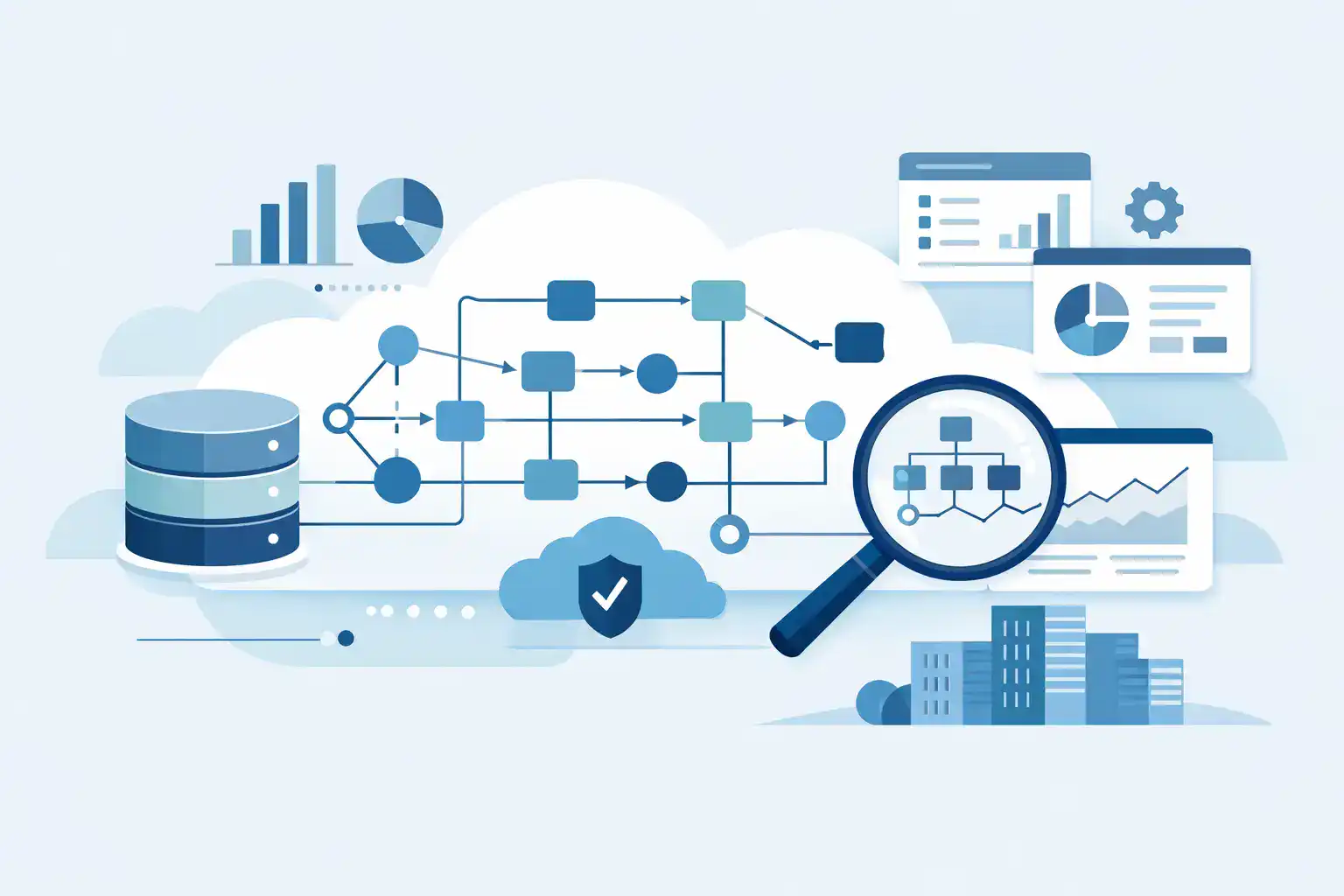
A dashboard shows a revenue drop, the CFO questions the metric, and within minutes the conversation shifts from performance to trust. Not trust in the team, but trust in the data. That is where knowing how to build data lineage becomes operationally important. In regulated and complex enterprises, lineage is not documentation for its own sake. It is the evidence trail that explains where data came from, how it changed, who touched it, and why a number can be relied on.
For CIOs, CDOs, and platform leaders, the challenge is that lineage often gets treated as a metadata side project. It is usually started too late, scoped too narrowly, or assigned to a governance function without engineering ownership. The result is predictable: partial visibility, stale diagrams, and low confidence when audit, risk, finance, or AI teams need answers quickly.
What data lineage actually needs to do
At an enterprise level, lineage should answer four practical questions. What is the origin of the data, what transformations shaped it, where is it consumed, and what breaks if a source or rule changes? If your lineage model cannot answer those questions with enough precision for operations, compliance, and analytics, it is not mature enough.
That means lineage is more than a visual map between systems. It needs to connect business meaning to technical execution. A field in a regulatory report, a KPI in an executive dashboard, and a feature used in a machine learning model should all be traceable back through pipelines, transformations, source tables, and policy controls. Without that connection, lineage remains technically interesting but commercially weak.
How to build data lineage with the right scope
The first mistake many organizations make is trying to document everything at once. The better approach is to start with critical data products, regulated reporting domains, and high-impact decision flows. In banking, this may be risk exposure, customer onboarding, anti-money laundering monitoring, or liquidity reporting. In government and GLC environments, it may be finance, citizen service performance, procurement, or master data shared across agencies.
Start by defining the business questions lineage must support. Auditability is one. Change impact analysis is another. Root cause analysis, policy enforcement, and AI model traceability are also valid objectives. When the use case is clear, the architecture decisions become much sharper.
This is also where executive sponsorship matters. Lineage crosses data engineering, governance, enterprise architecture, security, and business ownership. If it is framed only as a tooling initiative, it will stall. If it is framed as a control layer for trusted intelligence, it gains the attention it needs.
Build lineage into the architecture, not around it
The strongest lineage capabilities are designed into the data platform itself. They do not depend on teams manually updating spreadsheets or creating diagrams after pipelines are deployed. If your environment includes cloud, on-premises, and hybrid workloads, lineage must be able to follow data across those boundaries in a governed way.
In practice, this means capturing metadata from ingestion, transformation, orchestration, semantic modeling, and consumption layers. Source system metadata should describe origin and ownership. Pipeline metadata should capture movement and scheduling. Transformation metadata should reveal business logic and dependencies. Consumption metadata should show which dashboards, reports, APIs, or models rely on the data.
There is a trade-off here. Automated lineage provides broader coverage and better freshness, but it may miss business context unless naming, standards, and modeling disciplines are strong. Manual curation adds context but does not scale well. Most enterprises need both: automation for technical lineage and stewardship for business lineage.
Start with metadata discipline
If metadata is inconsistent, lineage becomes noisy and unreliable. Standardize naming conventions, dataset ownership, critical data element definitions, environment labels, and transformation documentation. Require pipelines and data products to declare purpose, owner, source classification, and downstream dependencies.
This can feel procedural, especially to engineering teams under delivery pressure. But without metadata discipline, lineage becomes a collection of disconnected traces rather than an enterprise asset. The effort pays off later when teams need to assess the impact of a source change or prove the lineage of a metric used in a board report.
Capture lineage at multiple levels
A useful lineage model operates at several levels of granularity. System-level lineage shows movement between platforms. Dataset-level lineage shows dependencies between tables, files, and views. Column-level lineage traces how a specific field was transformed across joins, calculations, and business rules.
Not every use case requires full column-level lineage on day one. For some domains, dataset-level tracing is enough to support modernization and operational visibility. For regulated reporting, financial controls, and AI model explainability, column-level lineage becomes much more valuable. The right depth depends on risk, compliance requirements, and business criticality.
Make governance part of the lineage design
Lineage becomes far more useful when governance policies are attached to it. Knowing where data moved is helpful. Knowing whether sensitive data was masked, whether access controls were applied, and whether retention rules were followed is what turns lineage into a governance control.
This is especially relevant for BFSI institutions and public sector organizations where data handling obligations are strict. A lineage map should not just tell you that customer data moved from one domain to another. It should help show whether that movement aligned with policy, whether sovereignty constraints were respected, and which downstream assets inherited classification and control requirements.
This is one reason mature organizations increasingly connect lineage to their broader data governance operating model. Stewardship, policy management, quality monitoring, and cataloging become stronger when lineage provides the connective tissue between them.
Design for change impact, not just traceability
One of the most overlooked benefits of lineage is change management. Enterprises modernizing warehouses, migrating to lakehouse architectures, or restructuring business logic need to understand downstream consequences before they deploy. Lineage allows teams to see which reports, interfaces, models, and workflows depend on a dataset or transformation.
That capability matters because modernization programs often fail at the handoff between architecture and operations. The design looks sound, but hidden dependencies cause outages, broken reports, or conflicting numbers. Lineage reduces that risk by making dependencies visible before the change reaches production.
This is also where engineering-led implementation makes a difference. If lineage is embedded in CI/CD, data testing, and release controls, teams can identify high-risk changes earlier. That moves lineage from passive documentation to an active part of platform reliability.
How to build data lineage people will actually use
Even well-designed lineage programs fail when the output is too technical for business and control stakeholders. A data engineer may be comfortable reading SQL dependencies and orchestration logs. A Head of Risk or Finance leader needs a business-facing path from source to report, with enough clarity to support decisions.
The answer is not to simplify the lineage until it loses value. The answer is to present different views for different users. Technical teams need transformation logic and dependency graphs. Business users need definitions, ownership, certification status, and the ability to trace a KPI to authoritative sources. Compliance teams need evidence of controls and policy inheritance.
Adoption improves when lineage is integrated into the places where decisions are made: data catalogs, governance workflows, operational support processes, and analytics delivery. If teams have to visit a separate environment and interpret unfamiliar metadata structures, usage will remain low.
Measure lineage as a capability, not a deliverable
A common trap is declaring success when a lineage tool is implemented or when a few critical reports are mapped. Enterprise lineage should be measured as an operating capability. Are critical data elements traceable end to end? Can impact analysis be completed quickly before releases? Are audit inquiries answered with evidence rather than manual reconstruction? Has trust in key metrics improved across executive reporting?
These are stronger indicators than asset counts alone. Coverage matters, but usefulness matters more. An enterprise may have thousands of lineage relationships recorded and still struggle to resolve a disputed KPI quickly.
For organizations building AI-ready data foundations, lineage also supports model governance. If a model output influences credit decisions, fraud handling, citizen service prioritization, or resource allocation, decision-makers need visibility into the provenance of training and inference data. That requirement is only going to become more central.
The practical path is to start with high-value domains, automate where possible, apply stewardship where necessary, and tie lineage directly to governance and change control. ORTECH often sees the strongest results when lineage is treated as part of analytics engineering and platform modernization, not as an isolated governance artifact.
Trusted intelligence does not come from dashboards alone. It comes from being able to explain the numbers when they are challenged, changed, or used to make consequential decisions.