

Data strategy consulting helps organizations turn data into a trusted, scalable business capability. For CIOs, CDOs, CFOs, internal audit leaders and digital transformation executives, the challenge is no longer simply acquiring more data or deploying another platform. Instead, it is about establishing the strategic direction, governance model and operating discipline needed to support analytics, compliance and AI readiness.
Data Strategy Consulting: Executive Overview
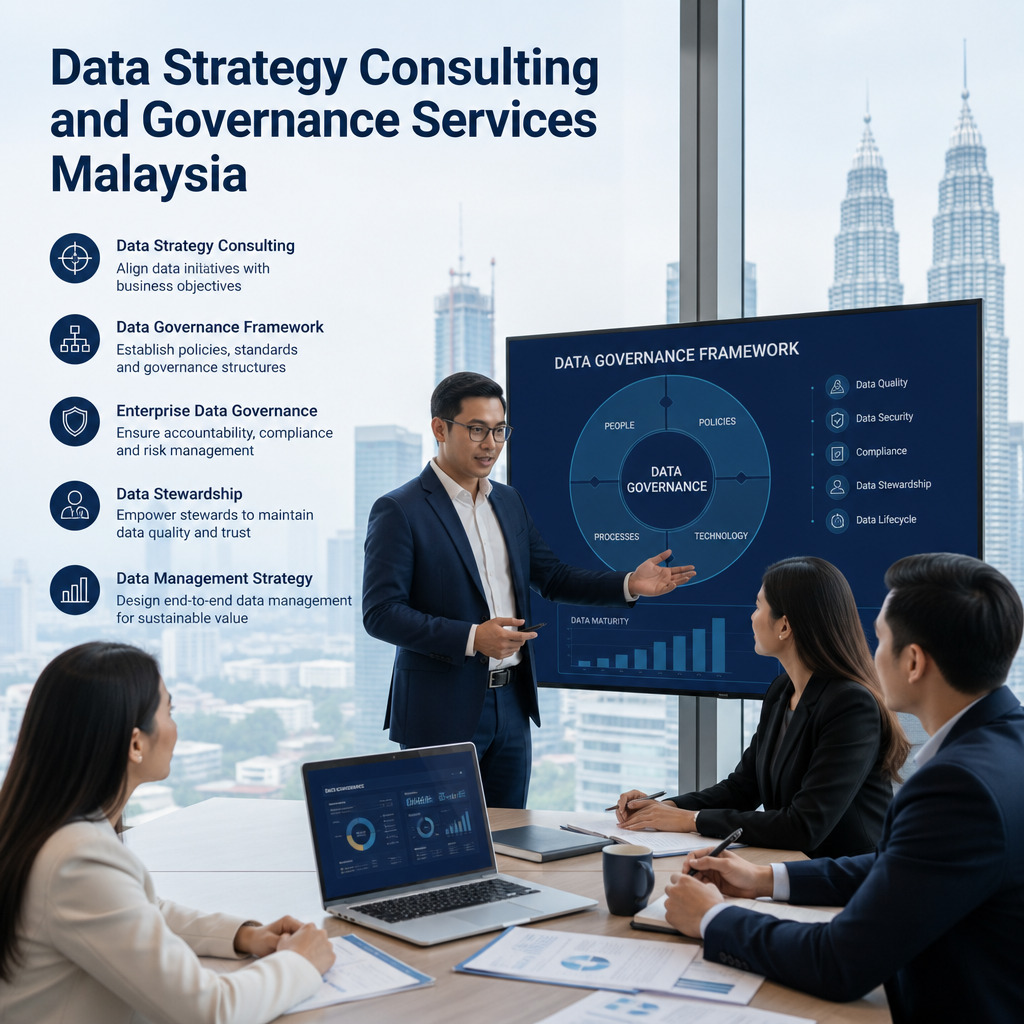
OR Technologies Sdn Bhd (ORTECH) provides data strategy consulting and enterprise data governance services for Government, BFSI, GLC and enterprise organizations across Malaysia. We help leadership teams define the target state for data management, prioritize investment decisions, establish accountable governance structures and modernize the foundations needed for analytics automation, data lakehouse architecture and Enterprise AI.
For another helpful perspective, this Data Strategy Consulting highlights practical trade-offs for buyers. For another helpful perspective, this article highlights practical trade-offs for buyers. Our approach connects board-level priorities with practical execution. It includes data ownership, stewardship, quality controls, metadata management, policy design, platform architecture, operating models and measurable adoption outcomes. As a result, organizations can build a data management strategy that supports regulatory confidence, operational performance, analytics self-service and long-term AI readiness.
Data Strategy Consulting: Business Challenges
Organizations often invest heavily in data platforms, reporting tools and transformation initiatives without achieving the expected business value. The underlying issue is frequently not technology capability, but the absence of a coherent data strategy and enforceable governance framework.
Common challenges include:
- Fragmented data ownership across business units, functions and agencies
- Inconsistent definitions for critical business metrics, customer, financial, operational and risk data
- Limited accountability for data quality, lineage, access and usage decisions
- Siloed reporting environments that create multiple versions of the truth
- Manual, spreadsheet-driven controls that cannot scale with enterprise demand
- Difficulty demonstrating compliance with regulatory, audit, security and records-management requirements
- Unclear prioritization of data investments, resulting in duplicated platforms and low adoption
- Inadequate metadata, catalogue and lineage capability for trusted analytics and AI use cases
- Weak alignment between business strategy, data architecture and operating model design
- Legacy data environments that constrain cloud adoption, lakehouse modernization and enterprise AI initiatives
- Concerns around digital sovereignty, sensitive data residency and controlled data sharing
- Lack of formal data stewardship practices across critical data domains
For Government agencies and GLCs, these issues can affect service delivery, policy outcomes, public accountability and cross-agency coordination. For banking and financial services institutions, they can increase exposure to regulatory findings, model risk, reporting inaccuracies, fraud-related blind spots and inefficient compliance processes. Across all sectors, poor governance reduces confidence in analytics and limits the organization’s ability to scale AI responsibly.
Data Strategy Consulting: ORTECH Approach
ORTECH applies an Analytics Engineering-led approach to data strategy consulting and governance. We combine executive advisory, enterprise architecture, governance design and implementation delivery to establish a practical operating model that can be sustained beyond the initial programme.
Our methodology is designed to move organizations from fragmented data management practices to a governed, measurable and AI-ready data ecosystem.
1. Assess the Current State
We begin with a structured assessment of the organization’s data landscape, governance maturity, business priorities, architecture, operating model and risk profile. This includes reviewing data domains, source systems, reporting environments, quality issues, ownership models, policies, metadata practices and analytics demand.
The assessment identifies where governance gaps are creating operational, financial, regulatory or strategic risk. It also establishes a realistic baseline for improvement.
2. Define the Target Data Strategy
ORTECH works with executive and functional stakeholders to develop a data management strategy aligned to corporate objectives, digital transformation priorities and sector obligations. The strategy defines the target state for:
- Enterprise data governance
- Data architecture and data lakehouse adoption
- Data quality and master data controls
- Metadata, catalogue and lineage management
- Analytics automation and self-service enablement
- AI-ready data platforms
- Data security, privacy and digital sovereignty
- Data operating model and capability development
- Investment sequencing, business cases and implementation roadmap
3. Design the Governance Framework
A governance framework must create accountability without creating unnecessary bureaucracy. ORTECH designs fit-for-purpose governance structures that clarify decision rights, escalation paths, roles, policies, standards and control mechanisms.
This includes the establishment or strengthening of data councils, domain ownership, data stewardship, governance offices and working groups. Governance becomes embedded into operational processes, delivery practices and technology workflows rather than treated as a separate compliance exercise.
4. Implement Priority Capabilities
We translate strategy into execution through prioritized initiatives that address the highest-value data domains, business processes and risk areas. Implementation may include governance tooling, data quality automation, catalogue deployment, lineage design, policy operationalization, lakehouse modernization, analytics workflow automation and enterprise dashboard rationalization.
ORTECH delivers in incremental releases, so organizations can demonstrate business value while building a scalable foundation.
5. Institutionalize the Operating Model
Sustainable enterprise data governance depends on adoption, capability and accountability. ORTECH supports the transition to a durable operating model through role definition, stewardship processes, governance playbooks, metrics, training and change management.
The outcome is not merely a governance document. It is an operating capability that enables the organization to manage data as an enterprise asset.
Service Capabilities
Enterprise Data Strategy and Roadmap
ORTECH develops enterprise data strategies that connect business ambition with the data capabilities required to deliver it. Our data analytics advisory services address the strategic decisions that leadership teams need to make: which data domains matter most, where to invest, which governance controls are necessary, how to modernize architecture and how to measure value.
We develop a sequenced roadmap that balances foundational work with high-impact use cases. This enables organizations to avoid large-scale platform programmes that lack adoption or clear business sponsorship.
Key deliverables may include:
- Enterprise data vision, principles and strategic objectives
- Current-state maturity assessment and gap analysis
- Target data architecture and AI-ready platform direction
- Priority data domain assessment
- Data investment portfolio and implementation roadmap
- Governance operating model and organizational design
- Business case development and value realization framework
- Data risk, compliance and digital sovereignty considerations
Data Governance Framework and Operating Model
ORTECH designs enterprise data governance frameworks that establish clear ownership, oversight and control across the data lifecycle. The framework is aligned to organizational structure, regulatory obligations, business processes and technology architecture.
Our governance model defines the roles of executive sponsors, data owners, data stewards, custodians, governance councils, risk functions, technology teams and business users. It also establishes decision rights for data access, definitions, quality thresholds, retention, issue resolution and policy exceptions.
The framework may cover:
- Data governance charter and principles
- Governance council structure and terms of reference
- Data ownership and data stewardship model
- Critical data element identification and classification
- Policy, standards and control design
- Data issue management and remediation workflow
- Governance KPI and maturity reporting
- Integration with risk, compliance, internal audit and cybersecurity functions
Data Quality, Metadata and Lineage Management
Trusted data requires visibility into where information comes from, how it is transformed, who is accountable and whether it meets agreed quality standards. ORTECH helps organizations establish a disciplined approach to data quality, metadata and lineage management across critical business domains.
We design controls that enable consistent measurement, prioritization and remediation of data issues. This improves confidence in management reporting, regulatory submissions, analytics models and operational decision-making.
Our capabilities include:
- Data quality assessment and profiling
- Critical data element definition
- Data quality rules, thresholds and scorecards
- Data issue logging, ownership and remediation processes
- Business glossary and enterprise data catalogue design
- Technical and business metadata management
- End-to-end data lineage requirements
- Data classification, retention and lifecycle policies
- Governance controls for analytical datasets and AI training data
Data Stewardship and Domain Management
Data stewardship is the operational backbone of enterprise data governance. ORTECH helps organizations establish practical stewardship capabilities that connect business accountability with day-to-day data management.
We work with domain leaders to define the scope, responsibilities, workflows and performance measures for data stewards. This supports consistent management of key domains such as customer, product, supplier, financial, asset, employee, transaction, risk and operational data.
Our approach enables stewards to manage data definitions, quality expectations, access requirements, metadata, issue resolution and change impact in a coordinated manner. The objective is to make data stewardship a recognized business responsibility with clear authority and measurable outcomes.
Data Architecture, Lakehouse and AI Readiness
A data management strategy must be supported by an architecture that can scale across transactional systems, analytics environments, cloud platforms and emerging AI workloads. ORTECH provides advisory and implementation support for data lakehouse architecture, open data architectures and AI-ready data platforms.
We help organizations establish governed data products, shared data layers, semantic consistency and secure access patterns that support enterprise reporting, analytics automation and AI initiatives.
This includes:
- Data lakehouse strategy and reference architecture
- Data product and domain-oriented architecture design
- Open data architecture and interoperability principles
- Data ingestion, transformation and orchestration patterns
- Governed data access and sharing models
- Analytical data modelling and semantic layer design
- AI-ready data preparation, traceability and control requirements
- Digital sovereignty and sensitive data deployment considerations
- Platform rationalization and modernization roadmap
Business Outcomes
ORTECH’s Data Strategy & Governance Services are designed to deliver measurable business outcomes, not only policy documentation or platform implementation.
Organizations can expect to strengthen their ability to achieve:
- Faster decision-making through trusted metrics, governed data definitions and reduced reconciliation effort
- Improved operational efficiency through standardized data processes, analytics automation and reduced manual intervention
- Reduced business risk through clearer accountability, data quality controls, lineage visibility and issue management
- Enhanced governance and compliance through consistent controls, auditability and policy enforcement
- Better AI readiness through more reliable data foundations and stronger stewardship
In practice, data strategy consulting helps teams sequence the right initiatives, while enterprise data governance keeps execution aligned to business goals. For organizations that need stronger control over sensitive information, the next step is often to review the Data Sovereignty Compliance Guide. For broader context on governance principles, the ISO 8000 family of data quality standards offers a useful reference point.
ORTECH’s approach also connects well with analytics modernization and AI programs. As a result, leaders can build confidence in reporting, improve stewardship discipline and support enterprise growth with a more resilient data management strategy.