Monday morning should not begin with six analysts manually refreshing spreadsheets, rerunning SQL queries, and reconciling KPI discrepancies before an executive meeting. Yet that is still the operating model in many enterprises. If you are evaluating how to automate analytics workflows, the real question is not which task to script first. It is how to make analytics delivery faster, more trustworthy, and easier to govern across the organization.
Automation in analytics is often misunderstood as a reporting shortcut. In practice, it is an operating model shift. The goal is to reduce dependency on manual intervention across data ingestion, transformation, validation, metric production, orchestration, and distribution, while preserving control over quality, lineage, security, and policy enforcement. For regulated industries, that distinction matters.
What automating analytics workflows actually means
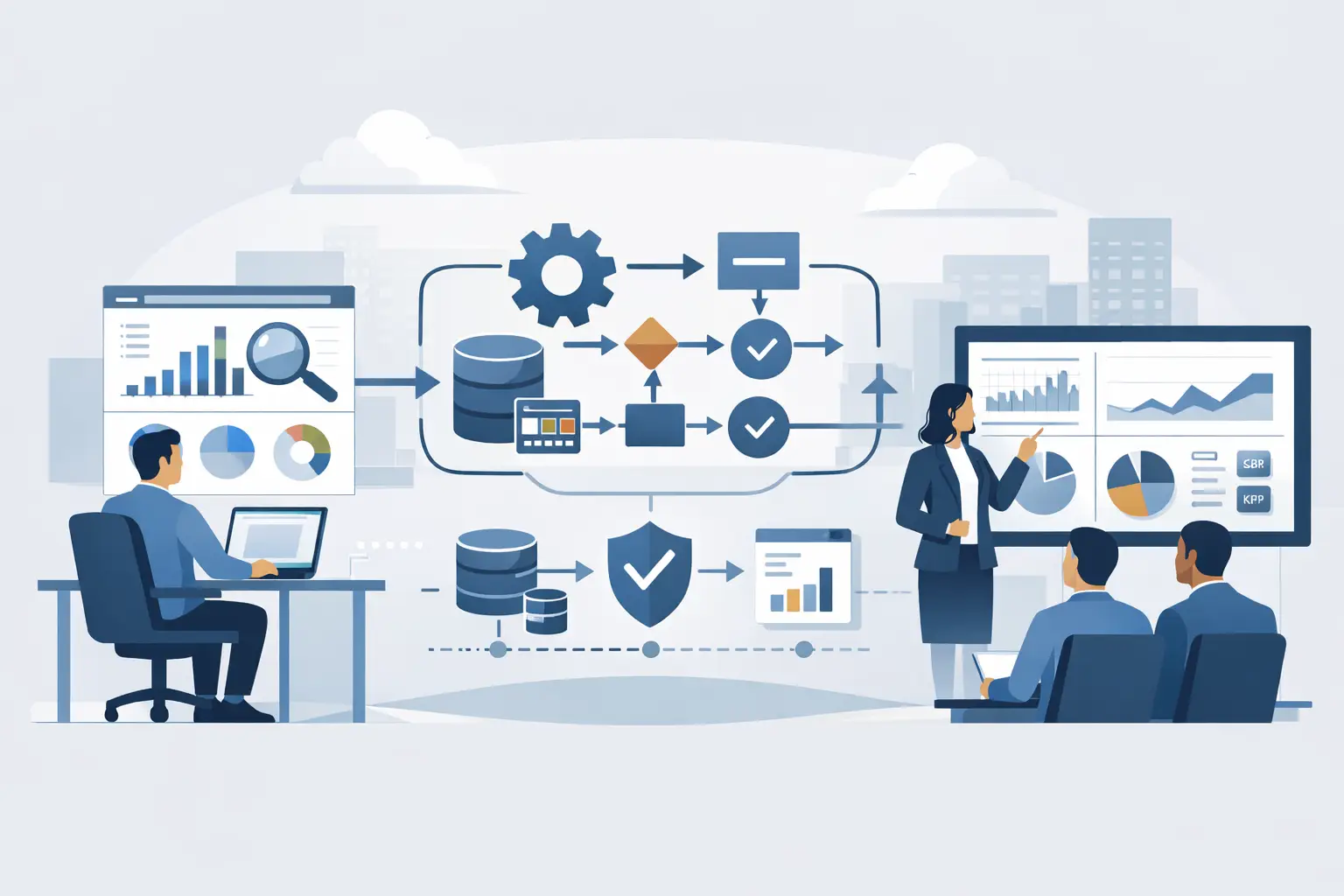
An analytics workflow includes far more than dashboard refreshes. It starts when source data changes and ends when a decision-maker receives trusted information in the right format, at the right time, with enough context to act on it. Between those points, teams typically handle extraction, data quality checks, business rule transformations, model execution, semantic standardization, report generation, approvals, and exception management.
When those steps are manual, delays multiply. Different teams create their own logic, business definitions drift, and operational resilience weakens. One missed handoff can affect month-end reporting, regulatory submissions, or risk monitoring. Automation addresses these failure points by standardizing repeatable processes and embedding controls into the pipeline itself.
That does not mean every step should be fully automated. High-impact judgment points such as policy exceptions, regulatory interpretations, or unusual data events may still require human review. The strongest automation strategies distinguish between repeatable process and institutional judgment.
How to automate analytics workflows without creating new risk
The common mistake is to begin with tools rather than workflow design. Enterprises buy orchestration software, add scripts, connect a few APIs, and expect analytics operations to improve. Instead, they often end up with a faster version of the same fragmented process.
A better approach starts with identifying where value is lost today. That usually shows up in a few places: repeated manual preparation, inconsistent KPI calculations, delayed reporting cycles, unstable pipelines, and weak traceability when data issues occur. Once these friction points are clear, automation can be designed around outcomes rather than activity.
The first step is workflow mapping. Document how data moves from source to consumption, who touches it, where validation happens, which steps are time-sensitive, and where approvals or exceptions are required. This exercise often reveals that the real problem is not a lack of automation, but a lack of standardization.
The second step is classification. Some workflows are ideal for immediate automation, especially recurring, rules-based processes such as daily ingestion, data transformation, reconciliation checks, scheduled model scoring, and executive dashboard refreshes. Others need partial automation because they involve contextual review or evolving business rules. Treating these categories differently prevents overengineering.
The third step is architectural alignment. Automated analytics workflows perform best when they run on a governed data foundation with clear lineage, metadata, access controls, and reusable transformation logic. If the underlying environment is fragmented across uncontrolled extracts, isolated scripts, and department-owned definitions, automation will amplify inconsistency rather than reduce it.
Build the workflow around trusted data products
For enterprise environments, the most effective automation does not happen at the report layer. It happens upstream, where raw data is transformed into governed, reusable data products. These can include conformed customer views, finance-ready transaction models, risk event datasets, or standardized performance metrics.
This matters because downstream automation is only reliable when upstream logic is stable. If every dashboard embeds its own transformation rules, automating refreshes simply scales confusion. If core business entities and KPIs are defined once and managed centrally, automation becomes repeatable, auditable, and much easier to extend.
That is why analytics engineering plays a central role. It creates the structure needed to version transformations, test data quality, maintain lineage, and operationalize change management. For CIOs, CDOs, and enterprise architects, this is the difference between isolated automation wins and a durable analytics operating model.
The components that make automation sustainable
Sustainable automation depends on a small set of capabilities working together.
Orchestration coordinates dependencies across ingestion, transformation, testing, model runs, and publication. It ensures workflows run in the correct order and handles retries, failures, and alerts when something breaks.
Data quality controls are equally critical. Automated pipelines without validation can move bad data faster than manual processes ever did. Rules for completeness, uniqueness, accuracy, timeliness, and business thresholds should be embedded directly into the workflow.
Semantic consistency is another requirement. Executive trust deteriorates quickly when finance, risk, and operations define the same metric differently. A governed semantic layer or standardized metric framework reduces that risk.
Observability is often overlooked. Teams need visibility into runtime status, data freshness, anomaly detection, and lineage impact when upstream sources change. Without this, automation becomes harder to manage at scale.
Finally, governance cannot be bolted on later. Role-based access, audit trails, approval checkpoints, and policy enforcement need to be designed into the workflow from the start, especially in banking, insurance, public sector, and other regulated environments.
Where organizations should start
Most enterprises should not begin by trying to automate everything. The better path is to select one or two high-value workflow families where manual effort is significant, business impact is visible, and process logic is stable enough to standardize.
Monthly management reporting is a common starting point because it exposes delays, reconciliation effort, and KPI inconsistency. Regulatory or compliance reporting can also be a strong candidate, provided governance requirements are clearly defined. Operational risk monitoring, customer portfolio analysis, and finance performance reporting are other practical entry points.
Start with a narrow scope, but design with scale in mind. That means setting standards for naming, testing, scheduling, monitoring, and ownership from the beginning. A pilot that depends on one engineer’s scripting habits is not a foundation. A pilot that establishes reusable workflow patterns is.
In ORTECH’s experience, organizations see better long-term results when automation is treated as a capability program rather than a sequence of disconnected use cases. The immediate objective may be faster reporting, but the larger outcome is a governed analytics delivery engine that supports modernization and AI readiness.
Common trade-offs leaders should consider
There is no single blueprint for how to automate analytics workflows because operating context matters.
Highly centralized models provide stronger control, standardization, and oversight. They are often a better fit for heavily regulated institutions, but they can slow domain responsiveness if every change must pass through a central team.
Federated models allow business units more agility, especially when analytics demand is diverse. But without strong platform governance and shared standards, they can produce duplicated logic and fragmented controls.
Batch automation is sufficient for many executive and regulatory workflows. Real-time automation may be justified for fraud detection, operational alerts, or mission-critical service environments, but it introduces more architectural complexity and higher operational expectations.
The right choice depends on risk tolerance, regulatory exposure, data maturity, and organizational structure. Leaders should resist copying another organization’s operating model without examining these variables.
What success looks like
Successful automation shows up in business outcomes before it shows up in technical metrics. Reporting cycles shorten. Reconciliation effort drops. Data incidents are detected earlier. Analysts spend more time interpreting results and less time preparing inputs. Leaders gain confidence that the numbers they see are consistent across functions.
Technical indicators still matter. Pipeline reliability, test coverage, workflow runtime, failure recovery, lineage completeness, and metric reuse all signal whether automation is becoming institutionalized. But the broader measure is whether analytics has become more operationally dependable.
That is the standard worth aiming for. Not more scripts. Not more scheduled jobs. A modern analytics workflow should behave like an engineered enterprise capability – governed, scalable, observable, and aligned to decisions that matter.
The practical starting point is often simpler than expected: choose one workflow that leadership already depends on, redesign it around trusted data, and automate it end to end with governance intact. That is where momentum begins, and where analytics starts acting less like a manual service and more like critical infrastructure.