If your data program keeps producing pipelines but not decisions, the issue may not be tooling. It may be role design. The debate around analytics engineering vs data engineering matters because many enterprises still expect one team to handle ingestion, transformation, semantic modeling, governance, and business-ready reporting at the same time. That usually creates bottlenecks, weak ownership, and slow time to value.
For CIOs, CDOs, enterprise architects, and heads of analytics, this is not a naming exercise. It is an operating model decision. The way you separate – or combine – these functions affects data quality, platform scalability, AI readiness, and how quickly business teams can trust and use data.
What analytics engineering vs data engineering really means
Data engineering is primarily concerned with building and operating the data foundation. That includes ingesting data from source systems, managing pipelines, orchestrating workloads, handling storage layers, and ensuring data is available, reliable, and performant across the platform. In large enterprises, data engineers are often closest to platform architecture, integration patterns, and operational resilience.
Analytics engineering sits closer to the point where data becomes usable for reporting, decision intelligence, and analytical applications. Analytics engineers transform raw and curated data into business-aligned models, define trusted metrics, test transformation logic, and structure data so analysts, finance teams, risk teams, and operations leaders can work from a consistent version of truth.
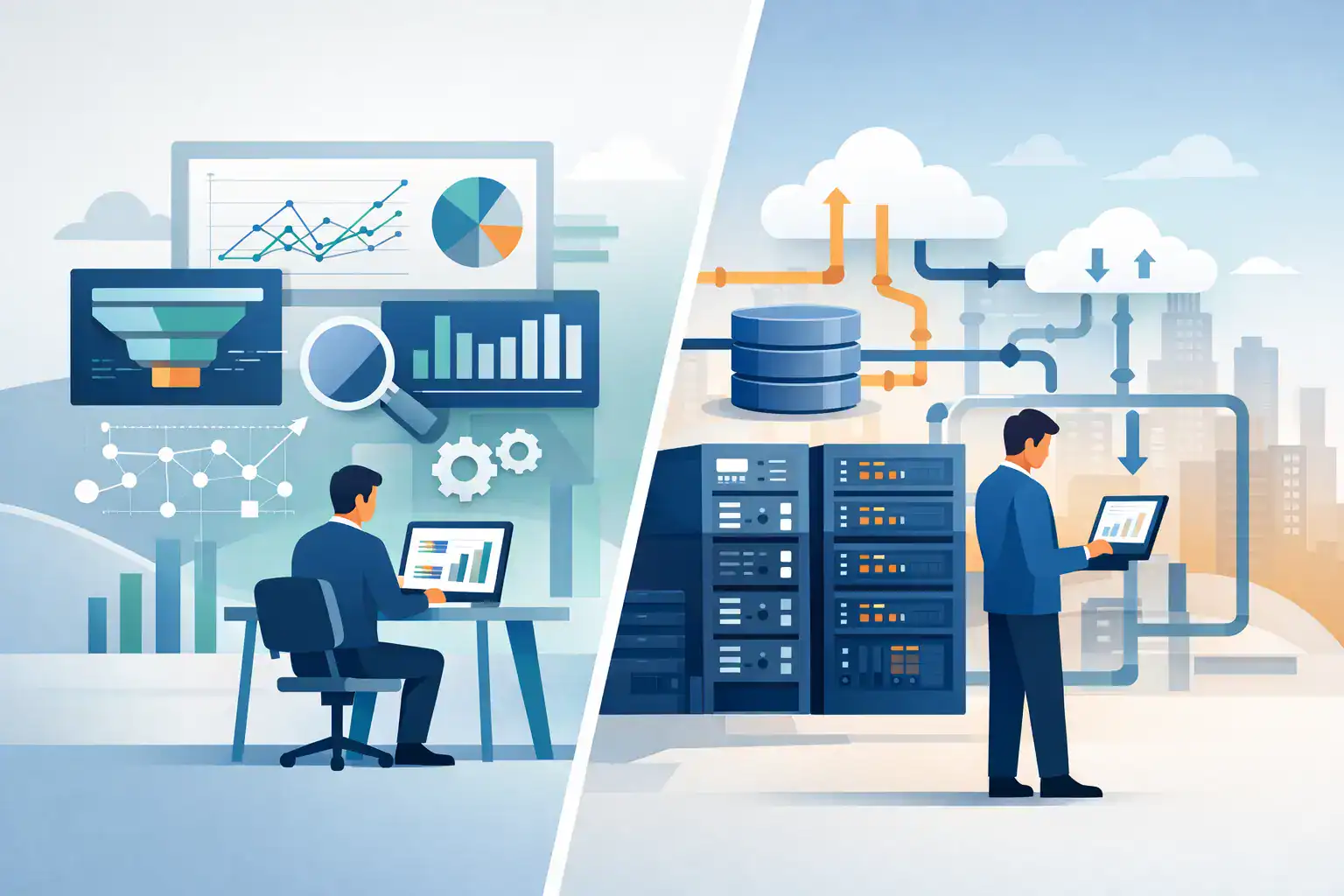
In simple terms, data engineering builds the roads and utilities. Analytics engineering designs the business district that people actually use. Both are engineering disciplines. Both require rigor. But they solve different problems.
The core difference is not technical depth – it is proximity to business meaning
A common misconception is that data engineering is the “hard” technical work and analytics engineering is a lighter reporting layer. In mature organizations, that is inaccurate. Analytics engineering is not dashboard formatting. It is the disciplined engineering of data models, transformation logic, lineage, testing, and metric definitions that connect enterprise data platforms to operational decision-making.
Data engineers typically optimize for movement, scale, latency, security, and infrastructure reliability. Analytics engineers optimize for usability, consistency, semantic clarity, and analytical trust. One focuses on whether the data arrives correctly and efficiently. The other focuses on whether the data means the same thing across finance, risk, operations, and executive reporting.
That distinction becomes especially important in regulated sectors. A bank may have a highly capable data engineering team that can centralize transaction data across multiple systems. But without analytics engineering, the institution may still struggle to define exposure, delinquency, profitability, or customer-level risk in a way that is consistent across departments. The platform exists, yet trust remains fragmented.
Where each role fits in the modern data stack
In practice, data engineering usually owns source integration, batch and streaming pipelines, data lakehouse ingestion zones, workload orchestration, storage optimization, and platform observability. The work is foundational and often invisible to business users until something fails.
Analytics engineering usually operates in the transformation and consumption layers. The role often includes building curated models, managing reusable transformation logic, documenting business rules, creating metric layers, implementing data tests, and improving lineage visibility between source systems and dashboards or AI use cases.
There is overlap. Both roles may write SQL. Both may use orchestration frameworks, version control, CI/CD, and automated testing. In cloud and lakehouse environments, the boundary is not always fixed. Smaller teams may combine responsibilities. Larger enterprises tend to separate them because the specialization improves quality and accountability.
A useful way to think about it is this: data engineering makes data available, analytics engineering makes data usable.
Why enterprises often get this wrong
Many organizations grew their data function around platform delivery. They invested in ingestion, storage, cloud migration, and integration, then assumed analytics value would naturally follow. It rarely does.
The missing layer is often governed transformation tied to business logic. Raw and even lightly curated data does not automatically become decision-ready. Finance definitions differ from operational definitions. Risk metrics evolve. Regulatory reporting requires traceability. Executive dashboards need stability, not constant reinterpretation.
Without analytics engineering, business teams end up recreating logic in BI tools, spreadsheets, or departmental marts. That leads to metric drift, duplicate transformation work, and governance gaps. The platform appears centralized, but analytics remains fragmented.
The opposite mistake also happens. Some organizations focus heavily on reports and semantic models without enough investment in core engineering. They can move quickly at first, but performance degrades, lineage breaks, and scale becomes difficult. This is why analytics engineering vs data engineering should not be framed as a choice between one or the other. The real question is how to design both functions so they work together.
Analytics engineering vs data engineering in enterprise operating models
For enterprise leaders, the more useful question is not which role is better. It is where responsibility should sit.
If your organization is building a modern data platform, data engineering should usually establish the ingestion framework, storage architecture, orchestration standards, access controls, and operational SLOs. That creates a governed, scalable base layer.
Analytics engineering should then own the transformation standards that make data consumable across domains. That includes reusable business logic, conformed entities, metric definitions, quality tests, and documentation that business and technical teams can both understand.
This separation creates cleaner accountability. When a source pipeline fails, the issue belongs to platform engineering. When the revenue metric differs between finance and sales, the issue belongs to the analytical model and semantic layer. Without this clarity, every incident turns into a cross-team debate.
In regulated environments across banking, insurance, government, and GLCs, that clarity also supports auditability. Leaders need to know not only where data came from, but how it was transformed into reportable intelligence.
When the boundary should stay flexible
Not every organization needs a large, standalone analytics engineering function on day one. Team size, platform maturity, and business urgency matter.
In an early modernization phase, one engineering team may temporarily handle both foundational pipelines and analytical transformations. That can work if the architecture is still evolving and the business domains are limited. The trade-off is that business modeling often gets deprioritized in favor of urgent integration work.
As adoption grows, the need for specialization becomes clearer. More domains mean more definitions, more stakeholders, and more governance requirements. At that stage, analytics engineering becomes essential because it reduces dependency on ad hoc reporting logic and helps institutionalize trusted metrics.
This is particularly relevant for AI readiness. AI initiatives do not fail only because of poor models. They often fail because feature inputs, business definitions, and data quality controls are inconsistent. Analytics engineering strengthens the layer where business meaning is standardized, tested, and reusable.
What executive teams should look for
A healthy data organization does not measure success only by the number of pipelines delivered or dashboards launched. It looks at whether critical decisions are supported by trusted, traceable, reusable data products.
If your teams are repeatedly reconciling metrics between departments, analytics engineering is likely underdeveloped. If transformations are buried in reporting tools with little governance, the function is probably missing. If platform teams are overloaded with business logic requests, responsibilities may not be structured correctly.
On the other hand, if analytical teams constantly face broken upstream feeds, missing historical data, or unstable performance, the data engineering layer likely needs strengthening.
The strongest enterprise programs treat both disciplines as part of one modernization agenda. Data engineering provides scale, resilience, and access. Analytics engineering provides trust, consistency, and business usability. Together, they create the conditions for decision intelligence, governed self-service, and sustainable AI adoption.
For organizations modernizing across complex environments – especially those balancing cloud, on-premises, and sovereign data requirements – this alignment becomes even more important. It is not just about technical handoffs. It is about building an operating model where data can move from source to action without losing integrity along the way.
The practical takeaway is straightforward: do not ask whether analytics engineering replaces data engineering. Ask whether your current model turns enterprise data into trusted intelligence fast enough, with enough control, for the decisions that matter. That question usually leads to a clearer architecture – and a better outcome.