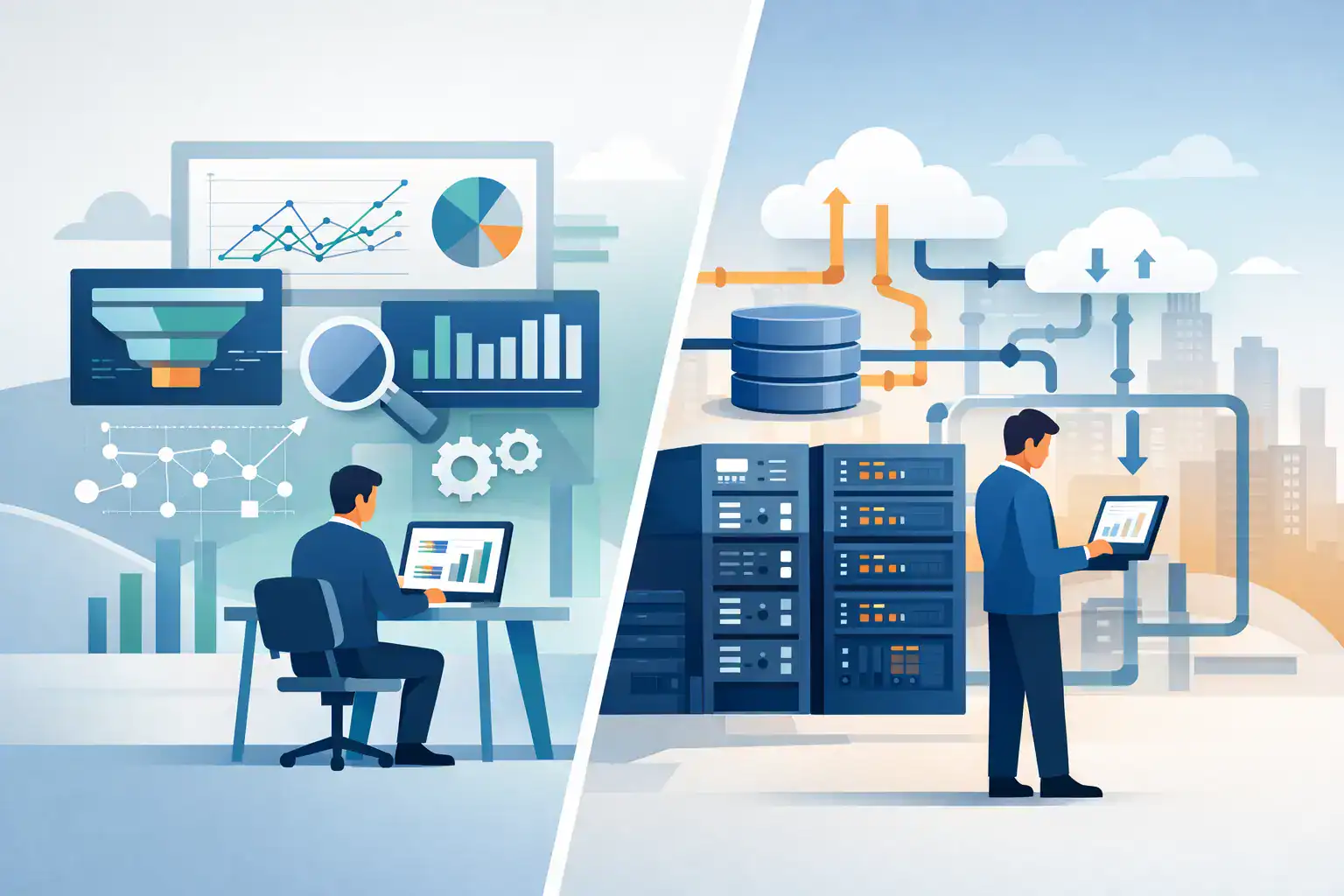
A team can spend millions on cloud platforms, pipelines, and dashboards and still struggle to answer a basic business question with confidence. That gap is exactly why the idea of an analytics engineering course matters. For enterprise leaders, the real question is not whether the discipline is relevant. It is whether the course develops the capabilities needed to turn fragmented data into trusted, governed, decision-ready assets.
Analytics engineering sits between data platform engineering and business analytics. It is the layer where raw data becomes usable, reliable, and aligned to enterprise definitions. In practice, that means data modeling, transformation logic, testing, documentation, orchestration awareness, and collaboration with stakeholders who depend on accurate metrics. A course that treats analytics engineering as only a SQL upskilling exercise misses the point.
Why an analytics engineering course matters now
Many organizations have already modernized parts of their data estate. They may have cloud storage, ingestion pipelines, BI tools, and even early AI initiatives. Yet operating results often remain inconsistent because the analytical layer is underdeveloped. Definitions vary across business units, data quality checks are informal, and reporting logic lives in isolated dashboards rather than governed transformation workflows.
This is where analytics engineering creates enterprise value. It establishes a controlled path from source data to business-ready outputs. That path matters for more than reporting. It supports regulatory traceability, financial reconciliation, risk visibility, service performance monitoring, and AI readiness.
For regulated sectors such as banking, insurance, and government, the stakes are even higher. When data lineage is weak or business logic is duplicated across teams, the problem is not only inefficiency. It becomes a governance and accountability issue. An analytics engineering course should therefore prepare professionals to work in environments where data trust is not optional.
What a strong analytics engineering course should cover
A credible course should begin with the operating model, not the toolset. Participants need to understand where analytics engineering fits across ingestion, storage, transformation, semantic design, consumption, and governance. Without that context, technical exercises become disconnected from business outcomes.
Data modeling for decision use cases
The core skill is modeling data so it can be reused across reporting, self-service analytics, and operational decision-making. This includes fact and dimension design, business event modeling, conformed definitions, and performance-aware structures for analytical workloads.
A good course should also cover trade-offs. Highly normalized models may serve governance and integration well, but they can slow down analytical consumption. Denormalized models may improve usability, but they can increase maintenance complexity if business rules are not centrally managed. Enterprise teams need to know when each approach is appropriate.
Transformation logic as a managed asset
Analytics engineering is not just about querying data. It is about creating repeatable, version-controlled transformations that can be tested and maintained. That means participants should learn modular SQL patterns, transformation layering, dependency management, and deployment discipline.
This matters because business logic is often one of the least governed assets in the enterprise. Revenue recognition rules, customer segmentation logic, risk indicators, and service-level calculations are frequently embedded in downstream reports. A strong course should teach how to move that logic into governed transformation layers where it can be reviewed, audited, and reused.
Testing, quality, and observability
If a course does not address testing, it is incomplete. Data trust depends on validation at multiple levels – source conformance, null checks, uniqueness, referential integrity, freshness, reconciliation, and rule-based business tests.
Participants should learn that quality is not a final checkpoint added after development. It is part of the engineering process. They should also understand observability concepts such as pipeline health, run failures, anomalies, and upstream change detection. In enterprise environments, silent data drift can be more damaging than visible outages.
Metadata, lineage, and documentation
A transformation pipeline that only one developer understands is not enterprise-ready. Documentation, metadata management, and lineage are essential for sustainability, especially in large institutions where teams change and controls are scrutinized.
An effective course should teach how to document business definitions, source-to-target mappings, ownership, and transformation intent. It should also explain why lineage is central to impact analysis, audit readiness, and change management. This is particularly important where multiple departments rely on common metrics but operate under different compliance obligations.
The capabilities most courses overlook
Many courses focus heavily on syntax and workflow mechanics. Those are necessary, but not sufficient. Enterprise analytics engineering also requires judgment.
One overlooked capability is metric governance. Teams need to know how to define and maintain enterprise metrics so finance, operations, risk, and digital teams are not working from competing versions of performance. Another is stakeholder translation. Analytics engineers must be able to convert business policy into data logic without introducing ambiguity.
A third is architectural awareness. Not every participant needs to become a platform architect, but they should understand how transformations interact with the lakehouse, warehouse, orchestration layer, security model, and consumption tools. Decisions made in the analytics layer affect cost, scalability, latency, and compliance.
A mature analytics engineering course should also address data sovereignty and access control where relevant. In public sector and regulated environments, data movement, residency, masking, and role-based access are design considerations, not later-stage enhancements.
How to evaluate an analytics engineering course
For CIOs, CDOs, and data leaders, the goal is not simply to enroll staff in training. The goal is to build institutional capability. That requires a more disciplined evaluation standard.
First, assess whether the course is built around real operating scenarios. Does it show how to support finance reporting, risk monitoring, customer intelligence, or service operations? Or does it stay at the level of isolated coding exercises?
Second, look for governance depth. A course should address testing, lineage, documentation, access considerations, and change control. If it presents analytics engineering as a fast path to dashboard delivery without governance, it may create more technical debt than capability.
Third, examine whether the course reflects team-based delivery. In real environments, analytics engineers work with data engineers, architects, BI developers, domain owners, and governance teams. Training should mirror that collaborative reality rather than framing the role as a standalone technical function.
Fourth, consider whether the curriculum supports AI readiness. AI programs depend on reliable, well-structured, business-aligned data. If the course only teaches reporting transformations and ignores reusable semantic design, data quality discipline, and governed feature-ready datasets, it may not support the organization’s broader roadmap.
Who should take an analytics engineering course
The obvious audience includes analytics engineers, BI developers, and data analysts moving into more formal engineering practices. But in enterprise settings, the value often extends further.
Data platform leaders benefit because analytics engineering helps reduce fragmentation between platform investment and business consumption. Enterprise architects benefit because the discipline clarifies how governed data products are structured and delivered. Even data governance teams can gain value by understanding how policy, controls, and lineage are operationalized in transformation workflows.
That said, not every course should target the same depth. Senior leaders usually need enough understanding to make operating model and capability decisions. Delivery teams need hands-on competence. The best training paths recognize this distinction instead of forcing one curriculum on every role.
From skills training to organizational capability
A course alone will not modernize analytics delivery. Organizations also need standards, reference architectures, development workflows, ownership models, and enablement support. This is where many training investments underperform. People return from a course energized, but the enterprise environment does not allow them to apply what they learned consistently.
To create durable value, training should align with the target operating model. If the organization is moving toward a lakehouse architecture, domain-oriented data products, stronger governance, or AI-enabled decision processes, the course should reinforce those priorities. Otherwise, the learning remains academic.
This is also why capability transfer matters. In mature programs, education is connected to implementation patterns, quality controls, and delivery guardrails. ORTECH often sees the strongest outcomes when analytics engineering training is embedded within broader modernization initiatives rather than treated as a separate learning exercise.
A useful closing test is simple. After completing an analytics engineering course, can the team produce trusted datasets, reusable business logic, documented lineage, and governed metrics that decision-makers will actually rely on? If the answer is yes, the course is teaching more than tools. It is helping build the foundation an enterprise needs to operate with confidence.