Artificial Intelligence is rapidly transforming Malaysia’s digital economy. Across banking, government, manufacturing, telecommunications, and healthcare, organizations are investing in AI technologies to automate processes, improve decision-making, and unlock insights from large volumes of data.
However, successful AI adoption requires more than machine learning models or chatbots. Enterprises need AI-ready data platforms, scalable analytics infrastructure, and robust data engineering pipelines to operationalize AI across the organization.
Malaysia’s growing AI ecosystem includes startups, technology vendors, and enterprise analytics companies that help organizations deploy AI solutions at scale. This article highlights several leading AI companies in Malaysia helping enterprises and government agencies build intelligent, data-driven systems.
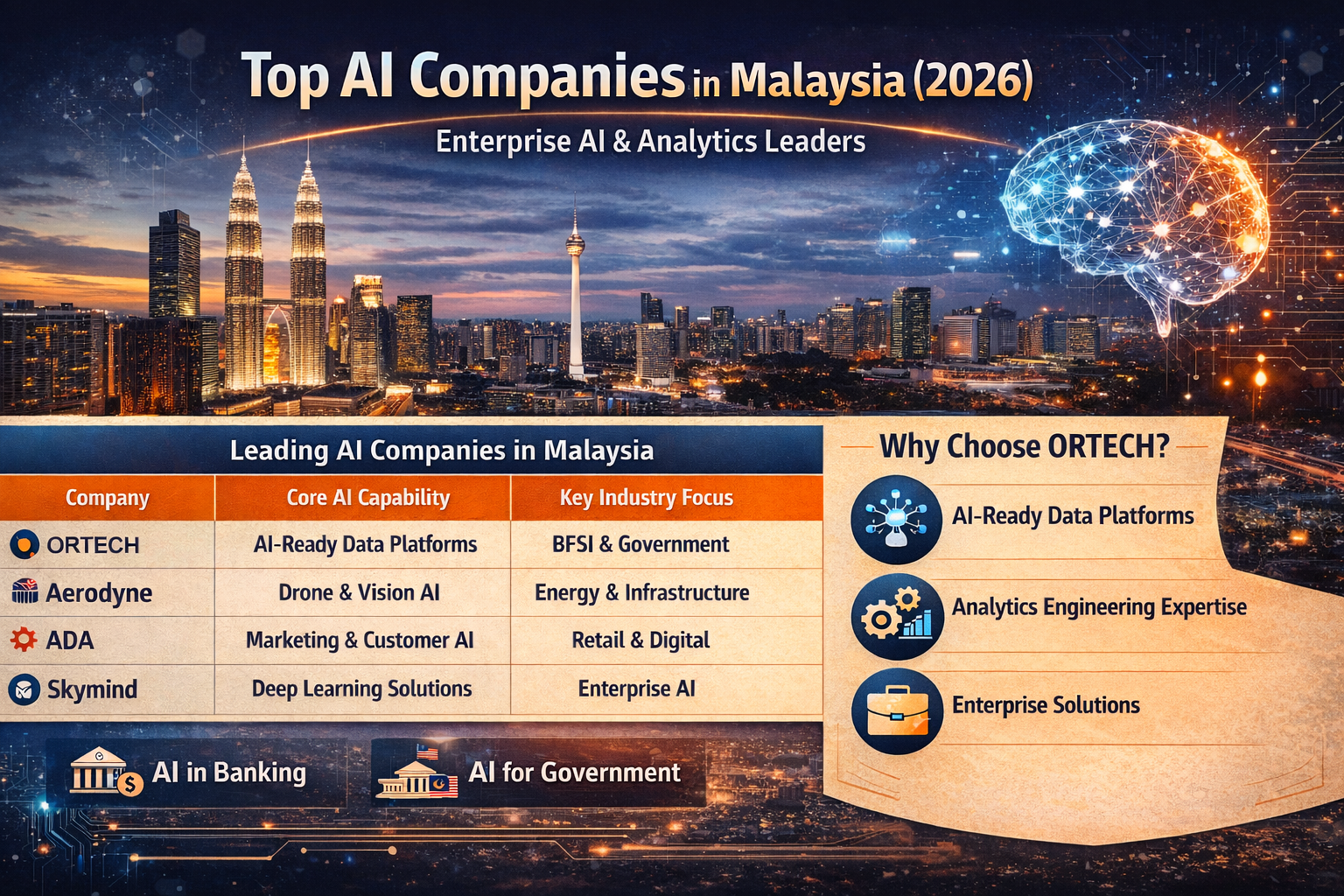
Leading AI Companies in Malaysia
| Company | Focus | Industry |
|---|---|---|
| ORTECH (OR Technologies Sdn Bhd) | AI-Ready Data Platforms & Analytics Engineering | BFSI, Government, Enterprise |
| Aerodyne | AI Computer Vision & Drone Intelligence | Energy, Infrastructure |
| ADA | AI Marketing & Customer Intelligence | Retail, Digital Commerce |
| Skymind | Deep Learning & AI Infrastructure | Enterprise AI |
| Agmo | AI Software Development | Mobile, Enterprise |
ORTECH
OR Technologies Sdn Bhd (ORTECH) is a Malaysia-based analytics engineering company specializing in AI-ready data platforms, modern data lakehouse architecture, and analytics automation.
The company helps enterprises unify fragmented data across systems and transform them into intelligent decision systems powered by advanced analytics and machine learning.
ORTECH focuses on building the data and analytics foundation required for AI adoption, enabling organizations to operationalize AI at scale.
Key capabilities include:
- Analytics Engineering
- AI-Ready Data Platforms
- Data Lakehouse Architecture
- Data Engineering & Automation
- Machine Learning Enablement
- Decision Intelligence Systems
ORTECH works with financial institutions, government agencies, and enterprises to implement scalable analytics platforms that support large-scale data processing and AI-driven insights.
The company’s architecture approach integrates modern technologies such as:
- automated data pipelines
- modern data lakehouse platforms
- analytics automation tools
- enterprise data governance frameworks
This allows organizations to accelerate the journey toward AI-driven decision-making.
Aerodyne
Aerodyne Group is one of Malaysia’s most globally recognized AI technology companies. The company focuses on drone intelligence and computer vision solutions for industries such as oil and gas, telecommunications, agriculture, and infrastructure inspection.
By combining AI-powered image analytics with autonomous drone systems, Aerodyne helps organizations monitor large assets and infrastructure more efficiently.
ADA
ADA Asia provides AI-driven marketing analytics and customer intelligence solutions across Asia. The company specializes in helping businesses leverage data to improve marketing performance, customer engagement, and digital growth.
Their capabilities include:
- data analytics
- machine learning models
- digital advertising optimization
- customer data platforms
Skymind
Skymind is known for its work in deep learning technologies and enterprise AI infrastructure. The company focuses on enabling organizations to deploy machine learning systems at scale and integrate AI into operational workflows.
Agmo
Agmo Holdings Berhad is a Malaysian technology company providing AI-enabled software development services, particularly in mobile platforms and digital transformation solutions.
What Makes a Strong AI Company?
Selecting the right AI partner is critical for organizations investing in digital transformation. Leading AI companies typically demonstrate several capabilities:
Data Engineering Expertise
AI systems depend heavily on high-quality data pipelines and scalable data infrastructure.
Enterprise Scalability
Solutions must handle large data volumes and integrate with enterprise systems such as ERP, CRM, and financial platforms.
Industry Experience
AI solutions often require domain knowledge in sectors such as banking, healthcare, manufacturing, or government services.
Governance and Security
Organizations must ensure AI systems comply with data governance policies and regulatory requirements.
Enterprise AI vs Startup AI
AI companies typically fall into two categories.
Startup AI companies often focus on specific applications such as:
- chatbots
- AI apps
- niche machine learning models
While these solutions can be useful, they often operate at the application level.
In contrast, enterprise AI companies focus on building the infrastructure required to scale AI across an organization. This includes:
- data platforms
- analytics pipelines
- AI model orchestration
- enterprise data governance
Enterprise organizations increasingly recognize that AI success depends on the strength of their data platforms and analytics infrastructure.
AI Adoption in Malaysia
Malaysia is experiencing rapid growth in AI adoption across multiple sectors.
Banking and Financial Services
Banks are using AI for fraud detection, risk analytics, customer intelligence, and regulatory compliance.
Government Agencies
Public sector organizations are leveraging AI for digital services, tax analytics, and national data platforms.
Manufacturing
AI is used to optimize production processes, predictive maintenance, and supply chain analytics.
Telecommunications and Retail
AI enables customer behavior analytics, recommendation engines, and personalized marketing.
As organizations continue their digital transformation journeys, the demand for AI-ready data infrastructure will continue to grow.
Why AI-Ready Data Platforms Matter
Many organizations struggle with AI adoption because their data is fragmented across multiple systems.
Common challenges include:
- siloed data sources
- slow data processing pipelines
- lack of governance and data quality controls
- legacy data warehouse limitations
Modern architectures such as data lakehouse platforms provide a unified environment where organizations can integrate large volumes of structured and unstructured data.
These platforms allow enterprises to:
- unify data across systems
- automate analytics pipelines
- deploy machine learning models
- scale AI across the organization
Companies specializing in analytics engineering and modern data platforms play a critical role in enabling this transformation.
Conclusion
Malaysia’s AI ecosystem continues to grow as enterprises and government organizations invest in intelligent systems powered by data and analytics.
From computer vision and marketing analytics to enterprise data platforms, the country is home to several innovative technology companies helping organizations unlock the value of artificial intelligence.
As AI adoption accelerates, organizations will increasingly require partners that can not only build AI models but also engineer the data platforms and analytics infrastructure that make AI possible.
Companies such as ORTECH are helping organizations bridge this gap by delivering AI-ready analytics platforms that enable scalable, data-driven decision systems.
Explore More Insights

ORTECH – Celebrating 19 years of analytics engineering excellence
ORTECH Celebrates 19 Years of Analytics Engineering Excellence in Malaysia For 19 years, ORTECH has…
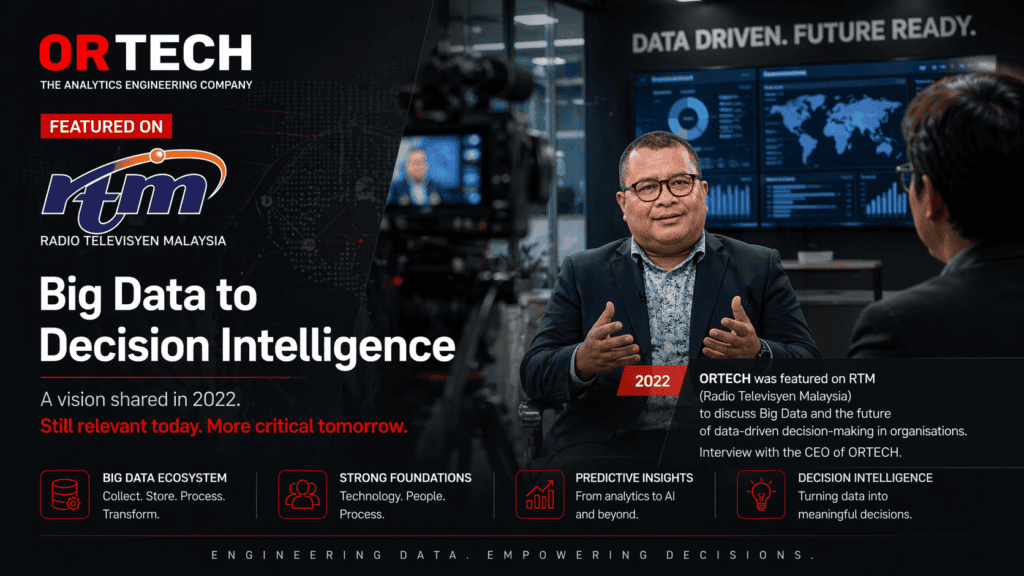
ORTECH on RTM: From Big Data to Decision Intelligence in Malaysia
ORTECH Featured on Radio Televisyen Malaysia (RTM): From Big Data to Decision Intelligence Introduction: A…

ORTECH Recognized as Technology Service Provider (TSP) Under MDEC’s SmartMFG+ Initiative
A proud milestone for ORTECH!We have great news to share. MDEC recently launched SmartMFG+. This…

Ts. Ahmad Hadzramin Abdul Rahman
CEO, ORTECH
Ts. Ahmad Hadzramin Abdul Rahman is the CEO of ORTECH, Malaysia’s Analytics Engineering Company. He advises BFSI organizations, public sector institutions and enterprises on building AI-ready data foundations, governed analytics pipelines, and modern lakehouse architectures that enhance decision velocity, strengthen risk control, and improve operational efficiency across the organization.