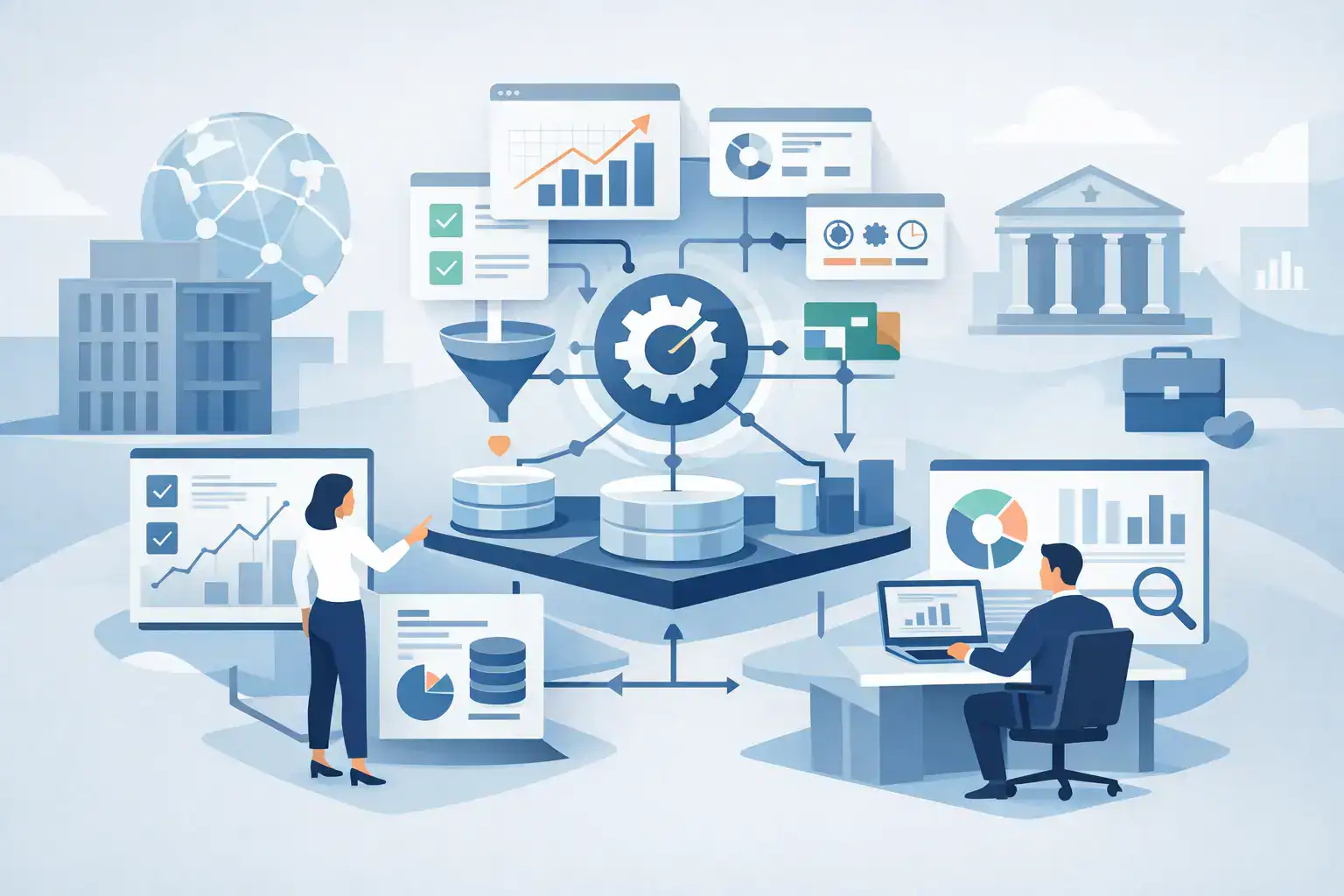
A dashboard shows revenue up 12 percent, finance reports 8 percent, and risk cannot reconcile either number back to source. That is not a visualization problem. It is a data modeling problem. Analytics engineering with SQL and dbt addresses this gap by turning raw warehouse data into trusted, testable, documented data products that business teams can actually use.
For enterprise leaders, this matters because most analytics bottlenecks are no longer caused by storage or compute. They come from inconsistent business logic, duplicated reporting pipelines, weak lineage, and unclear ownership. When every team defines customer, exposure, or active account differently, confidence drops and decision cycles slow down. A modern analytics stack needs more than ingestion and dashboards. It needs engineering discipline applied to analytics.
What analytics engineering with SQL and dbt actually does
At its core, analytics engineering sits between raw data platform operations and business consumption. Data engineers focus on ingestion, orchestration, platform reliability, and access to source data. Analysts focus on answering business questions. Analytics engineers create the structured layer in between – where source data is cleaned, modeled, tested, governed, and prepared for reporting, planning, regulatory use, and downstream machine learning.
SQL remains central because it is the most widely understood language for data transformation. In regulated enterprises, that matters. SQL logic is transparent, auditable, and easier to review across engineering, analytics, finance, and compliance stakeholders. dbt adds the software engineering layer that SQL alone often lacks. It introduces modular development, dependency management, testing, documentation, environment control, and deployment discipline.
This combination changes how teams work. Instead of maintaining opaque SQL scripts scattered across BI tools, teams build reusable models in a structured project. Instead of discovering data quality issues after executives see the report, tests run earlier in the pipeline. Instead of relying on tribal knowledge, documentation and lineage become part of delivery.
Why analytics engineering with SQL and dbt matters in enterprise settings
In startups, poor data definitions can be inconvenient. In banks, insurers, public sector institutions, and large enterprises, they can create operational risk. A mismatched metric can affect board reporting, regulatory submissions, capital planning, customer segmentation, or fraud monitoring. That is why analytics engineering should be treated as a capability, not just a tooling choice.
The value is not that dbt writes SQL in a prettier way. The value is that it helps organizations standardize transformation logic across domains and teams. A finance metric can be built once, tested, versioned, reviewed, and reused. A customer 360 model can be governed and traced to approved source systems. A risk exposure mart can have explicit assumptions rather than hidden calculations buried in spreadsheets or dashboard layers.
This is also where AI readiness becomes more practical. Many organizations want advanced analytics and generative AI outcomes, but their underlying data remains fragmented or weakly modeled. If the core business entities are not defined consistently, downstream AI systems inherit those inconsistencies. Clean prompts and powerful models do not solve poor data foundations. Trusted analytical models do.
SQL is still the right language for business logic
Enterprise data leaders sometimes assume modernization means moving away from SQL. In practice, the opposite is often true. SQL remains the most effective language for expressing business rules at scale inside cloud warehouses and lakehouse environments. It is declarative, broadly understood, and well suited to transforming tabular enterprise data.
The real issue is not SQL itself. It is unmanaged SQL. When transformation logic lives in individual analyst workbooks, BI semantic layers, or ungoverned scripts, complexity compounds quickly. Two teams can query the same source and produce different answers with no obvious way to reconcile them.
Well-structured analytics engineering keeps SQL where it belongs – in centralized, version-controlled transformation layers with clear naming, review processes, and documentation. That creates better consistency without forcing every stakeholder into a specialist programming paradigm.
Where dbt adds engineering discipline
dbt is valuable because it operationalizes good habits that many organizations know they need but struggle to sustain manually. Models can be broken into logical layers, often moving from raw or staged data toward intermediate business logic and then curated marts aligned to business domains. This reduces duplication and makes change easier to manage.
Testing is another major advantage. Simple checks such as uniqueness, non-null constraints, accepted values, and referential integrity catch common failures early. More advanced custom tests can validate policy rules, reconciliation thresholds, or business-specific control points. In regulated environments, these controls are not just technical safeguards. They support trust, auditability, and operational resilience.
Lineage also matters more than many teams expect. When a KPI changes, leaders want to know what was affected, what upstream source changed, and which downstream reports depend on that model. dbt makes those relationships visible. That visibility improves impact analysis, change management, and governance.
The operating model matters as much as the tool
Many dbt projects underperform for a simple reason: the organization treats analytics engineering as a side task for analysts or as a narrow implementation led only by platform teams. Both approaches usually create gaps.
If analysts own all transformation logic without engineering guardrails, standards drift. If central engineering owns everything without business context, models may be technically correct but commercially unhelpful. The better pattern is a federated model with shared standards. Central teams define architecture, conventions, testing frameworks, governance controls, and deployment practices. Domain teams contribute business logic within that structure.
This is especially relevant for institutions with multiple business units, jurisdictions, or legacy environments. A single monolithic data model is rarely realistic. What works better is a governed model architecture where core entities are standardized and domain marts remain purpose-built. It depends on organizational complexity, reporting obligations, and the maturity of source systems.
What good implementation looks like
A strong implementation usually starts with a narrow but high-value domain, not an enterprise-wide rewrite. Finance reporting, customer analytics, regulatory metrics, or risk data products are often better starting points than broad transformation programs with vague scope. These use cases have visible business value and force the right conversations about definitions, controls, and ownership.
The next step is model design. Teams should define how raw data is staged, how conformed business logic is created, and how curated outputs are published for consumption. Naming conventions, data contracts where relevant, code review workflows, test coverage expectations, and release processes should be agreed early. This may sound procedural, but it avoids disorder later.
Documentation should not be treated as optional cleanup. If a model supports executive reporting, regulatory review, or automated decisions, users need to understand its purpose, source dependencies, transformation logic, and limitations. Good documentation shortens onboarding, reduces support requests, and improves trust across data producers and consumers.
Common pitfalls to avoid
One common mistake is rebuilding every transformation at once. That often creates long delivery cycles and weak adoption. Another is assuming that dbt alone will fix data quality problems originating in source systems. It improves detection and control, but it does not replace upstream remediation.
There is also a temptation to over-engineer. Not every analytical model needs complex abstraction layers or dozens of custom macros. For stable, high-value domains, more structure makes sense. For exploratory analysis, lighter patterns may be more appropriate. The goal is controlled agility, not process for its own sake.
Another issue is weak business ownership. Analytics engineering improves data products, but someone still needs to own the meaning of key metrics and entities. Without accountable business stewards, technical teams end up debating definitions they should not own alone.
What executives should expect from the investment
When analytics engineering with SQL and dbt is implemented well, the benefits are visible beyond the data team. Reporting cycles become faster because logic is reusable. Audit and control discussions become easier because lineage and tests are explicit. Change requests become less disruptive because dependencies are known. Teams spend less time reconciling numbers and more time acting on them.
There are strategic benefits as well. Standardized analytical models improve platform portability across cloud, on-premises, and hybrid environments. They support governance programs because definitions and controls are embedded in delivery. They also create a stronger foundation for AI, forecasting, and decision intelligence because downstream systems consume data products that are already curated and trusted.
For organizations modernizing their analytics estate, the real question is not whether SQL or dbt is fashionable. The question is whether the business has a disciplined way to turn fragmented source data into governed, reusable intelligence. That is where analytics engineering earns its place.
The strongest data programs do not win by producing more dashboards. They win by making business logic reliable enough that leaders can move faster with fewer doubts.