Most enterprises do not have an analytics problem. They have an execution problem. Reports exist, dashboards exist, data pipelines exist, yet decision cycles remain slow, manual checks keep multiplying, and analytics teams spend too much time maintaining workflows that should already be industrialized. That is where an analytics automation platform becomes relevant – not as another tool in the stack, but as a way to operationalize data, analytics, and decision processes at scale.
For CIOs, CDOs, and data platform leaders, the real question is not whether automation belongs in analytics. It is what exactly should be automated, under what controls, and with what business outcomes. In regulated sectors such as banking, insurance, government, and large public institutions, the answer has to go beyond speed. It has to include governance, lineage, repeatability, and accountability.
What an analytics automation platform actually is
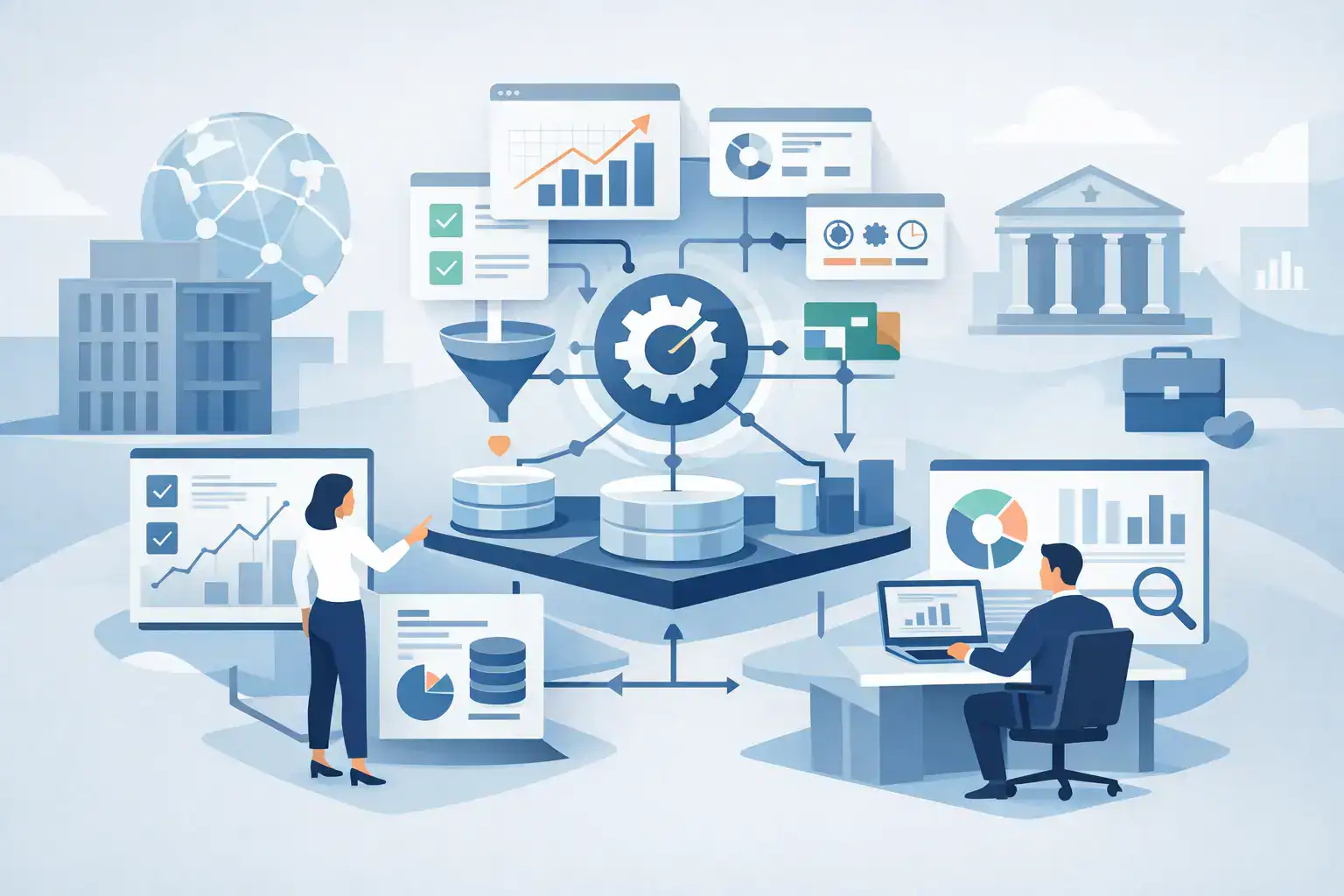
An analytics automation platform is an operating layer that reduces manual effort across the analytics lifecycle. That includes data ingestion, transformation, quality validation, orchestration, model or rules execution, report generation, exception handling, and distribution of outputs to downstream users or systems.
The distinction matters. Many organizations already have BI tools, data integration tools, workflow schedulers, and machine learning environments. Yet those components often function in silos. Analysts prepare data manually before each reporting cycle. Risk teams reconcile numbers outside the governed platform. Business users wait for engineering teams to rerun jobs when upstream conditions change. The result is analytics that appears mature on paper but behaves like a collection of disconnected tasks.
A credible platform brings those tasks into a governed, repeatable system. It standardizes how data moves, how business logic is applied, how quality is checked, and how outputs are delivered. In practice, this means fewer spreadsheet workarounds, less dependency on tribal knowledge, and more confidence that the same input conditions will produce the same output every time.
Why enterprises adopt analytics automation platforms
Most adoption starts with one of three pressures: scale, control, or responsiveness. Scale becomes a problem when analytics demand grows faster than team capacity. Control becomes a problem when regulators, auditors, or internal governance bodies ask how a number was produced and nobody can answer consistently. Responsiveness becomes a problem when business teams need near-real-time insight but the underlying process still depends on overnight batches and manual interventions.
An analytics automation platform addresses all three, but not equally in every organization. In BFSI, the priority is often control first, then scale. In government agencies and GLCs, data sovereignty, lineage, and operational resilience may shape platform decisions more than pure speed. In commercial enterprises, the first win may come from shortening the path from raw data to action.
This is why platform strategy should not begin with feature checklists. It should begin with the operational bottlenecks that prevent analytics from becoming a dependable business capability.
Core capabilities that matter most
The best way to assess an analytics automation platform is to ask whether it improves the industrial discipline of analytics, not just the convenience of analysis.
Data orchestration is foundational. A platform should coordinate movement across batch, streaming, API, and file-based sources without creating a fragile web of custom scripts. It should support dependency management, retries, monitoring, and recovery in a controlled way.
Transformation management is equally important. Enterprises need a consistent method for applying business rules, standardizing metrics, and versioning logic over time. If the organization cannot trace how a KPI was calculated last quarter versus this quarter, automation has not solved the real problem.
Data quality automation should be built in, not added later. Validation rules, threshold checks, anomaly detection, and exception workflows need to operate as part of normal pipeline execution. This is especially important where financial, regulatory, or operational reporting is involved.
Metadata, lineage, and auditability are often underestimated until a control event exposes the gap. A platform should make it easy to see where data came from, what transformations were applied, who approved changes, and which downstream assets were affected.
Finally, a strong platform supports operational delivery. That may include automated report generation, triggered alerts, API-based serving of curated datasets, or integration with business process systems. Analytics only creates value when outputs reach the point of decision.
What an analytics automation platform is not
It is not just a dashboarding environment with scheduled refreshes. It is not only a workflow tool for moving files from one system to another. It is not a machine learning platform dressed up as enterprise analytics modernization.
This distinction is important because many transformation programs overestimate maturity by focusing on isolated capabilities. A team may automate dashboard refreshes but still rely on manual reconciliations upstream. Another may implement advanced models while the underlying data quality process remains inconsistent. In both cases, automation exists, but enterprise-grade analytics does not.
A platform should reduce operational dependency across the full chain, from source to trusted decision output. If it automates one layer while preserving manual risk in the next, the business case will remain partial.
Where the business value shows up first
The first measurable gains usually come from cycle time reduction and control improvement. Monthly and quarterly reporting processes become less dependent on heroic effort. Analytics engineers spend more time improving data products and less time fixing recurring breaks. Business stakeholders receive outputs faster and with fewer disputes over data consistency.
Then the second-order benefits begin to matter. Standardized pipelines make it easier to onboard new use cases. Reusable transformation patterns reduce duplicated logic across departments. Strong lineage improves readiness for internal audit, risk review, and regulatory scrutiny. Over time, the organization shifts from project-based analytics delivery to platform-based capability.
For executive stakeholders, this shift has strategic value. It creates a more reliable foundation for forecasting, decision intelligence, and AI adoption. AI readiness is not only about model access. It depends on whether the enterprise can produce governed, high-quality, reusable data assets consistently. Without that, AI initiatives remain expensive experiments.
Implementation trade-offs leaders should expect
No platform decision is neutral. Centralizing too aggressively can slow domain teams that need flexibility. Giving each business unit complete autonomy can create duplicated pipelines, conflicting definitions, and fragmented governance. The right design usually sits between those extremes.
Another trade-off is between speed of deployment and standardization. A fast implementation can deliver early wins, but if naming conventions, data contracts, and governance controls are deferred for too long, technical debt returns quickly. On the other hand, overly rigid architecture can delay value and reduce adoption.
Cloud, on-premises, and hybrid decisions also shape platform design. In regulated environments, sovereignty and residency requirements may limit how certain workloads are deployed. That does not make automation harder, but it does require architecture that respects policy, operational resilience, and institutional control.
This is where engineering discipline matters more than product branding. The platform is only as effective as the operating model around it – ownership, change control, quality standards, platform support, and workforce enablement.
How to evaluate platform fit in an enterprise setting
A useful evaluation starts with business-critical workflows, not vendor demos. Identify where analytics delays, manual interventions, or control failures are creating measurable cost, risk, or decision latency. Then map the current process from source ingestion to final consumption.
From there, assess whether a proposed platform can support five enterprise realities: cross-system integration, governed transformation, automated quality controls, traceable lineage, and scalable operations. If one of these is weak, the platform may still be useful, but it is unlikely to become the backbone of analytics modernization.
It is also worth testing for organizational fit. Can platform teams and domain teams work within the same framework? Can risk and compliance functions obtain the visibility they need? Can changes be deployed without disrupting downstream reporting cycles? These questions matter as much as technical features because enterprise analytics is an operating model problem before it becomes a tooling problem.
Organizations across Malaysia and the wider ASEAN region often face an added challenge: legacy estates mixed with newer cloud services, with different governance expectations across jurisdictions and institutions. In that context, platform success depends on designing for coexistence, not assuming a clean-sheet architecture.
The real goal: trusted automation, not more automation
Automation is not valuable simply because it removes human work. Some human review should remain, especially where policy judgment, risk interpretation, or exception approval is required. The goal is to remove repetitive, error-prone effort while strengthening the reliability of what stays under human oversight.
That is why the strongest analytics automation platform strategies focus on trusted execution. They create consistency in data preparation, transparency in business logic, visibility in controls, and speed in operational delivery. More importantly, they make analytics scalable without making it opaque.
For enterprise leaders, that is the standard that matters. Not whether the platform promises automation, but whether it helps the organization produce governed intelligence repeatedly, explain it confidently, and act on it faster.